Coastwatchers
pp. 58-59 · Read in the full issue
A New Slant On The
it’s taken more than 30 years to tell the stories of the wartime Coastwatchers, and they are not all told yet, but a new book from American author Walter Lord, Lonely Vigil, gets close to completing the records. It’s certainly the
most thoroughly-researched
and documented account since Eric Feldt’s authorita tive The Coast Watchers was published in 1946, and it adds a new dimension a Japanese viewpoint.
The Coastwatching Service was developed by the Royal Australian Navy after World War I. It was aimed at re porting any suspicious move ments on Australia’s unguard ed coastline in time of war, and with the advent of the Pacific War in 1941 the ser vice was extended to more than 100 coastwatching sta tions established outside Australia in a 2 500 mile cres cent of islands stretching from the western part of New Guinea through the Solomons to the New Hebrides.
The reporting stations were equipped with two-way radio and staffed part-time by volunteer spotters — planters, traders, missionaries, govern ment officials. They reported to control stations at Port Moresby, Rabaul, Tulagi (then the chief port of the Bri tish Solomons) and Vila, which in turn worked to the Australian headquarters of this unusual network at Townsville, northern Queens land.
The man in charge at Townsville was the legendary Commander Eric Feldt, RAN, who through personal contact had largely built up the string of volunteers. They were Islands personalities like himself, for Feldt had worked before the war in commerce and in government in New Guinea, knew his men and was respected by them. It was Eric Feldt who was best equipped to tell the Coastwatchers’ war time story, although his 1946 book was never republished in exactly the same form because his account, having been writ ten very close to events, was too forthright in its criticism
of some troops (not Coast watchers).
Later, a number of Feldfs men, H. J. Murray, J. K. Mc- Carthy, D. C. Horton and Malcolm Wright gave details of their particular experiences in books of their own, and from time to time there also appeared, mostly in the pages of PIM, numbers of other detailed accounts of the work of men like C. W. Seton, Martin Clemens and the ir repressible Ken Dalrymple Hay.
Walter Lord ( A Night to Remember, Day of Infamy, Incredible Victory, etc) de cided in this new account to concentrate his considerable writing and research skills on recording the Coastwatching activities in the Solomons, and since he includes Bougainville in that geographical area, the scope of his story is well worth the effort and expense that took him 40 000 miles over several years, digging into archives, examining private diaries, interviewing surviv ing Coastwatchers or their families while he got it all together. He also had the ad
vantage of hindsight, with the authoritative war histories that have appeared.
The work of the Coast watchers on Bougainville and the Solomons, who for the most part were forced to op erate deep within Japanese occupied areas, was probably the most spectacular, the re sults more rewarding. The Solomons’ Coastwatchers helped the Allies get a foothold on Guadalcanal and then helped keep them there while they widened it and ad vanced, despite determined counter measures by the Japanese which for months kept the opposing forces balanced. As Admiral Halsey put it in a line which has been repeated a thousand times since, “The Coastwatchers saved Guadalcanal and Guadalcanal saved the Pacific.”
All the names are here in Walter Lord’s book and their stories some stories, but many more told for the first time Seton, Hay, Horton, Clemens, Paul Mason, Jack Read, Father de Klerk, Reg Evans, Henry Josselyn, “Sno wy” Rhoades, John Keenan, Donald Kennedy, Geoffrey Kuper, Hugh Mackenzie, “Wobbie” Robinson, Jacob Vouza, Nick Waddell, Sgt Yauwika, and dozens of others. The illustrations, mostly from private albums, enhance the stories, and Lord’s appended list of his in-
Books
formants is an historical re cord in itself.
It’s an unput-downable nar rative, but the special value of The Lonely Vigil is that it places the work of the Coast watchers in perspective against the continuing back drop of the larger battle that was waging for ownership of the Pacific thus a war histo ry within a war history. The battles of the Coral Sea, Cape Esperance and Savo, the de sperate, lengthy struggle for Henderson Field, the daring tactics employed by the Japanese in running reinforce ments down The Slot nightly aboard fast destroyers (the “Tokyo Express”), the brilliant aerial ambush of Ad miral Yamamoto, are told here in their right order. It is in recreating the trials of strength that Lord has made good use of Japanese infor mants, so we get a rounded view of cause and effect.
Among the many new details we get the stories of Father Albert Lebel whose work and initiative was re sponsible for the evacuation of American nuns from Bougainville, and of Corporal Frank Nash, the only American Coastwatcher behind enemy lines in the Solomons. Painstaking inter viewing has brought out new information from the more celebrated Coastwatchers; whose stories, one would have: thought, had been told.
Yet perhaps all the stories* will never be told, as I was re minded by two rare errors ini Walter Lord’s highly-reada ble book.
The picture on p 44 of Pauli Mason “photographed withi Wang You, one of the many\ natives he worked closely, with on Bougainville”, depicts? in fact Paul Mason with the; popular former Bougainville; trader Wong You, proudly\ Chinese and later a naturalis ed Australian. Wong is not! mentioned elsewhere in the; book, but some years ago onr Buka, Wong told me how he; had a sticky time when beings interrogated by Japanese om
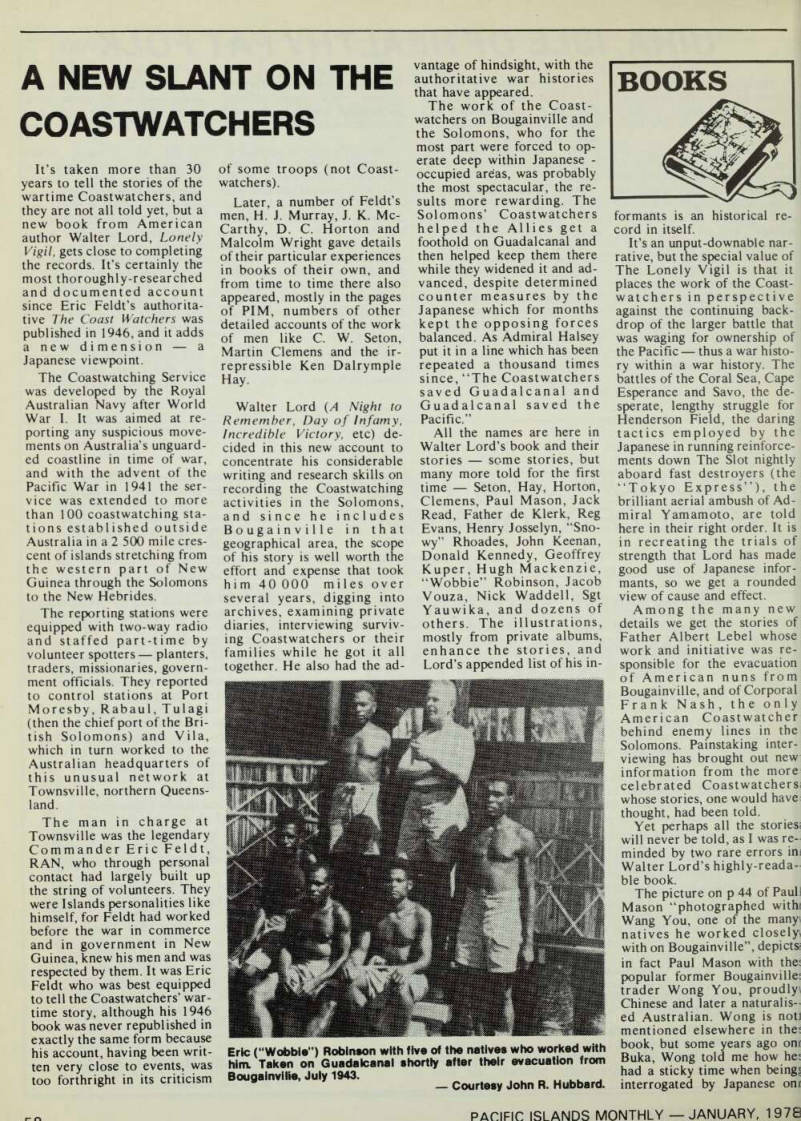
Eric ("Wobble”) Robinson with five of the natives who worked with him. Taken on Guadalcanal shortly after their evacuation from Bougainville, July 1943. -Courtesy John R. Hubbard.
Bougainville about the whereabouts of Mason, who was then hidden with his radio in the hills.
Wong wasn’t giving any answers, but when the inter rogation began to get de sperate it was stopped by Tsunesuke Tashiro, a Japanese political affairs of ficer, who had arrived with the Japanese forces, having worked in Bougainville before the war. Tashiro knew both Wong You and Mason and he told the interrogator, “This man has known Mason for 20 years; he has known you for only five minutes!”
Tashiro is named in A Lonely Vigil as Tashira, and the few references to him tend to identify him as an unsym pathetic hound-dog, but in fact Tashiro had the re putation of being “a good bloke”. Paul Mason told me once that he believed Tashiro would have been quite capa ble of having him tracked down on Bougainville, but ob viously didn’t try too hard.
And Bishop Thomas Wade revealed in a letter to PIM after the war that Tashiro had sent a friendly message to him when the Japanese had arriv ed in Kieta in 1942, warning him to get out while he could (Wade stayed put).
Tashiro returned to the Pacific after the war, and in 1960 I met him at Santo in the New Hebrides, where he was construction manager for the South Pacific Fishing Com pany. He asked me whether I thought there was any chance he could permanently settle in Australia.
Lonely Vigil is both an im portant and exciting narrative of a colourful period in the
Pacific War.
Stuart Inder.
(Lonely Vigil Coastwatchers Of The
SOLOMONS. By Waltir Lord. Publithod by Viking Prtit, Now York. tU512.50.)
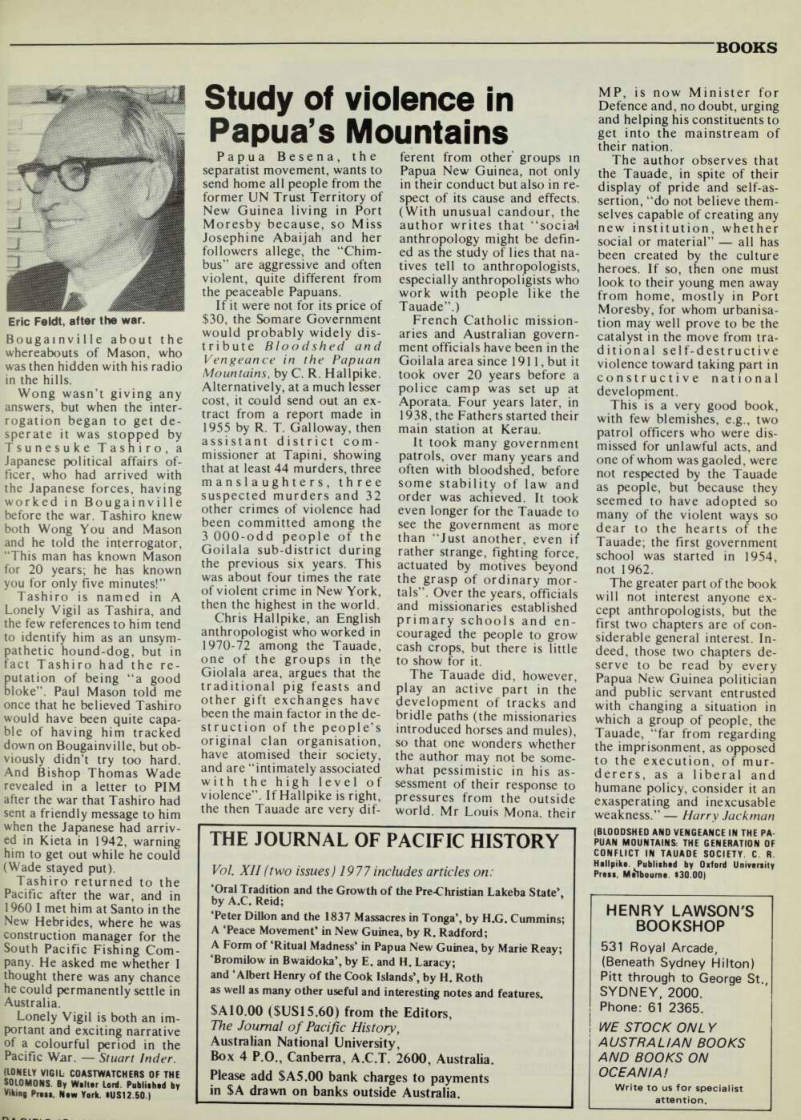
Eric Feldt, after the war.