self primarily toward rural
pp. 40-42 · Read in the full issue

development. Previously a district commissioner in Trenggalek, one of the poorest areas in Eastern Java, Sutran managed to bring prosperity to this deficit area oy growing cloves, a much wanted commodity for the national cigarette industry.
Now all the administrators in Irian Jaya are instructed to plant clove trees in their areas. In addition, Sutran favours the import of as many Javanese farmers as possible to be resettled in the empty spaces of Irian Jaya in order to stimulate the local Irianese to copy new agricultural methods and learn new manual skills.
Sutran’s policy seems also to be giving the Irianese the chance to be responsible for their own affairs. Four out of seven district administrators of the province are Irianese.
Many department heads in his office are Irianese; E.
Paprindej, Deputy Governor; L. Runbiak, head of the Economic Bureau; W. P. Bonay, head of the Development
Bureau; A. Mampioper,head, and M. B. Ramandey, deputy head, of the Public Health Bureau; F. J. Djopari, deputy head of Personnel, and A.
Manggara, head of the Bureau of Material Supplies, In the Bureau of Admin istration the following Irianese are heads of the following sub-bureaus; S.
Wanma for Administration, E. Mayor for Town Develop ment; D. Rumbiak for Village Administration; A. De motokay for Population Affairs, and J. D. Mambrasar for Security. In the Bureau ot Legal Procedures W. C. Ru mainum heads the Depart ment of Organisation, Under W. P. Bonay the re sponsibility for promotion ot village development is given to W. Mariawasi. Under F. J.
Djopari the Central Personnel Office is headed by Karel Ur binas, and under A. Mang gar a, Herman Wayoi and Koos Urbinas are heading the Supply and Distribution Departments. Under A. Mam pioper and M. B. Ramandey, the Social Department is
headed by Silas Tokoro, the Department of Religion, Education and Culture by T.
Mansawan, and the Public Health Department by Theo Wainuri Even Sutran’s bodyguards are Irianese. He aims also to have Irianese as representatives for Irian Jaya at both national and international conferences. It remains a matter for speculation as to
how much Sutran’s policy will be appreciated by either the Irianese or the other Indone sians. . , .
In one interview he showed his caution with the remark that in Irian Jaya “one should not expect direct and immedi ate results from his work, but onl y an , l , ici P ate long-term benefits . He has also said that he would immediately step down if his agricultural
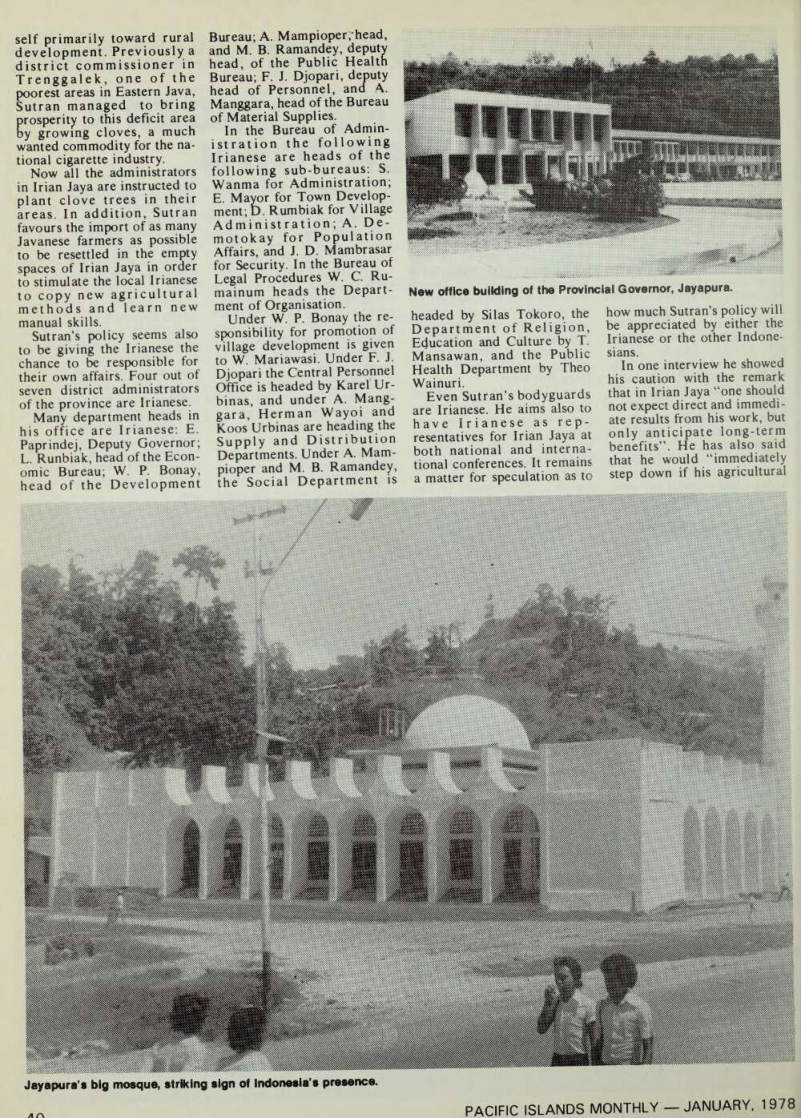
New office building of the Provincial Governor, Jayapura.
Jayapura’s big mosque, striking sign of Indonesia’s presence.
approach fails”. Despite the simplicity of his personal and family life, Sutran is known as a tough administrator with a wide knowledge of rural Irian Jaya.
In June 1976, when I last visited Irian Jaya, a tremen dous earthquake struck the Balim (formerly spelt Baliem) valley in the Jayawijaya high lands, leaving a large and still undetermined number of villagers dead, buried beneath landslides.
When I returned to Jayapura on this visit, I saw that the provincial capital had been given a facelift. From the new provincial government building, at Dok 11, with its air-conditioned offices, one gets a scenic view of the islets in the Yos Sudarso (formerly Humboldt) Bay, with the na tive outrigger canoes powered with outboard motors passing swiftly by. Then there is the recently finished modern sports area, which must be one of the achievements of Acub Zainal’s dream to promote sports in Irian Jaya.
Since mid-1977 Irian Jaya
has had television. Its relay station is situated in the Bhayangkara up-town area where police personnel are housed, while the TV tower stands high on nearby Polima que Hill. TV shows in Irian Jaya are merely programmes relayed from Jakarta via the national Palapa satellite, and are shown only for a few hours after 9 p.m. At present, re ception is only possible in Jayapura and Biak. There are plans to extend the TV net work to eight more places in Irian Jaya.
For the past two years Jayapura has been growing fast, in terms of population, business and administration.
People from Java have joined their relatives, already settled in Jayapura, to try their luck.
Many have started catering businesses. As they are ready to accept modest earnings, the prices in Jayapura’s re staurants and eating stalls are kept down. Most of the thriv ing petty trade and retail busi ness is in the hands of Southern Celebes traders, who were in Irian Jaya even
when the Dutch were still there, and Chinese from Jakarta who monopolise the department stores on Yani Boulevard,Jayapura’s “Broadway”.
In general, the number of Irianese engaged in profit making business, even in the form of small private en terprises or petty trade, re mains extremely small. Part of the reason for this stagnation is that the Irianese are not given the opportunity to develop their business talents and initiatives, as they are usually barred or gradually pushed out by the more dynamic and cunning Macassan, Buginese and West Sumatran traders who have almost taken over the entire world of small trading in Irian Jaya. Competition is so keen that, in rural towns such as Nabire, even Chinese shopkeepers are gradually moving out due to the in creasingly incoming Macassan traders.
Only a small number of Irianese can be seen selling in side the concrete Pasar
Sentral (Central Market) in Jayapura’s Hamadi sector.
They are still in their tradi tional places, squatting out side the building, selling their meagre produce. Retail stores, repair shops, eating stalls, restaurants, bars, nightclubs, minibus transport, small hotels and inns are all run either by Indonesians or Chinese coming from outside the province.
Even outside town, in the profitable activities of cro codile hunting and logging, in which the Irianese could have played an active and leading role, again it is either the Chinese or Macassan who takes the initiative of organ ising swamp and jungle safaris and financing the enterprise, while local Irianese merely function as labourers. In the remote villages they are often paid in kind, with tobacco for example.
In the light of this static situation of the native econ omy the West Irian Joint Development Foundation lends money, preferably to Irianese, to finance small-
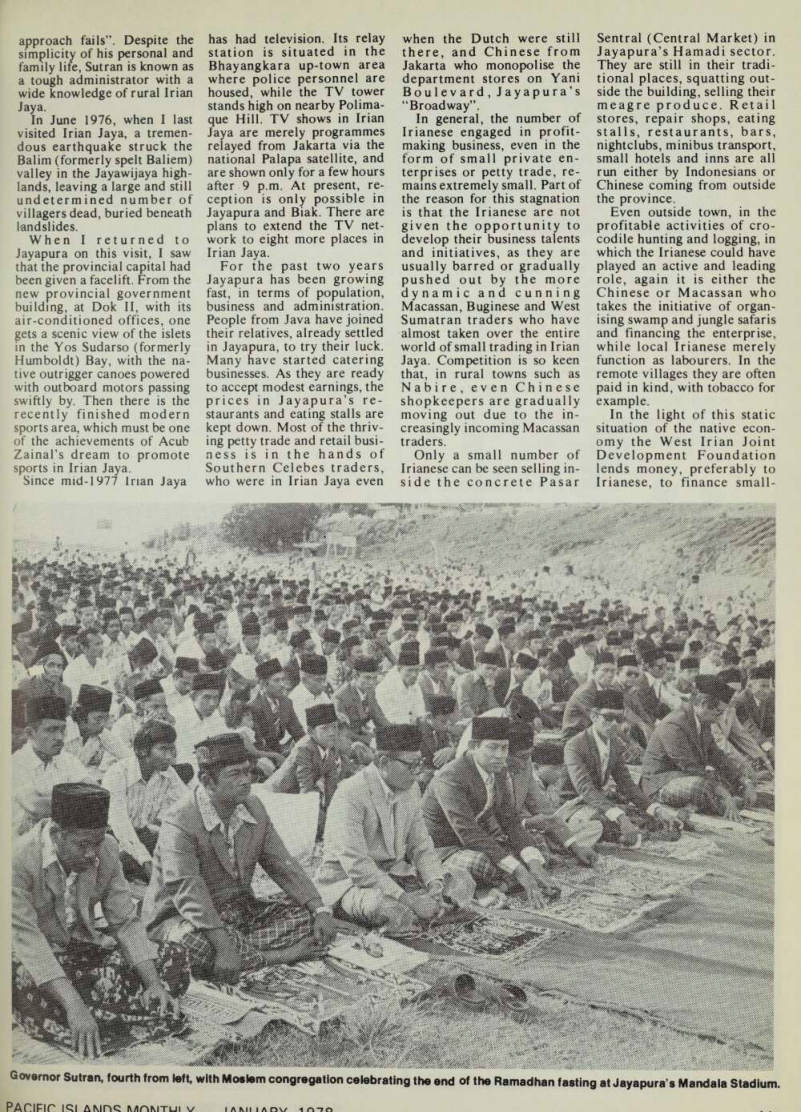
Governor Sutran, fourth from left, with Moslem congregation celebrating the end of the Ramadhan fasting at Jayapura’s Mandala Stadium.
scale enterprises in such fields as crop-growing and cattle breeding. Small loans are also made to Irianese fishermen for the purchase of outboard motors to be attached to their primitive outrigger canoes to increase their catch.
Among the educated Irianese there is a common desire to join the public ser vice with its regularly paid salaries, and the chance of being sent outside their home region. “It is better to marry a public servant than to eat taro (= marry a villager)” has become a popular saying with Jayapura is no longer the frontier town of the past where people felt like outcasts and lived with the insatiable yearning to buy a ticket to fly straight back to Jakarta. One can now enjoy the amenities of a large Indonesian city, but in a better atmosphere with less pollution, less traffic and less interference from government regulations.
Parents no longer have to send their children to Java for their primary and secondary education which is now stan darised to Jakarta re quirements.
Apart from the “Bird of Paradise” (Cenderawasih) University in Abepura, terti ary education has been ex panded with four colleges; the College of Accountancy and Office Management, the Col lege of Local Administration, and the Protestant and Catholic theological colleges.
Collecting data for the
Pacific Islands Year Book in Jayapura meant running for a fortnight from one office to another, meeting officials who were as eager to know about “the other side of the border” as I was eager to know about Irian Jaya. I was bombarded with questions every time I entered an office.
I was also invited by the Rev Williem Maloali, a native of the Jayapura area, to speak before the Irian Jaya Parlia ment, of which he is chairman.
The following questions were asked by its members: in what respect does Michael Somare’s point of view toward Indonesia differ from Maori Kiki’s (Minister for Foreign Affairs and Trade in the pre vious PNG government); what is the aim of the Papua Besena movement; how does PNG’s policy of self-reliance work out in practice; how much is Australia’s annual financial aid to PNG; what is the volume of PNG’s annual im ports from Australia; what is the lot of the West Irian refugees in Papua New Guinea; how much do people in PNG know about In donesia, and how to improve friendly PNG-Indonesia rela tions?
In reply to the last two ques tions I suggested the parlia ment should organise cultural exchange programmes be tween Irian Jaya and Papua New Guinea, and invite the Papua New Guinea parlia ment to come over to Jayapura, to see things in Irian Jaya for themselves. -
Irian Jaya’s Deputy Governor E. Paprindej greets Moslems on occasion of Idulfitri celebrations.