Political
pp. 28-29 · Read in the full issue
Currents
Fencing In
The Micronesians
Several major issues surfac ed in the first round of renew ed Micronesia-US negotia tions in IMolokaiu over the future political status of Micronesia. The negotiations ended in late October, after three days of meetings. They are to resume no later than
January 5, 1 978,
In a key development, the Micronesians presented a pro posal to the US demanding specific compensation for denying the ocean area of Micronesia to any third na tion for military purposes. For this “denial right,” the pro posal called on the US to pay $6O million annually to be distributed among the six is land districts on an even basis.
Through eight years of earlier negotiations, the US has held that denial of Micronesia to other nations is worth a “great deal” to the military, but it has been un willing to put a price on it.
“The concept of military denial is like a fence,” com mented a Micronesian negotiator. “The US intends to put a fence around Micronesia, to keep other na tions out and Micronesians in.
We believe that we will ac commodate the US need to deny our lands, waters and sky to others for a period of time, but the value of this ac commodation should not be ignored or hidden.”
Captain James Elster, of the office of the Assistant Secre tary for Defense for Interna tional Security Affairs, articu lated the US position against military denial payment.
From a military perspective, he stated, “Denial is worth a great deal to us, particularly with our global defence in terests and responsibilities.
However,” he added, “I’m not willing to put a price on it.”
The importance of the Micronesian islands (which lie as close as 500 miles east of the Philippines) to the US military was evident during World War 11, when they
were taken from the Japanese in some of the bloodiest bat tles of the war. At the close of the war, the island of Tinian in the Marianas was used to stage the atomic bomb attacks on Hiroshima and Nagasaki.
Now, since the US withdrawal from Indochina and the possi ble removal of US military bases from the Philippines, Okinawa and elsewhere, Pen tagon planners see Micronesia and Guam as the fallback defence line to Asia and the key to a continued US presence in the Pacific.
The most unsatisfactory base posture for the US has usually occurred, according to Elster, where the host coun try has tried to establish a landlord-tenant relationship.
'I know of several cases where the demand for rent was seen by the U.S. Congress as an outright form of blackmail ...”
Ambassador Peter Rosen blatt, President Carter’s per sonal representative to the negotiations, stated bluntly, “The concept of denial ... is unworthy of discussion.”
Commenting on Elster’s reference to blackmail, Stuart Beck, the legal counsel for the delegation from the Palau Is lands, said; “When one ex tends the concept (of blackmail), one must, ot course, accuse (the Microne sians) of being the black mailers.” Referring to the fact that the US has subjected the Marshall Islands and its peo ple to nuclear testing and radiation contamination, Beck concluded; “The history of Micronesia will render fears of blackmail to be groundless.”
In response to the US posi tion that no price can be put on denial, Beck said. “We came up with what we deem to be a solution to the problem of pricing we named price. If that price is unaccep table we would deem it ap propriate for the US to make a counter-offer.” If no offer is forthcoming, he maintained, then putting Micronesia bn the open market would be the best way to deal with the problem of setting a price.
Despite Ambassador Rosenblatt’s initial response on the denial concept, the following day he announced that the proposal would be referred back to Washington, DC, for consideration.
In a move to bring the is
land groups together, all dis tricts agreed that there should be an all-Micronesian entity in the post-trusteeship period.
Despite disagreement regard ing the nature of this entity, observers close to the negotia tions saw this as a major ac complishment because Micronesia is currently rep resented in the negotiations by three different status com missions: the Congress of Micronesia Commission on Future Political Status and Transition representing the central districts of Ponape, Kosrae, Truk and Yap; the Palau Political Status Com mission; and the Marshall Is lands Status Commission.
In a move that recognised the Marshalls and Palau status commissions, in July of this year, the US proposed a new “two-tier” negotiating format.
On one level this new format would include all the issues that will be negotiated on a multilateral (all-Micronesia) basis and the other level would include issues such as defence land requirements and economic assistance in in dividual districts to be negoti ated on a bilateral or district basis.
Through eight previous rounds of negotiations with the US which began in 1969, the Congress of Micronesia’s negotiating team represented all the districts of Micronesia and produced what is known as a draft “Free Association Compact.” This draft although initialled by both the US and Micronesia, has never been ratified. The free as sociation status would give Micronesia internal self government, but would hand over authority on foreign affairs and defence of the is lands to the US.
The US hopes these renew ed negotiations will simply
“modify” but not substantially change the existing draft Free Association Compact, accord ing to a position paper pre sented at the negotiations. On the other hand, the Microne sians, particularly the Marshalls and Palau status commissions, intend to com pletely renegotiate sections of the compact.
Among other provisions in the compact, the military denial right is given to the US free.
The American negotiators, under the new Carter admin istration, intend to complete the negotiations within the next eight months to stay on schedule for termination of Micronesia’s US Trusteeship arrangement by 1981. This termination date was set ar bitrarily by the US and has met sharp criticism from the Congress of Micronesia Com mission on Future Political Status and Transition
(Cfpst).
“Our position is and has been that the end of the trusteeship period should mark the accomplishment of the purposes of the trustee ship,” stated Bailey Olter, speaking for the CFPST.
“There are many funda mental respects in the econ omic and political develop ment where it cannot be said objectively that the purposes of the trusteeship have been accomplished,” Olter con tinued.
“I am speaking of modest accomplishments, not of unrealistic goals. For exam ple, putting in place basic in frastructure ... facilities of a productive nature which are necessary to sustain economic development. I am speaking also of providing the means for a sound development programme that can make Micronesia economically via ble in the foreseeable future.”
While few agreements were reached between the Microne sians and Americans, accord ing to one Micronesian negotiator, they were en couraged by the direction the negotiations had taken.
Ambassador Rosenblatt said that except for the mili tary denial compensation issue, which the Palau and Marshall Islands groups have said they will not back down on, he is hopeful of an early conclusion to the talks.
Gifford Johnson[?]
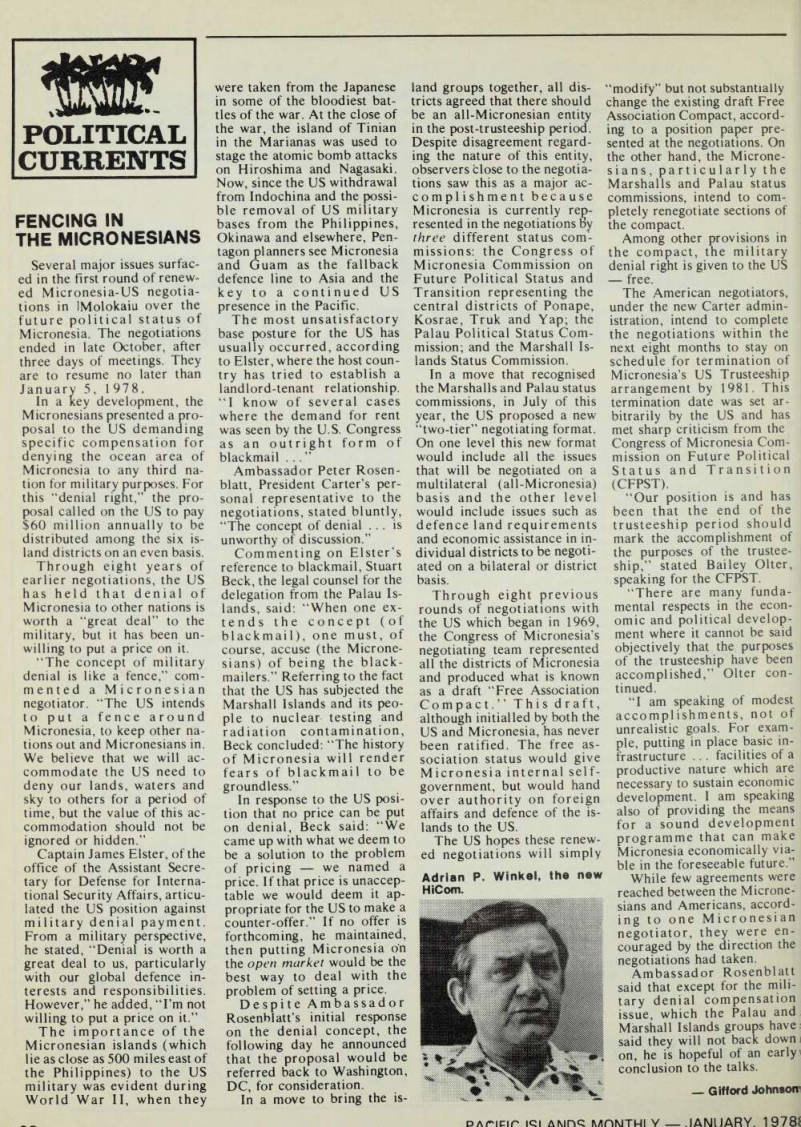
Adrian P. Winkel, the new HiCom.
Experiment In
Local Government
From the Gazelle Cafe came the booming beat and wail of one of Papua New Guinea’s most popular songs of recent years “Missis sippi” by the Dutch group, Pussycat.
As has become his habit, the clerk to the East New Britain Provincial Assembly trotted the 40 metres through the trees and grass to the cafe to make his also habitual re quest to the cafe to shut down Rabaul’s only jukebox.
Waiting for his return, the Speaker and Members of the Assem bly shifted in their hard chairs, not greatly put out, but conscious of their still new dignity. They were, after all, waiting to hear details of the brand new provincial govern ment’s first budget K 1.375 million to spread around 150 000 people living in the top half of the island of New Britain. It was to cover the six months to the end of 1977 when a calendar financial year begins in PNG.
The wail of Pussycat suddenly died. The everyday sounds of the chatter and traffic noise of the Rabaul food market right outside the Assembly building resumed as the background to the Pidgin ex planation of the budget by the clerk.
In the grubby open-sided Assem bly “chamber” high roofed, bare concrete floor, half walls of open concrete brick, and views of frangipani trees six metres high with almost violently varied colours from yellow through to red there is one dominant feature; The in congruous Victorian Speaker’s chair.
It was given in the 1960 s to a “progressive” local government council on the Gazelle Peninsula of New Britain by the people of Sydney, Australia. The chair came from the old Paddington Town Hall when Paddington was absorbed into the City of Sydney and the chair could no longer serve as the rostrum for Paddington’s mayor.
The three-metres high, carved cedar relic of past mayoral splen dour, with its cathedral-style cedar canopy, stuffed and black buttoned red leather seat and arms, and tall rostrum over which the Speaker almost must peer, will soon be hous ed in a virtually new air-condition ed building.
The old chamber will be walled and divided to accommodate the Assembly, public gallery and news reporters’ gallery in one part, and conference rooms in the other. Cost will be about Kl2O 000 when other office renovations are counted.
With this big change will go the present observers, who, very much
in local style, crowd about one of the four open corners of the Assem bly.
Will the mainly older men feel as much at home when they can no longer squat on the plain concrete floor, the elders with backs against the bricks, dressed to a man in their Tolai “uniforms”, of belted lap-laps of some plain material?
Will they continue their con templative smoking of newspaper wrapped cigarettes? It is even less likely that they will ease the boredom of slumbrous debate with the chewing of betel nut when they can no longer take a short walk to the garden surrounds to squirt the vivid red nut and crushed lime from their stained mouths.
At present, the rural feeling is strongly retained with Members all including the one nominated woman Member taking part in this ritual of huai chewing. For is not Rabaul the town where betel nut is the cheapest in the country?
Gone too will be the plainly visi ble mark of the Gazelle, the cor onous dust or volcanic rock powder which floats in still, to smother the surface of the old chair. The dust is the ever-present reminder that Papua New Guinea’s loveliest town is built in an ancient volcano crater and is ringed by other volcanoes, dead and alive.
Local government began on the Gazelle. It also began to die there.
The “progressive” local government councils imposed by the Australian administration on the prickly sen sitivities of the Tolais collapsed in the face of civil disobedience in the form of refusal to pay the council taxes. The Mataungan Association and other groups formed to collect the tax money for their own ideas of development.
Now, years later, under provin cial government, the acceptable concept of community governments is taking root. In August, the first of about 20 was declared in the un developed Duke of York Islands, within sight of Rabaul.
Provincial government is the monument to the compromise the government of Michael Somare has had to make in its two-year grind since independence to hold Papua New Guinea together.
Unity in diversity. The well known concept, it is hoped, will ap ply. And urging the acceptance of Provincial Government by all 20 provinces by the end of this year is the former secessionist leader of Bougainville, Father John Momis, now Minister for Decentralisation in the new Somare government.
Provincial government has been forced, virtually, on the Somare government by the provincialism
which still dominates politics in this country. The undignified spectacle of the addition of ministers to the new national government after the original ministry was announced resulted from insistence on regional representation in Cabinet.
In East New Britain, the last to hold out as a local government council has been the Rabaul Town Council, pig-headedly held together by John Chipper. His flint-covered heart and scratchy tongue are known also for their devotion to what he sees as the town’s good.
Now, when he thinks it will work, he is giving in to the pressure of years from radicals to work with other town leaders in forming a communi ty government.
Relevance and contact with the people appear to be the main ad vances from old to new local government, although it is yet to be proven. Some look at community governments as merely a new name for councils which will still operate mainly through the executives.
However, provincial government holds the promise of more control by the people of the provinces over development and change.
Denis Fisk
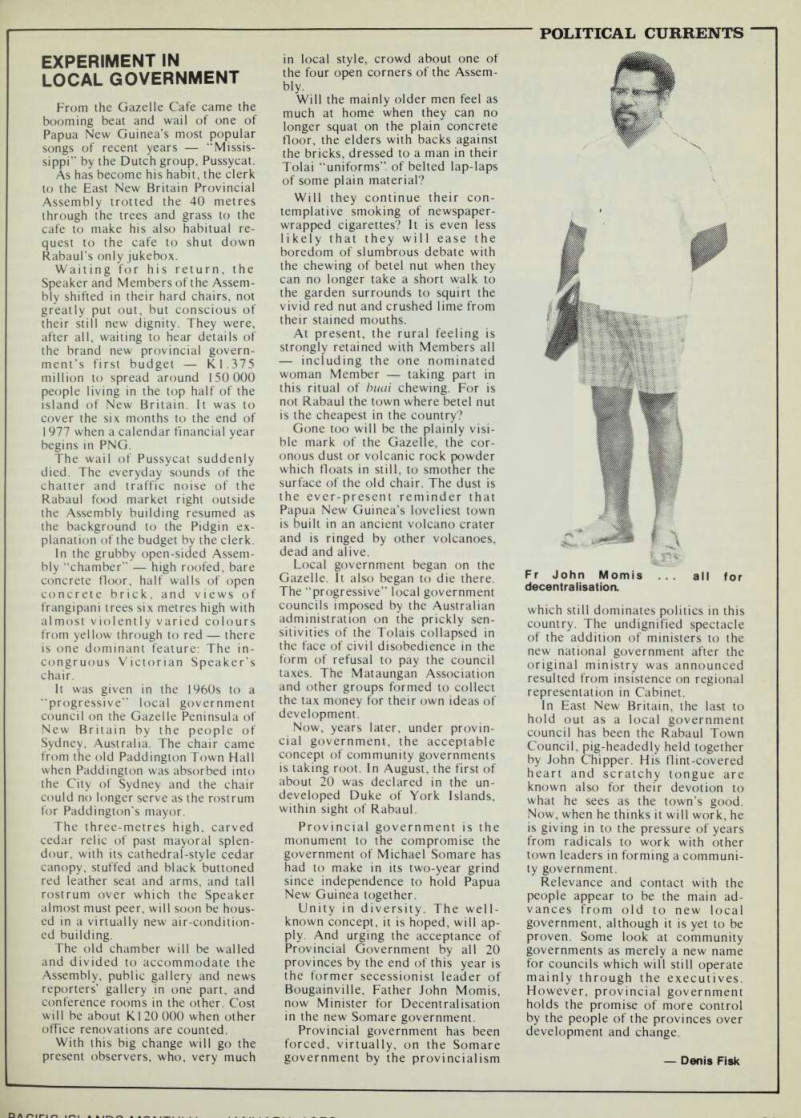
Fr John Momis ... all for decentralisation.