Business
pp. 57-62 · Read in the full issue


Incentives galore for Cooks growers, but how many takers?
From W. H. PERCIVAL on Rarotonga
In a pep talk to the seventh annual Cook Islands growers conference held in Rarotonga, Premier Sir Albert Henry had this to say; “The growers of today are better off than their predecessors who had little or none of the assistance growers of to day enjoy, yet they were able to pro duce thousands of cases of fruit for the NZ market.”
The Premier told the conference that with the amount of aid and in centive schemes available to today’s planters, their production should have exceeded by far that of plan ters of the past, but had not.
Working papers heard at the con ference dealt mainly with crop pro duction and incentive schemes.
The price support scheme is so designed that planters who have well cared-for plots will be able to make considerably higher profits under it, but owners of neglected plots who could still make a small profit under the old system with subsidies on inputs will not be able to do so.
The scheme, with an allocation of $llO 000 in the 1977-78 budget, had brought a “terrific response” from the pineapple planters of Mangaia said Minister of Agriculture, Mr William Estall, during the debate on the Ap propriation Bill in the House in late August. They now had about 200 acres under pineapples.
The total value of government as sistance to the citrus, pineapple and banana producers of the Cooks is more than sl'/ 2 million. This in cludes aid given by NZ under the forward aid programme as well as budgetary provisions made by the Cook Islands Government.
The Ministry of Agriculture is giving the Mangaia Growers As sociation a grant of $35 000 to assist it in pineapple production, and a grant of $3O 000 to the Enuamanu Corporation of Atiu for the same purpose. Further aid, worth $BO 000, is being given to the plan
ters of those two islands under the NZ forward aid programme to buy capital equipment.
As in past years, there is a government subsidy of 50% on fertilisers, and the hire of government machinery to planters is 50% below true
va i_Hf•
The Ministry has given the Primary Produce Marketing Board a grant of $7O 000, plus $25 000 for the economic development fund.
Planters who can convince the board that they deserve assistance can obtain it from the EDF money.
Funds from the National Development Corporation will also become available to planters.
A copra fund has been established within the Marketing Board which successfully negotiated a 40% increase for Cooks’ export bananas last July. The Rarotongan branch of NZ s Department of Scientific and Industnal Research had introduced an unproved method of packing export bananas with the result that the fruit is arriving at market in excellent condition. Previously, much of
the fruit had arrived bruised in NZ.
The DSIR is currently working on the production of high quality dried bananas.
There is a seasonal servicing fund of $5O 000 under which the Minis try of Agriculture will service citrus plots after agreement with plot owners, who must pay for this ser vice.
This year, again, a free spray programme worth $lOO 000 has been provided for all citrus, banana and pineapple planters. This service has been in operation since 1973.
Agricultural experts within the ministry give their advice free.
Regular shipping calls are made at Rarotonga every 18 days from NZ and the inter-Cook Islands ship ping service was recently improved by the introduction of a second motor vessel, the 408 tonne Mataora. The government subsidis ed Mataora and Manuvai uplift outer island cargoes of citrus and pineapples for the juicing factory on Rarotonga.
Because of the inadequate sup-
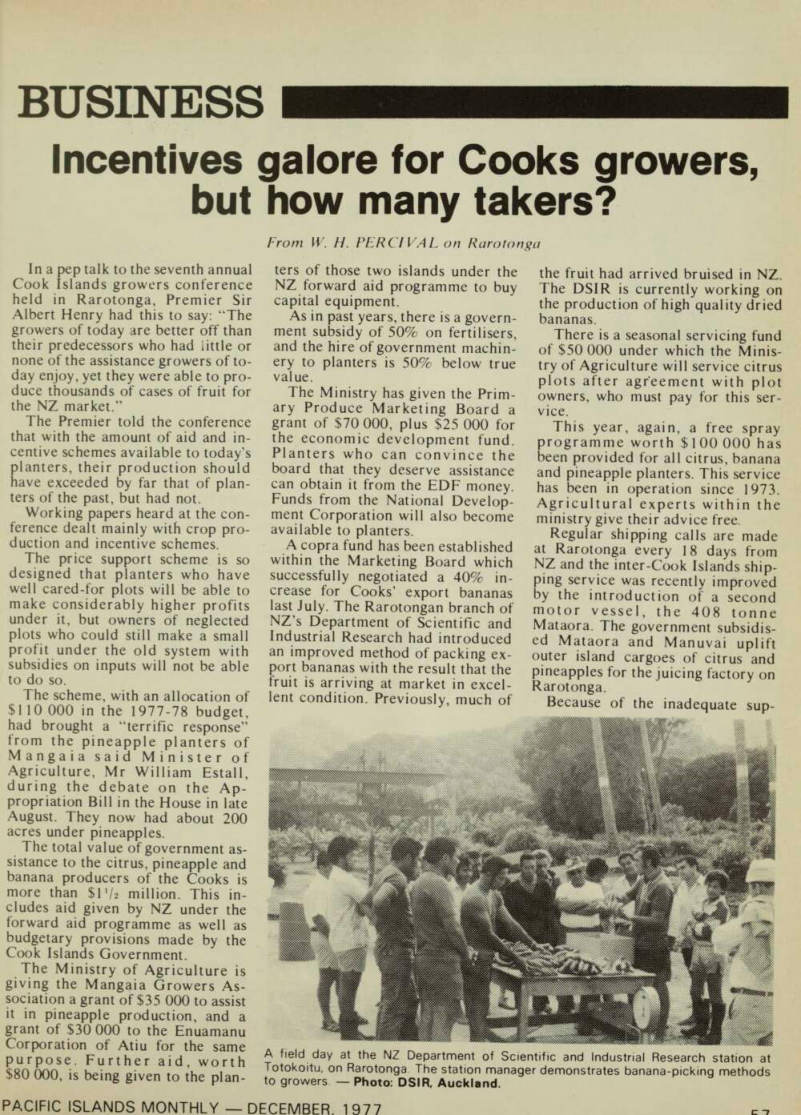
A field day at the NZ Department of Scientific and Industrial Research station at Totokoitu, on Rarotonga The station manager demonstrates banana-picking methods to growers Photo: DSIR, Auckland.
plies of fruit to Island Foods fac tory, a subsidiary of W. Gregg and Co of Dunedin, NZ, Greggs decided to cease Rarotonga operations on August 31. However, on July 21, the Cook Islands Government reached a new arrangement with Greggs which will allow the factory’s op erations to continue (PIM, Nov, p 88).
Under the new agreement Island Foods will carry on with a local par ticipation of 51%, those shares being bought initially by the govern ment. Later, the shares will be made available to Cook Islanders, especially planters who supply the factory with fruit.
Greggs will manage the factory and distribute the canned juice pro ducts, but this arrangement will be reviewed later. The board will com prise three local people, three nomi nated by Greggs, and an indepen dent chairman. The government also undertook to improve fruit pro duction, especially of citrus and pineapples. Citrus production in 1976 was 194 361 701 b cases and 60 226 cases of pineapples.
The air-freighting of market garden produce from Rarotonga to NZ started on a small scale in 1974 and has grown into a profitable business that does not need the sup port of the Price Subsidy Scheme.
However, the market gardeners re ceive the benefit of government-sub sidised fertilisers.
Mr Estall reported to the House in August that in 1976 market gar deners earned about $250 000 from this source, in addition to local sales. Produce exported included papaw, avocado pears, drinking coconuts, mangoes, breadfruit, tomatoes, beans, eggplants, mar rows, cucumbers, capsicums and tarotarua.
The Minister said: “May I remind members of the assembly that unless a response is forthcoming from the growers to the aid being given, I doubt whether we can do much in promoting the agricultural industry and achieving our aim of increased production.”
“Give me some Moa
Tongan chook”
Tonga is now processing local chickens and selling them under the trade name of Moa Ifo. The chicks are raised, dressed, packaged and supplied by Farmers Development Co Ltd. About 20 labourers are dressing 1 000 birds a fortnight.
Spokesman Mr Kali Vailahi says the aim is to increase production to about 60 000 birds a year.
Some chicks are bought from the Department of Agriculture and some from Fiji. They are butchered at seven to eight weeks and are sold at one price. The average weight per bird is about 1.35 kg. One plan for the future is to grade the chickens.
The giblets are packaged and
retailed. Retail price for the chickens and the giblets is below that of imported birds. An allied product, manure, is bagged and sold to gardeners.
The company is aiming at hatch ing all chickens in Tonga, and to manufacture feed for them from local corn, copra meal and cassava.
This will enable the birds to be sold even more cheaply.
Boost for Fiji fruit
exports planned
An Australian-owned company, South Pacific Foods Pty Ltd, is planning to lift production and ex port of fruit, fruit pulp and juice from Fiji’s Sigatoka Valley. The managing director of the company, Mr Peter Holdsworth, said the value of exports of passionfruit pulp and juice to the US should rise to about $3OO 000 from $ 1 00 000.
Australian buyers were prepared to take as much papaw and mango as growers could supply. He said he was expecting exports worth $5OO 000 not too far ahead.
W. R. C. buys
in big in Honolulu
W. R. Carpenter Holdings Ltd has extended its Pacific Activities to Hawaii with the acquisition of two companies which operate in the con struction and agricultural equip ment fields. For SUSI.O7 million cash they have acquired Bacon Co Inc, and Universal Equipment Co Ltd, both of Honolulu.
Franchises held by the two com panies will be retained. These in clude Ford tractor division pro ducts, Keohring cranes/excavators, Worthington compressors, the Melroe Bobcat range and Champ forklifts. The Carpenter group ex pects an expansion of the Hawaiian companies’ product range
Rubber factory
planned for PNG
The Dunlop rubber group in Australia has taken several firm steps towards setting up a rubber processing plant at Port Moresby.
Negotiations with the PNG Govern ment are at an advanced stage. The plant is expected to cost about $3.6 million.
Port Moresby is strategically
placed for such a plant as most rub ber is produced within a 150 km
radius of the city. The plant will use about 800 tonnes, or 18% of the an nual rubber production of PNG.
Initially, the plant will manufac ture small rubber items, such as car mats, mud flaps and brushes. A large part of the production will go to Australia and will be allowed in duty-free under the PNG-Australia free trade agreement. The market in Australia for those products is esti mated at close to $4 million a year.
The plant will give a boost to employment prospects in Port Moresby for it will require a work force of 400-500 locals.
Tonga to crush
its own copra
Tonga’s Commodities Board is erecting a copra crushing mill to process the kingdom’s copra output, which is expected to be working by Christmas. The mill is a joint ven ture between the Commodities Board and a group of Australian businessmen.
It is not yet known as to where the oil output of the mill will be ex ported but an informed source has stated that the main market will be Australia unless, as a result of pressure from local vegetable oil producers, the Australian Govern ment imposes a tariff on coconut oil going into Australia.
Apia’s brand-new
brickworks
Apia Concrete Products has in stalled a new automatic bnck-mak ing plant, costing about SWSIOO 000, and expects to double business. The plant is capable of producing 1.5 million bricks a year of a standard which will meet New
Zealand, British and American specifications. However, the de mand is not expected to reach capacity, so production will be scal ed down to about 750 000 bricks a year. More than 50 different types of bricks will be made, n
PaCITIC Travel Mart
mfiOtinn for Manila meBim 9 » or Manila A Pacific travel mart, sponsored by .the Pacific Area Travel As sociation, will be held in Manila from June 2-6, 1978. The meeting was endorsed by PATA’s board of directors at a recent session in Fiji.
The Pacific travel mart will be similar in concept to the highly suc cessful “Discover America Interna tional Pow Wow” held in the United States. The programme will bring together tour wholesalers and op erators from North America, Europe, Australia and other parts of the world to meet with the suppliers from the east Asia region, Guam and Micronesia on a pre-arranged appointment basis. Approximately 400 people from the travel industry are expected to attend, K| ew fftr RP blOic TOl Dr
j|l Nukualofa
Burns Philp (South Sea ) Co Ltd expects any day to see the com pletion of its new s'/ 4 million store in Nukualofa, Tonga.
The new Store, situated on the former Riechelmann Bros Store site, will at least give BP a perma nent place of operation since its former store was completely de stroyed by fire in 1970. From 1970 to the present time, BP has been op crating in three different premises leased from various people. Early
Solomon Islands Chief Minister Peter Kenilorea was in Australia in October and one of his jobs was to visit the CSIRO's fisheries research centre at Cronulla in New South Wales, which will be the temporary headquarters of the South Pacific Fisheries Agency planned by the South Pacific Forum and the South Pacific Conference The permanent headquarters will be in Honiara, the Solomons' capital Mr Kenilorea is pictured with Dr Garth Murphy, the senior fisheries biologist at Cronulla.
this year, BP bought the Riechelmann Bros Store and award ed the job of constructing its new building to the Tonga Construction Company. The local manager, Mr Furby estimates that the store should be in full swing by late November, early December.
Former UN men to
help Tongan fishing
A company designed to help the Tongan fishing industry has been registered by Henry Simpson, Hans Mose and George Lokan. The men became familiar with Tongan waters, fishing methods and needs while working with the United Nations Development Program me/Food and Agriculture Organ isation fishing project while station ed in Tonga.
The company, known as Western Pacific Traders Ltd, has a floating barge workshop, which will help to reduce the number of fishing days lost because of poor maintenance. It hopes to provide fishing gear for bottom line fishermen, trolling lines, hooks, lures, etc, which are not now readily available. The com pany will also be able to advise on fish farming.
Dr Geoff Glasby (above) of the Depart ment of Scientific and Industrial Research NZ Oceanographic Institute, Wellington, has been awarded the NZ Association of Scientists’ Research Medal and the NZ in state of Chemists' ICI medal for 1977 The NZAS medal is awarded annually to scientists under 40 for outstanding re search over the preceding three years, and the NZIC prize is granted to members of the institute for published research in the past five years Dr Glasby's interests include the study of factors controlling the distribution, geochemistry and mode of formation of manganese nodules in the South Pacific, particularly the South-eastern Pacific and Samoan basins, and their relation to the underlying sediment type
Export award
for food firm
An Australian firm, Scotts Foods Pty Ltd, has won its second export award given by the Department of Trade, and is aiming for a third. Mr Ralph Rivers, export manager of the company, has made many trips to the Pacific Islands since Scotts started exporting to that area in 1965. In recent years as Scotts has started to penetrate new markets in South-East Asia, Mr Rivers has con centrated on that area and on Pacific Islands north of the equator.
The criteria for these Department of Trade prestigious awards include an increase in sales, and a percen tage of total sales in export markets.
In the period when it won its award Scotts sales in export markets were worth more than $2 million. These sales included products marketed by Scotts on behalf of other compa nies. • Niue Island now boasts an up to-date all-trades open workshop at its only high school. The workshop and new sets of tools for training in all mechanical, building and joinery trades have been given by the Inter national Labour Organisation.