Editor's Mailbag
pp. 37-39 · Read in the full issue

In Defence Of Bilingualism
I read with the keenest interest the two articles you published in the September PIM concerning the New Hebrides: “Hebrides Independence in 1980”, and “Shadow of the Tower of Babel”.
Reference is made in the latter ar ticle to Nabanga, a newspaper of which I am the director, as well as to an article in it which was written by me and which I signed I wish to pay particular tribute to the objectivity with which you have treated the present political situ ation in the New Hebrides. Such honesty is not always, alas, the fashion with the English-language press in the South Pacific. You have indeed shown very well the com plexity and the various, overlapping elements in the development of the country’s institutions, which are very difficult to grasp at the present moment when things are moving so fast.
Coming back to the de monstration in favour of the French-language education system of June 25, 1977, it is important and true to say that it was spontaneous.
This, no doubt, is the reason why it attracted such large crowds. The photographs I am attaching to this letter bear this out. What is perhaps even more important is that the de monstration drew in people who vote for the Vanuaaku Party. Some of them carried banners saying “Our parents vote for the Vanuaaku Party but we want to keep the bilingual system”.
Walter Lini’s party, to my mind, made a mistake at the congress held earlier on the island of Tanna at which it was announced that inde pendence would see teaching in French reduced to second-class status. To meddle with the language of a human being, with his means of perceiving the world around him, constitutes an offence to his dignity.
It was possible at first to believe that this demonstration would have an effect only in awakening for a day or two a higher consciousness on the issue of bilingualism on the part of the administrative and political
leaders of the New Hebrides. But it has had political consequences that will deserve close study in the weeks ahead, and more particularly at the time of the elections for the new As sembly, due to be held at the end of November.
In fact, in opposition to the state ments of the Vanuaaku Party against the French education system, but refusing to align themselves with the VP’s traditional adversaries (the Tan Union and the Federation of In dependents), a group of New Hebri dean notables, who are mainly English-speaking, in the wake of the June 25 demonstration set up a new political party, the Natatok Efate, which could well deprive the Vanuaaku Party of part of its elec toral following. The movement is still small but there are signs that it may be headed for a certain success.
Included in its programme is the defence of bilingualism in the New Hebrides after independence.
The problem of bilingualism in the archipelago merits close at tention. There are at present more than 13 000 children in the French schools, or slightly more than in the British schools. What is the future of these children? I believe it is to be wished that this future may be like that of the youngsters in Cameroon, or in Canada’s Quebec, who have the considerable advantage of knowing two languages, English and French, and who thus have access to the genius of both the British and French civilisations.
J. Massias
Vila, New Hebrides Director, Nabanga (PlM’s translation from French.)
Rev Albert Lebel
It might interest you to know that my copy of the September PIM ar rived here Stateside today, October 1. For the record!
But to the point about which I write; it intrigued me last year that no notice was given to the death of the Rev Albert Lebel, SM, a Marist
missionary stationed for many years in the Bougainville area, who died in November 1975.
Fr Lebel came to Bougainville in the early 30s. He worked as an as sistant in the Tinputz-Teop area. In about 1936 he started the mission station of Asitavi, near Numa-Numa and Wakunaia. He carved the local jungle there into a fine station, since destroyed during the war, but then rebuilt into the Girls’ High School conducted by the missionary sisters of the Society of Mary.
Father afterwards moved to Tunuru and the huge area embrac ing the North Nasioi, the Torau, and the Evos. Returning to Tinputz the war caught him there. He took to the mountains at the direction of Bishop Wade, and from there during the Japanese occupation helped to direct the rescue of both mission aries and plantation people by an American sub off Teop.
Postwar, Fr Lebel lost no time in returning, this time to Nissan where he got the collaboration of the Seabees to rebuild the mission sta tion. After his first return home to the States in 1947 he took over the job of launching Tearouki as a mis sion station. That has continued to flourish, especially at the time of the arrival of Sr M. Leo, SMSM, our first mission doctor amongst the religious. Fr Lebel was named, as well, the first religious Superior of the Marist Fathers in what was then termed the Region of the North Solomons. He went back to Hahela for six years. When his term was up, Father went to totally new environs as he took over Monoitu in the Siwai sector of South Bougainville.
Another trip to family and friends in the US and Father became the pastor of Hantoa on the East coast.
At this time his health began to decline and Bishop Lemay assigned him to Hahela where I found him
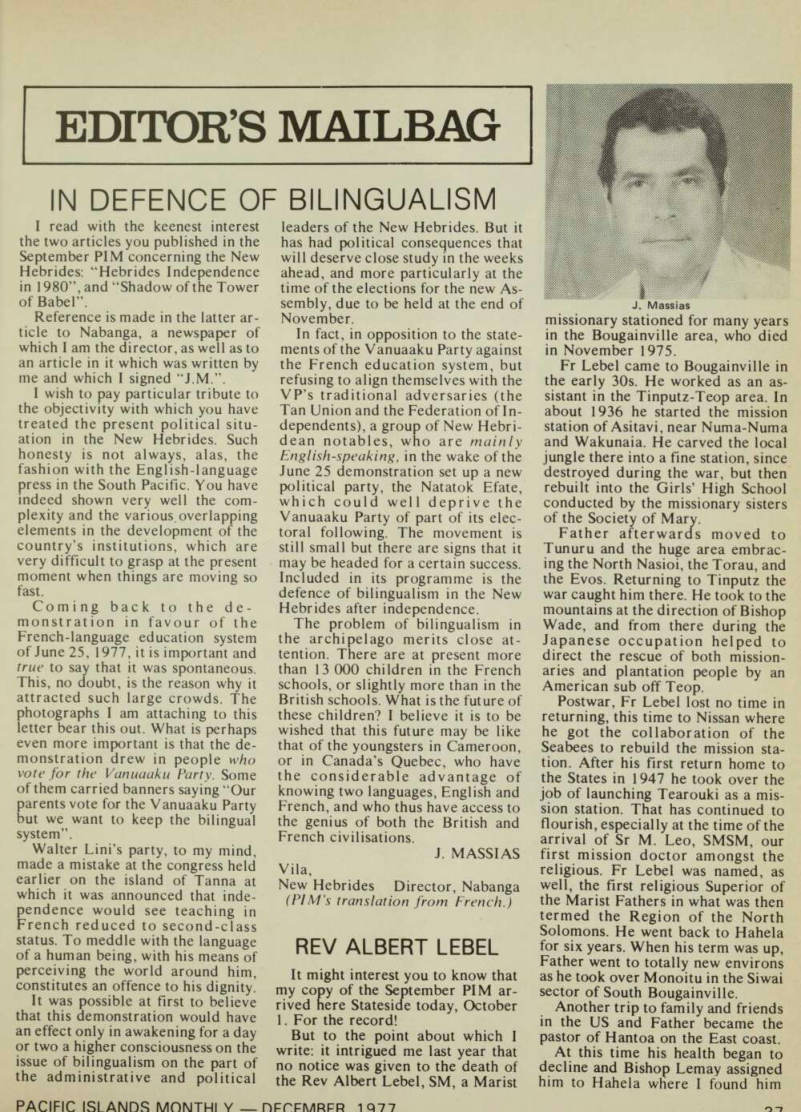
J. Massias
working on the history of the Marist missions in Bougainville. Being bilingual, Father was able to delve into our French resources of the early years.
In conclusion 1 simply want to salute Fr Lebel, Marist, priest, mis sionary and chief!
Rev Thomas B. Hogan, Sm
Marist Missions Washington, DC, USA
Gilberts Denial
The report in the October issue of PIM (p 15) “Gilbertese split on Ocean Island future” suggesting that the Opposition Party in the Gilberts House of Assembly sup ports the Banabans’ cause on Ocean Island is entirely misleading.
The Gilberts’ delegate quoted by the Banabans is not a member of the Assembly and has, at no time, been authorised by the Opposition to speak for them on this matter.
The policy of the Opposition on the future of Ocean Island is to maintain the integrity of the territo ry of the Gilbert Islands including Ocean Island.
Ieremia Taabai
Leader of Opposition, House of Assembly Gilbert Islands
Rabaul Air Fight
In the July issue of PIM (p 31) there was a reference to an article on page 39 of the March issue titled When the Rising Sun did barrel rolls over a battered Rabaul.
I somehow lost my copy of the March issue before getting a chance to read it. I was shot down over Rabaul on November 11, 1943, and in due course was a guest of that out standing man and coast watcher, Peter Figgis, until March 26, 1944.
W. F. Krantz
Captain, US Navy (retd).
St Paul, Minnesota • March issue on way! PIM
Slugged Yachties
I found Tardifs comments about Klaus Schaffer rather amusing (PIM Sept, p 28). Who, of the two, is un duly prejudiced? Schaffer says the Solomons Government is anti whitie and that the light fee is thinly disguised racism. Tardif finds this untrue after his two visits to the
Solomons. The amusing part is that Schaffer’s view was formed con siderably prior to June and prior to the new land and citizenship policy of the Solomon Islands Government which is blatant racism.
Tardif, however, was apparently in Gizo during the fervour when England was trying to tone down the Solomon Islands Government’s racist policy, the very subject of the lead article of the September 1977 PIM (ppB-10).
The News Drum, a Solomon Is lands weekly newspaper, has been full of racist statements about peo ple with “mixed blood” being unfit for land ownership or “first class” citizenship. It took considerable argument to get the Solomon Islands Government to back down from having “all-grandparents-born-in the-Solomons” a prerequisite for citizenship and land ownership.
Chinese, Gilbertese, and Europeans who have lived in the Solomons for whatever length of time (like Dr Fox) are somehow unfit to be first class citizens. The most alarming racist attitudes, however, are against Solomon Islanders of “mixed blood”. On my recent visit to the Solomons, I talked with several peo ple who were seriously afraid that, because their father was white, they would lose all of their land and their citizenship, even though they were born right in the Solomons. Who gets their land? Either the govern ment or the black half of their family.
People like the Tardifs are eager to raise a shout against a man who calls his cards as he sees them, a man who just happened to be astute enough to see some time ago what the Tardifs somehow cannot see when it is happening all around them.
It is a terrible thing for a white man to be a racist and a bigot but it’s OK for the poor under-privileged and uneducated blacks to be equally racist and bigoted. Why candycoat the obvious? Schaffer was proved correct by narrow-minded, ignorant bigots and racists of the worst kind, those men who are happily setting things up to rape their mixed-blood relatives, the whites, the Chinese, and the Gilbertese in the Solomons.
Tardifs of the world, open your eyes to what’s happening around you. You are condoning the worst kind of racism in your self-righteous objection to Schaffer’s honesty. You accuse Schaffer of creating racial problems which exist in the world today. He merely pointed them out.
Your insistence that such honesty be hushed up is what allows such rac ism to build and spread throughout the world. Let the Solomons government wear their racist pie.
Maybe the less racist people of the Solomons will stand up to prevent further abuse of human rights if there are any “less racist” people in the Solomons
John Fairbanks
Auckland