Islands dressing!)
pp. 17-19 · Read in the full issue
A US tale (with Thousand Islands dressing!)
From DAN GIBSON on Guam
Ihe USA ma y now be willing to resolve its claims to 25 islands in bve Pacific chains (PIM, Sept, p 57), °y early 1978.
The us State Department has anno u nced it has hopes of resolving the claims to 18 islands presently adminstered by Great Britain.
Three others are under New Zea- ,and control and four in the Cook Islands are internally indepen- Since the days of American whalers, the US has claimed islands * n tbe . Tuvalu (formerly Ellice), Phoenix, Tokelau, Cook and Line chains. . S° me have international significance. Christmas Island hosts a Japanese satellite tracking station.
The British plan to allow Christmas
islanders to vote on independence early next year. Canton and Enderb ury islands, in the Phoenix chain, have been used by the US in missile tracking programmes, Other islands, in the Line Islands are uninhabited: Flint, Malden,’
Starbuck, Vostok and the atoll of Caroline.
The islands have been considered of limited value. Diplomatic rela tions between the various claimants have always been good, virtually eliminating friction over the claims.
But with movement towards 200 nautical mile economic resource zones, the island area involved would include an expanse of ocean nearly as large as the continental
Usa.
For the US to formally quit its
claim may require an act of the US Congress.
Dan Gibson’s statement that the US is claiming only 25 islands rep resents a considerable “de-escala tion " from the 48 islands claimed in the original US Guano Act of 1856.
Twenty-three islands in fact.
Mr Lee Motteler of Honolulu’s Bishop Museum has stated that 15 of the islands claimed in the Act turned out to be non-existent, 12 of them were listed twice, and the names of only 18 of the 48 were spelled correctly.
How all this stacks up to a present claim on 25 islands we do not know. Perhaps some well-informed reader can help? — Editor.
For the record: PIM recently re ceived, through the good offices of the US Consulate-General in Sydney, the following statement from the US State Department con cerning the US claim to four of the Cook Islands; “Four of the Northern Cook Is lands (Danger Atoll, Manahiki Atoll, Penrhyn Atoll and Rakahanga Atoll) are claimed by both the United States and New Zealand.
“The United States’ claim goes back to legislation passed by the US Congress in 1856 concerning guano mining by US nationals in the South Pacific. During World War II the
Cont. on p 19
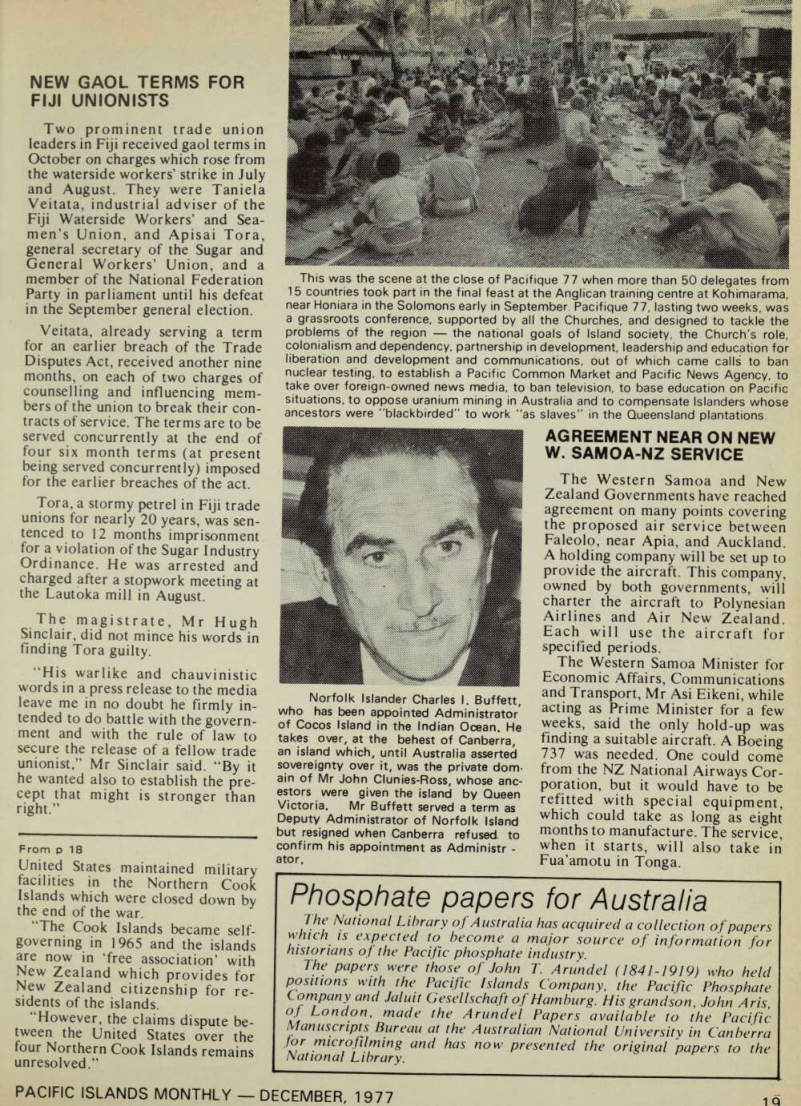
President Franklin Pierce, 14th president of the United States, who was in office when Congress passed the Guano Act on August 18, 1856. The act reflected Pierce's ambitious foreign policy, by which he hoped to divert public opinion from the slavery issue, which eventually led to the Civil War.
From p 18
United States maintained military facilities in the Northern Cook Islands which were closed down by the end of the war.
“The Cook Islands became self governing in 1965 and the islands are now in ‘free association’ with New Zealand which provides for New Zealand citizenship for re sidents of the islands.
“However, the claims dispute be tween the United States over the four Northern Cook Islands remains unresolved.”