Gilbertese Independence
p. 14 · Read in the full issue
Death Of Reuben Uatioa
The first architect of Gilbertese Independence
By Barrie Macdonald
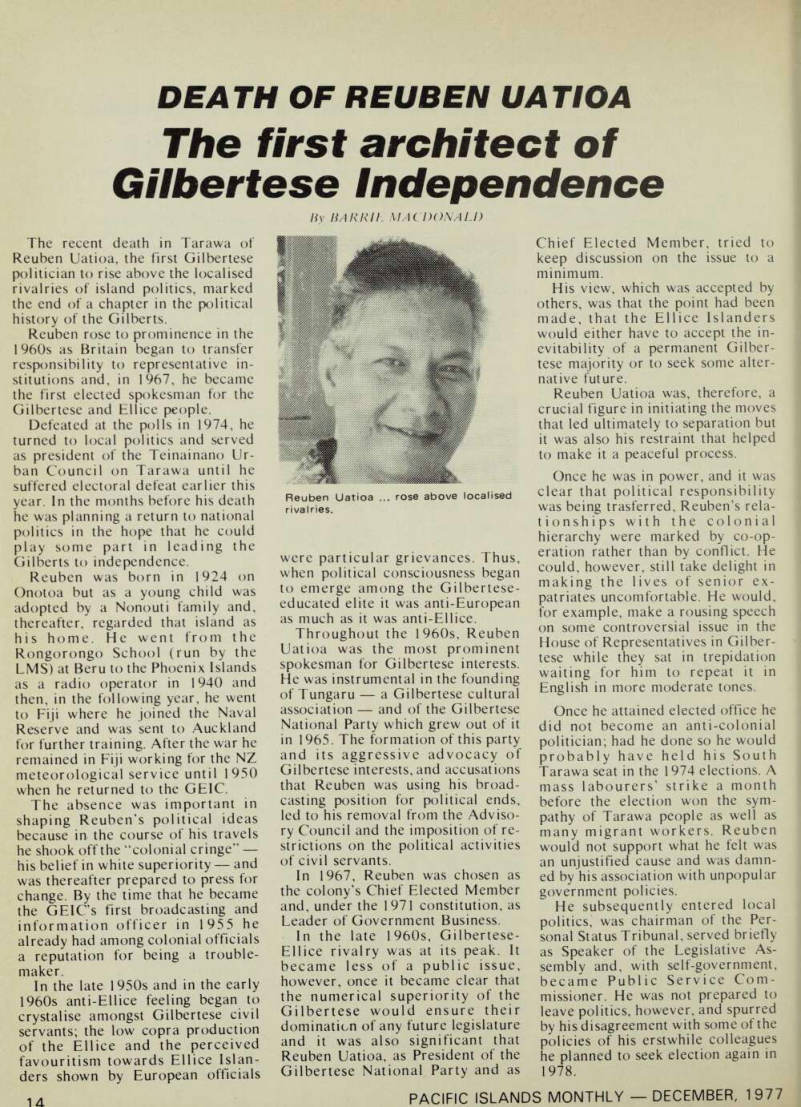
The recent death in Tarawa of Reuben Uatioa, the first Gilbertese politician to rise above the localised rivalries of island politics, marked the end of a chapter in the political history of the Gilberts.
Reuben rose to prominence in the 1960 s as Britain began to transfer responsibility to representative in stitutions and, in 1967, he became the first elected spokesman for the Gilbertese and Ellice people.
Defeated at the polls in 1974, he turned to local politics and served as president of the Teinainano Ur ban Council on Tarawa until he suffered electoral defeat earlier this year. In the months before his death he was planning a return to national politics in the hope that he could play some part in leading the Gilberts to independence.
Reuben was born in 1924 on Onotoa but as a young child was adopted by a Nonouti family and, thereafter, regarded that island as his home. He went from the Rongorongo School (run by the LMS) at Beru to the Phoenix Islands as a radio operator in 1940 and then, in the following year, he went to Fiji where he joined the Naval Reserve and was sent to Auckland for further training. After the war he remained in Fiji working for the NZ meteorological service until 1950 when he returned to the GEIC.
The absence was important in shaping Reuben's political ideas because in the course of his travels he shook off the “colonial cringe” his belief in white superiority and was thereafter prepared to press for change. By the time that he became the GEIC's first broadcasting and information officer in 1955 he already had among colonial officials a reputation for being a trouble maker.
In the late 1950 s and in the early 1960 s anti-Ellice feeling began to crystalise amongst Gilbertese civil servants; the low copra production of the Ellice and the perceived favouritism towards Ellice Islan ders shown by European officials
were particular grievances. Thus, when political consciousness began to emerge among the Gilbertese educated elite it was anti-European as much as it was anti-Ellice.
Throughout the 19605, Reuben Uatioa was the most prominent spokesman for Gilbertese interests.
He was instrumental in the founding of Tungaru a Gilbertese cultural association and of the Gilbertese National Party which grew out of it in 1965. The formation of this party and its aggressive advocacy of Gilbertese interests, and accusations that Reuben was using his broad casting position for political ends, led to his removal from the Adviso ry Council and the imposition of re strictions on the political activities of civil servants.
In 1967, Reuben was chosen as the colony's Chief Elected Member and, under the 1971 constitution, as Leader of Government Business.
In the late 19605, Gilbertese- Ell ice rivalry was at its peak. It became less of a public issue, however, once it became clear that the numerical superiority of the Gilbertese would ensure their domination of any future legislature and it was also significant that Reuben Uatioa, as President of the Gilbertese National Party and as
Chief Elected Member, tried to keep discussion on the issue to a minimum.
His view, which was accepted by others, was that the point had been made, that the Ellice Islanders would either have to accept the in evitability of a permanent Gilber tese majority or to seek some alter native future.
Reuben Uatioa was, therefore, a crucial figure in initiating the moves that led ultimately to separation but it was also his restraint that helped to make it a peaceful process.
Once he was in power, and it was clear that political responsibility was being trasferred, Reuben’s rela tionships with the colonial hierarchy were marked by co-op eration rather than by conflict. He could, however, still take delight in making the lives of senior ex patriates uncomfortable. He would, for example, make a rousing speech on some controversial issue in the House of Representatives in Gilber tese while they sat in trepidation waiting for him to repeat it in English in more moderate tones.
Once he attained elected office he did not become an anti-colonial politician; had he done so he would probably have held his South Tarawa seat in the 1974 elections. A mass labourers’ strike a month before the election won the sym pathy of Tarawa people as well as many migrant workers. Reuben would not support what he felt was an unjustified cause and was damn ed by his association with unpopular
government policies.
He subsequently entered local politics, was chairman of the Per sonal Status Tribunal, served briefly as Speaker of the Legislative As sembly and, with self-government, became Public Service Com missioner. He was not prepared to leave politics, however, and spurred by his disagreement with some of the policies of his erstwhile colleagues he planned to seek election again in 1978.
Reuben Uatioa ... rose above localised rivalries.