Fiji breathes a sigh of relief
pp. 10-11 · Read in the full issue
relief after poll
From L. G. USHER in Suva
The results of the September general election brought a sigh of relief from almost everybody in Fiji.
The uncertainty produced by six months of government by a party with a parliamentary minority was over.
The Alliance, with a clear majori ty of 20 in the House of Rep resentatives, and with Ratu Sir Kamisese Mara firmly at the helm as Prime Minster, was secure in power for the next five years.
The country could now settle down. Investment decisions could be made. Laws could be enacted and policies laid down without the likelihood, or at least the possibili ty, of their being torn asunder in Parliament.
At Government House, the sigh could have been of satisfaction. If protocol allowed such a thing to be dreamed of, the Governor-General, Ratu Sir George Cakobau, who had personally chosen Ratu Sir Kamisese Mara as Prime Minister, although the Alliance lacked a
parliamentary majority, could
justifiably have said, “I told you so.”
In most Fiji people’s minds there had been a certain amount of mys tery about some of the events that followed immediadely in the wake of the April election, but revelations during and after the September campaign cleared this away.
This was in spite of a “We wuz robbed” attempt by the Leader of the Opposition in the last parlia ment, Mr Siddiq Koya, to cloud the story. Mr Koya went further than just suggesting that he had been deprived of the opportuity to become Prime Minister. He claimed that there had been a deep, dark plot to stop an Indian from holding the post.
Ratu Mara reacted promptly and with anger. He described the allega tion as a “deep personal insult” and a “gross lie”. It was designed, he said, to “appeal to racialism” and its effects would “last for a very long time”.
One effect was a declaration by Ratu Mara that he would rather give
up the prime ministership than have to deal in any way with Mr Koya.
He gave the facts about immedi ate post-election events in April.
“When it was clear that we would only muster 24 seats againt the Op position’s 26 I immediately went to Government House and delivered my letter of resignation both for myself and my government,” he said.
Ratu Mara also recalled that he and his former ministers promptly moved out of their official re sidences, cleared their offices, sur rendered their official cars and began looking round for new or for their former jobs.
At the same time the Governor-
General was sending for Mr Koya, the ostensible leader of the National Federation Party, representing the largest group in the new parliament.
On the surface it seemed as if naming him as prime minister was not much more than a formality.
But it wasn’t as simple as that.
Mr Koya showed a remarkable reluctance to form and lead a government, and his fellow party members showed an equally remarkable reluctance to rally unitedly behind him, and to confirm him as a leader.
On the part of the party’s presi dent, Mrs Irene Jai Narayan, and the general secretary, Mr Karam Ramrakha, this reluctance had earlier been made apparent.
Now emerged two more rivals for the party leadership Lautoka lawyer Mr Jai Ram Reddy and one of the few Fijians in the NFP, Vanua Levu farmer and former soldier and civil servant, Mr Atunaisa Maitoga.
The first reaction of NFP mem bers to the awkward dilemma of having to choose a potential prime minister from among three rivals was to shy away from it by suggest ing that a coalition government would be a good idea, with some of them in the cabinet but with Ratu Sir Kamisese Mara as prime minister.
From both Ratu Mara and the
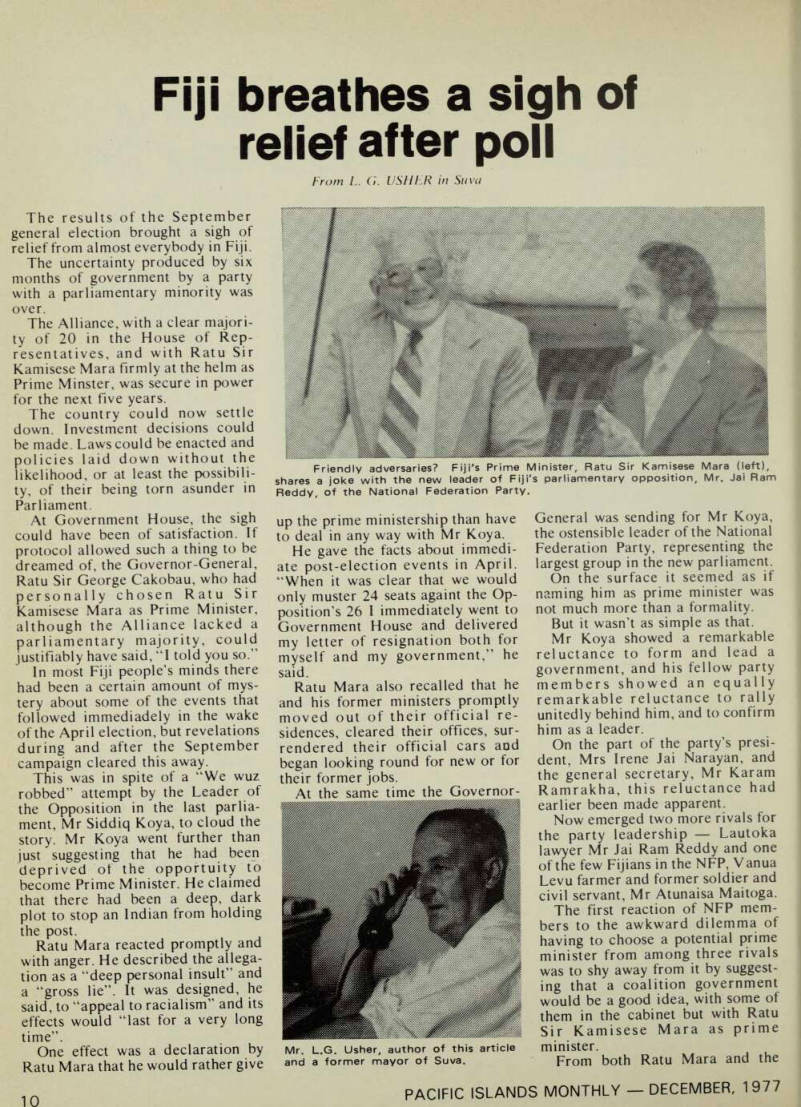
Friendly adversaries? Fiji's Prime Minister, Ratu Sir Kamisese Mara (left), shares a joke with the new leader of Fiji's parliamentary opposition, Mr. Jai Ram Reddy, of the National Federation Party.
Mr. L.G. Usher, author of this article and a former mayor of Suva.
Alliance the answer was a resounding No Ratu Mara later took up the story; I was not being asked to join in power-sharing, he said. “I was being begged to bail out the opposition from a position which they did not feel capable of sustaining ...
They talked about coalition, they talked about caretaker government, they talked about interim government and as a last resort . . . eventually said after four days that they were ready to form a government.”
Ihe reason for the change was at * ast ’ after much wrangling and by a majority of one vote, they had chosen Mr Koya as leader, though there were some notable retusals in advance to serve under hl off" 3 C f b \ l l et V l c Off went Mr Koya hopefully to uovernment House a second time, but by now the Governmor-General had made up his mind, and his decithZ Z'mpp’ m ° re irmly baSCd Th? V < > r • f key to it lies in a section of ir« nf h U Ul °r ° f FIJI WhlCh C i\ l Anctr.lia K S T s P eciall y iai ? S bemused by partisan reactions to the i entirely different Kerr IS efrh°/r M H W .!" , I ! am by ? lr John don t ’ understand k "° W ab ° Ut ° f °TrL UnderSt . a . j , rL»t n C ° n^ tltUt '? n dlrects ,he overnor-General to appoint as Prime Minister the member of the
House of Representatives who, in his own deliberate judgement, ap pears to him “best able to command the support of the majority of the House of Representatives”.
The all-important point is that it is a person, and not a party, or even a party leader, whom the Governor- General is charged to select.
Ratu Sir George chose well. Ratu Sir Kamisese Mara had the unques tioned support of the 24 Alliance members, and the NFP had been urging him to stay in office as Prime Minister even if it was as head of a coalition government.
Mr Koya, or any of his colleagues could, at best, command the reluc tant support of not more than a nar row majority of the NFP members.
Just how reluctant that support was for Mr Koya soon became ap parent.
With the aid of the two other non alliance members of parliament, the NFP was able to precipitate another election. This was the signal for the NFP to split into two bitterly war ring groups, with Mr Mr Koya at the head of one faction and Mrs Narayan, Mr Ramrakha and Mr Jai Ram Reddy speaking for the other.
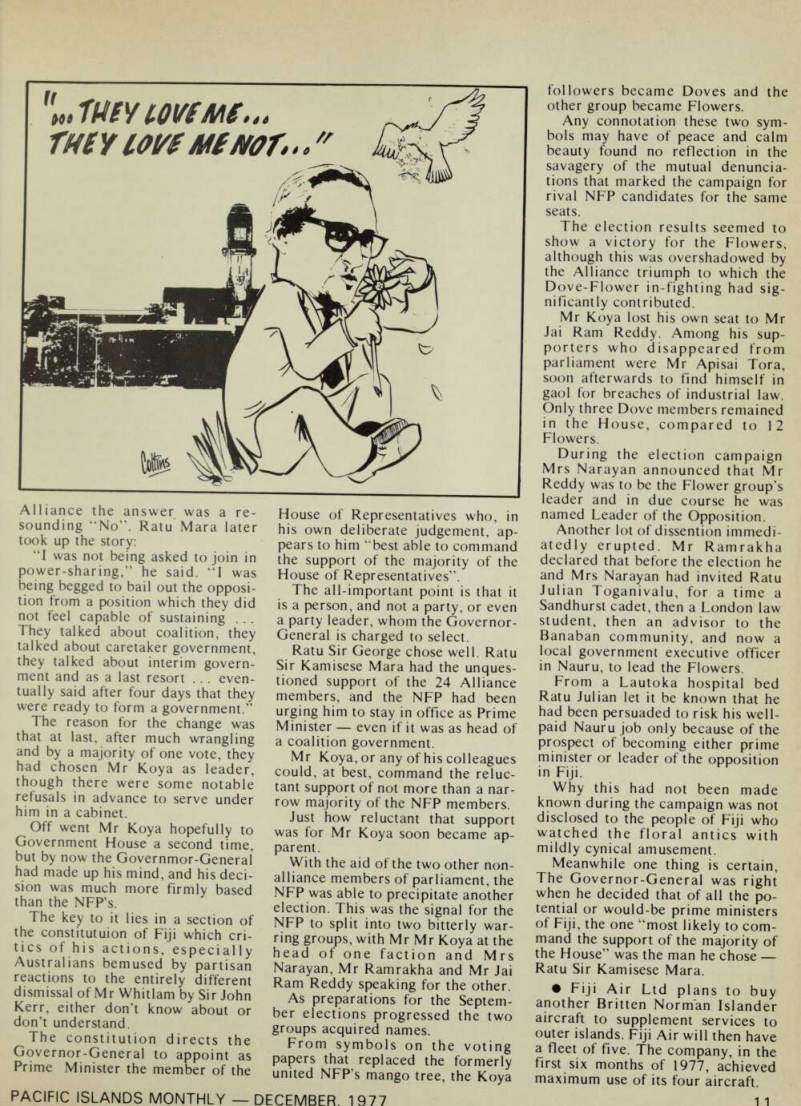
As preparations for the Septem ber elections progressed the two groups acquired names.
From symbols on the voting papers that replaced the formerly united NFP’s mango tree, the Koya
followers became Doves and the other group became Flowers.
Any connotation these two sym bols may have of peace and calm beauty found no reflection in the savagery of the mutual denuncia tions that marked the campaign for rival NFP candidates for the same seats.
The election results seemed to show a victory for the Flowers, although this was overshadowed by the Alliance triumph to which the Dove-Flower in-fighting had sig nificantly contributed.
Mr Koya lost his own seat to Mr Jai Ram Reddy. Among his sup porters who disappeared from parliament were Mr Apisai Tora, soon afterwards to find himself in gaol for breaches of industrial law.
Only three Dove members remained in the House, compared to 12 Flowers.
During the election campaign Mrs Narayan announced that Mr Reddy was to be the Flower group’s leader and in due course he was named Leader of the Opposition.
Another lot of dissention immedi atedly erupted. Mr Ramrakha declared that before the election he and Mrs Narayan had invited Ratu Julian Toganivalu, for a time a Sandhurst cadet, then a London law student, then an advisor to the Banaban community, and now a local government executive officer in Nauru, to lead the Flowers.
From a Lautoka hospital bed Ratu Julian let it be known that he had been persuaded to risk his well paid Nauru job only because of the prospect of becoming either prime minister or leader of the opposition in Fiji.
Why this had not been made known during the campaign was not disclosed to the people of Fiji who watched the floral antics with mildly cynical amusement.
Meanwhile one thing is certain, The Governor-General was right when he decided that of all the po tential or would-be prime ministers of Fiji, the one “most likely to com mand the support of the majority of the House” was the man he chose Ratu Sir Kamisese Mara. • Fiji Air Ltd plans to buy another Britten Norman Islander aircraft to supplement services to outer islands. Fiji Air will then have a fleet of five. The company, in the first six months of 1977, achieved maximum use of its four aircraft.