Noumea: The end of
p. 85 · Read in the full issue
a clinical dream
From PAUL STERLING in Noumea
The news that the Noumea Clinic had reached the end of its very short life was not a great surprise to the people of New Caledonia. Like most other private, and many public pro jects, it was completely out of pro portion with the city’s requirements, and had been built and equipped without even considering its even tual profit-earning capacity.
The building was undertaken by a company in which the CAFAT (social security fund) holds 99% of the shares, and cost $6.5 million.
CAFAT also holds more than 20% of the capital of the company that leases.the building, with a capital of $2.2 million. After two years of ac tivity, this company has lost $7OO 000. At the end of July, the board announced the official stop page of payment, which according to French commercial law meant that within a fortnight bankruptcy would be declared. It was thus that CAFAT’s Board decided to buy out the company, as its fellow shareholders, at the symbolic price of one franc a share.
Organisation is probably the wrong word to describe a country where State, Territory, mutual benefit fund, private enterprise and social security fund compete to pro vide insufficient services and above all insufficient health insurance.
The dilapidated hospital is run by the French Army. A good, and sometimes excellent medical team provides a service in absolutely ap palling conditions to public ser vants, indigent Melanesians and Polynesians and those who cannot afford to go elsewhere. The public servant pays a minimum fee. The Department of Health has also several dispensaries in the bush and a school medical centre.
The public servants also have their own Mutual Assurance Fund which has created its own medical and dental centre in competition with the private practitioners.
The staff and employees of the Societe le Nickel are covered by a similar organisation, also with its own installations;
The employees of commerce have also their organisation, and the three “mutuals” have co-operated to create their own pharmacy, There are private clinics. One built by a local doctor was transformed into offices, while nuns continue to provide the essential services in another. The third uses precarious and temporary installa tions built by the US Army in 1942.
CAFAT, the territorial security fund, was created to provide for child endowment, maternity-leave pay, retirement benefit, sick leave and workers accident compensation to employees of private enterprise.
It was mainly the high cost of pri vate medical, surgical and dental services which encouraged this organisation to create its own family medical centres and eventually in vest in the clinic.
Then there are the private practi tioners, the older generation of family doctors, the young genera tion fresh out of medical school, and above all the numerous doctors and dentists who arrived from France, attracted by high, tax-free fees.
Nearly 60 private doctors have their practices in Noumea, more than one doctor per thousand people.
The Territorial Assembly had already proposed to take over the clinic next January. Speaker for the Health Commission, Socialist Alain Bernut, declared that this would be the first step in creating a public health system, offering to the whole community facilities that had only been available to CAFAT benefici aries, or those wealthy enough to afford the expensive fees. He added that the clinic could be bought for a million dollars, while the proposed new hospital, which the territory would never be able to afford, had already cost two million in preliminary studies.
When the clinic announced its financial difficulties, there seemed to be no apparent solution. During the pre-election period, and with the precarious current budget, the as sembly could not advance the date of take-over, and refused to con sider any form of interim subsidy. It was in these circumstances that CAFAT decided to take over man agement until the end of the year.
CAFAT’s role is controversial.
While assuring compensations, en dowments and retirement income, the fund is undoubtedly right in placing its capital in income-earning investments. By creating its own medical centres, it has already step ped on the toes of private enterprise.
The territory badly needs a coherent medical system, like many other utopian projects it cannot afford under present budgetary restrictions. But it is also obvious that public funds cannot always be
invested in unprofitable projects
devised by inexperienced pro moters. The aquarium . . . the clinic, what next?
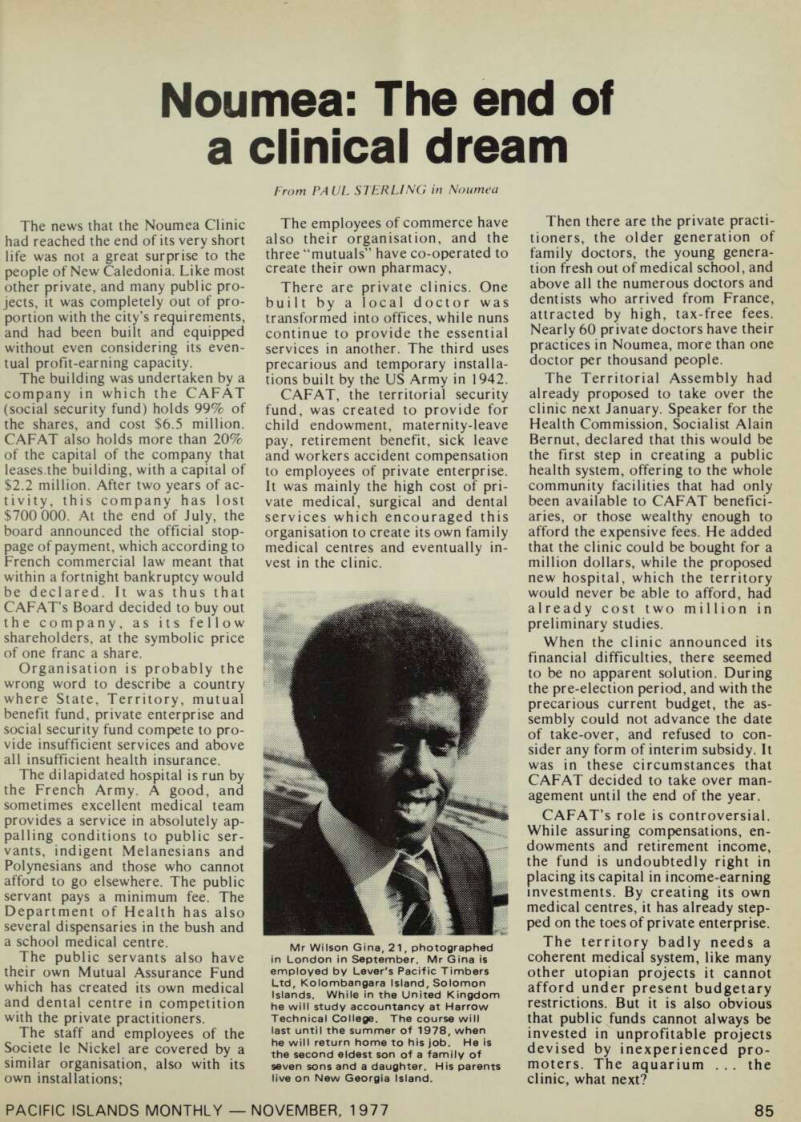
Mr Wilson Gina, 21, photographed in London in September. Mr Gina is employed by Lever's Pacific Timbers Ltd, Kolombangara Island, Solomon Islands. While in the United Kingdom he will study accountancy at Harrow Technical College. The course will last until the summer of 1978, when he will return home to his job. He is the second eldest son of a family of seven sons and a daughter. His parents live on New Georgia Island.