Bananas, a dying export industry
p. 79 · Read in the full issue
Business
Bananas, a dying export industry in the Islands
Back in the mid-sixties, the Island groups of Fiji, Tonga and Western Samoa supplied practically all the banana requirements of New Zea land. The Union Steam Ship Co’s ships Matua and Tofua each arrived at Auckland at fortnightly intervals with banana cargo of up to 60 000 cases (a case weighed 60 lb or 27.2 kg net). Production in those years was so high that Tonga even exported to the Japanese market.
New Zealand could not absorb all that Tonga could export.
Production on all these island groups was on the increase, shipping services were excellent and growers were kept happy by being paid hundreds of dollars every week for their scores of cases of bananas.
Unfortunately, those happy
years were shortlived. One often hears a number of the formerly big growers asking: “Where have all those bonanza banana years gone?
When will they ever return?”
From a profitable and bustling in dustry, especially in the mid sixties, the Islands’ banana export industry is facing a difficult battle to survive.
The drastic decline began in 1968 due, principally, to the introduction of the black leaf-streak disease. The disease was first diagnosed in Fiji.
Then it spread to the neighbouring Island groups. So devastating was its impact that within 12 months pro duction throughout the Islands had declined by about 70% Over the past several years efforts have been made by all the Island countries concerned to eradicate or at least control the black leaf-streak, but the result has been disappoint ing, to say the least. None of the authorities in the Islands ever thought that the disease could become so devastating. And, to date, research into ways and means of controlling it has not produced any cheap and easy solution.
In the bonanza years, Tonga, Western Samoa, Fiji and the Cook Islands were exporting up to a million cases of bananas a year to New Zealand. Now they are export-
ing less than 20% of that figure. In fact, Fiji is no longer exporting any bananas to New Zealand, or any where else. The last banana ship ment out of Fiji was less than 100 cases in late 1974.
In 1976, Western Samoa did no better than an average of 5 000 cases a month, and, judging by the export quantities to date, the monthly average for 1977 could be as low as 2 000 cases. As for the Cook Is lands, its current monthly export averages only 1 000 cases, and there are no strong indications that this figure will pick up appreciably in the near future.
By contrast, Tonga’s monthly ex port over the past five years have re mained rather static at an average of about 10 000 cases. And recent in dications there suggest that 1977 will be the turning point in Tonga’s battle to revitalise the industry.
Monthly exports during the first six months of 1977 have been averaging more than 13 000 cases, and could, by the end of the year, reach 14 000 to 15 000.
The NZ Government and the
South Pacific Bureau for Economic Co-operation (SPEC) have over the past few years, worked with the Is lands to revitalise the industry at a cost estimated to be, by the end of 1977, about a million dollars.
Unfortunately, the results have been disappointing, to say the least.
The following statistics do not, in general, paint a promising future.
Exports To Nz
In joint efforts to revive the in dustry in the Islands, the sole im porter of bananas into New Zea land, Fruit Distributors Ltd, has played a conspicuously-negative role.
Instead of lending a helping hand, its management kept insisting that the Islanders could not do it. For
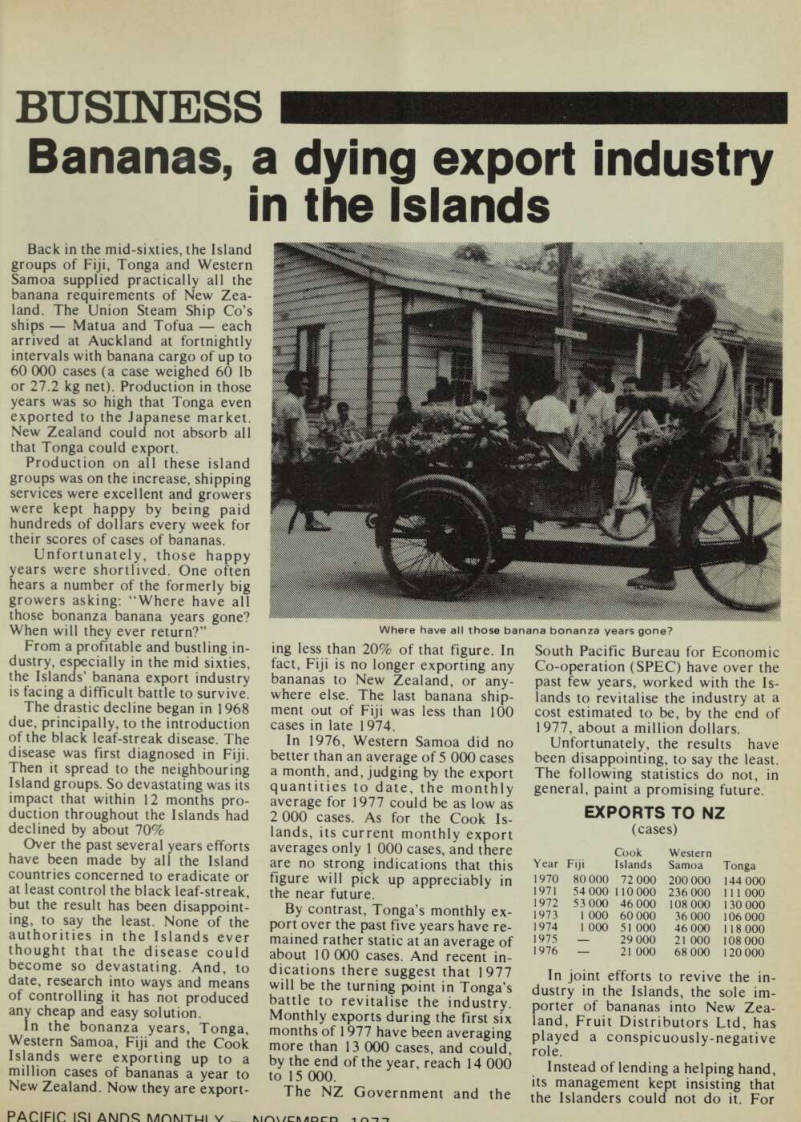
Where have all those banana bonanza years gone?
(cases)
Cook Western Year Fiji Islands Samoa Tonga 1970 80 000 72 000 200 000 144 000 1971 54000 110000 236000 111000 1972 53 000 46 000 108 000 130 000 1973 1000 60 000 36 000 106 000 1974 1000 51000 46 000 118 000 1975 — 29000 21000 108000 1976 — 21000 68 000 120 000