Tbopicalities
p. 39 · Read in the full issue
One for MPs to chew over?
A ban on betel nut chewing in Papua New Guinea’s public service may become a matter for parliament to decide.
An Opposition front-bencher, Mr J. Jaminen, told public servants in his electorate to ignore the ban. Mr Jaminen said in a national radio broadcast in September that he would call for a parliamentary debate on the issues involved.
“It’s anti-national it cuts across our traditions,” he said.
Betel nut, the small, green, fibrous fruit of the areca palm, is chewed by many Papua New Gui neans. Sometimes it is mixed with lime, creating a chemical change which causes red staining of the mouth and teeth.
Opinions vary on the extent to which betel nut chewing is con sidered to be drug-taking or even if the nut has any effect at all.
The chairman of the public ser vices commission, Mr Namaliu, caused a controversy when he directed that public servants must no longer chew betel nut during working hours.
Mr Namaliu kept out of the ensu ing controversy, but his directive is believed to have been directed at sloppy habits rather than having been a condemnation of betel nut as such. However, he has been criticis ed as anti-national, Western-orien tated and blind to “The cultural tra dition of betel nut chewing”.
Mr Namaliu was supported by the secretary of education, Mr Alkan Tololo, who said that since colonial rule had ended in PNG, betel nut chewing and sloppy dress habits had increased among public servants on
duty.
Alluding to the fact that betel nut chewing is notorious for the spitting which usually accompanies it, the PNG Post-Courier newspaper said editorially “less spit and more polish would appear to be the answer”.
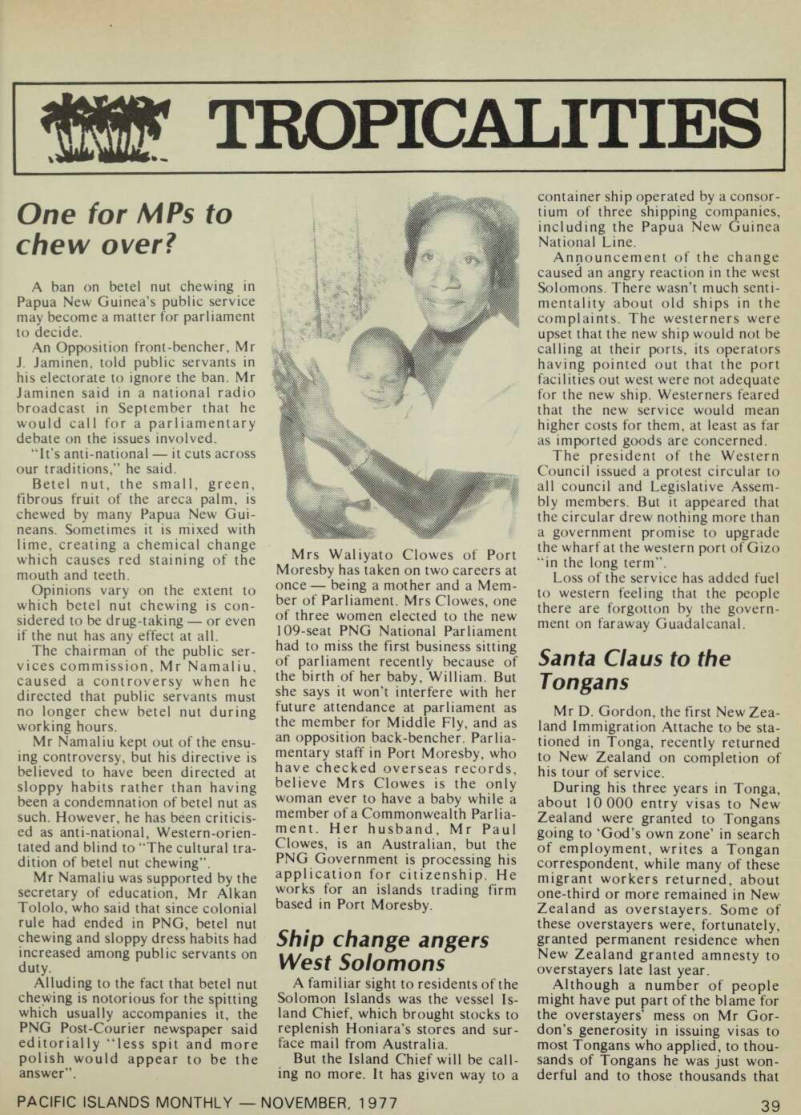
Mrs Waliyato Clowes of Port Moresby has taken on two careers at once being a mother and a Mem ber of Parliament. Mrs Clowes, one of three women elected to the new 109-seat PNG National Parliament had to miss the first business sitting of parliament recently because of the birth of her baby, William. But she says it won’t interfere with her future attendance at parliament as the member for Middle Fly, and as an opposition back-bencher. Parlia mentary staff in Port Moresby, who have checked overseas records, believe Mrs Clowes is the only woman ever to have a baby while a member of a Commonwealth Parlia ment. Her husband, Mr Paul Clowes, is an Australian, but the PNG Government is processing his application for citizenship. He works for an islands trading firm based in Port Moresby.
Ship change angers
West Solomons
A familiar sight to residents of the Solomon Islands was the vessel Is land Chief, which brought stocks to replenish Honiara’s stores and sur face mail from Australia.
But the Island Chief will be call ing no more. It has given way to a
container ship operated by a consor tium of three shipping companies, including the Papua New Guinea National Line.
Announcement of the change caused an angry reaction in the west Solomons. There wasn’t much senti mentality about old ships in the complaints. The westerners were upset that the new ship would not be calling at their ports, its operators having pointed out that the port facilities out west were not adequate for the new ship. Westerners feared that the new service would mean higher costs for them, at least as far as imported goods are concerned.
The president of the Western Council issued a protest circular to all council and Legislative Assem bly members. But it appeared that the circular drew nothing more than a government promise to upgrade the wharf at the western port of Gizo “in the long term”.
Loss of the service has added fuel to western feeling that the people there are forgotten by the govern ment on faraway Guadalcanal.
Santa Claus to the
Tongans
Mr D. Gordon, the first New Zea land Immigration Attache to be sta tioned in Tonga, recently returned to New Zealand on completion of his tour of service.
During his three years in Tonga, about 10 000 entry visas to New Zealand were granted to Tongans going to ‘God’s own zone’ in search of employment, writes a Tongan correspondent, while many of these migrant workers returned, about one-third or more remained in New Zealand as overstayers. Some of these overstayers were, fortunately, granted permanent residence when New Zealand granted amnesty to overstayers late last year.
Although a number of people might have put part of the blame for the overstayers’ mess on Mr Gor don’s generosity in issuing visas to most Tongans who applied, to thou sands of Tongans he was just won derful and to those thousands that