New Caledonia’s poll:
pp. 37-38 · Read in the full issue
Independence the issue
From PAUL STERLING in Noumea
After an exceptionally savage electoral campaign, New Caledonia has elected its new Legislative As sembly. In spite of the profusion of new parties, mainly due to personal ambitions or last-minute switches, the electors have been surprisingly conservative.
The territory is split into four electorates, each with a certain number of representatives. These are: the South, including Noumea with 16 seats; the West coast, with seven seats; the East coast, with seven seats; and the Loyalty Islands with five. Each party wishing to pre sent candidates had to submit a list with as many candidates as there are seats in the electorate. In fact, only the first names on the list are real candidates, the others merely pro viding moral support.
The South, with its predominantly European population of Noumea, includes some of the Melanesian set tlements such as Mont-Dore or Yate; the West coast is representa tive of the European farmer, but with the minority Melanesians either living on the scattered reserves or employed on the sta tions. The East coast is predomi nantly Melanesian, with a minority of European settlers with smaller properties. Finally, the Loyalty Is lands are purely Melanesian.
As in other cases, Noumea is the odd factor, with nearly 40% of the electors. It is essentially a European vote, although the Melanesian population has increased over the last few years. However many of the latter cannot vote, because they are registered in their places of birth, often several hundred kilometres away. On the other hand, the migrant French population, includ ing the public servants, are often registered in Noumea and vote with the sedentary population.
Nineteen parties presented 495 candidates for the 35 seats. Within a few days the streets of Noumea were littered with torn pamphlets and leaflets while the RPC, the right wing or “national” party, dis tributed tee-shirts and balloons.
Several parties took up substantial
advertising space in the two daily newspapers, and for the first time radio and television time was granted to parties, in proportion to the number of representatives they had in local government, or in the previous Assembly. None of the parties in favour of independence were offered, or else accepted, broadcasting time. Many of the new parties did obtain time, thanks to members who had left their customary party to join a new group for the election.
The provisional results showed that 11 parties will have seats in the new Assembly. Unless subsequent alliances are made, or secret alliances made during electoral period become apparent, there would appear to be no majority.
Twenty-two new councillors will be joining the House in the Boulevard Vauban, including, and for the first time, two women.
If New Caledonia appears to represent the common problem of “black and white”, French politics adds an extraordinary range of greys, off-whites and other hues which confuse the observer. Of the 35 councillors elected the party composition is as follows:
Rassemblement pour la Caledonie (RPC) (11 seats): A clever mixture of wealthy “Caledo nians” and other satellites, whose basic policy is permanent attach ment to France. The party is pre pared to negotiate a very limited form of a autonomous legislation, Union Caledonienne (9 seats): This left-wing, “two races, one na tion” party lost many members before the elections. The party de mands self-government, and has an nounced that this is a normal step towards independence in the long term.
Parti Socialiste Caledonien; (3 seats); A socialist party with a typi cal left-wing programme but which refuses independence while de manding self-government, Mouvement Liberal Caledonien (3 seats): A “centre” party, whose three representatives are Euro peans. Its attitude is similar to that of the RPC, but it attracts voters who object to the blatant “capitalist” attitude of the other party.
Palika(2 seats): A Melanesian In dependence Party, openly opposed to attachment to France.
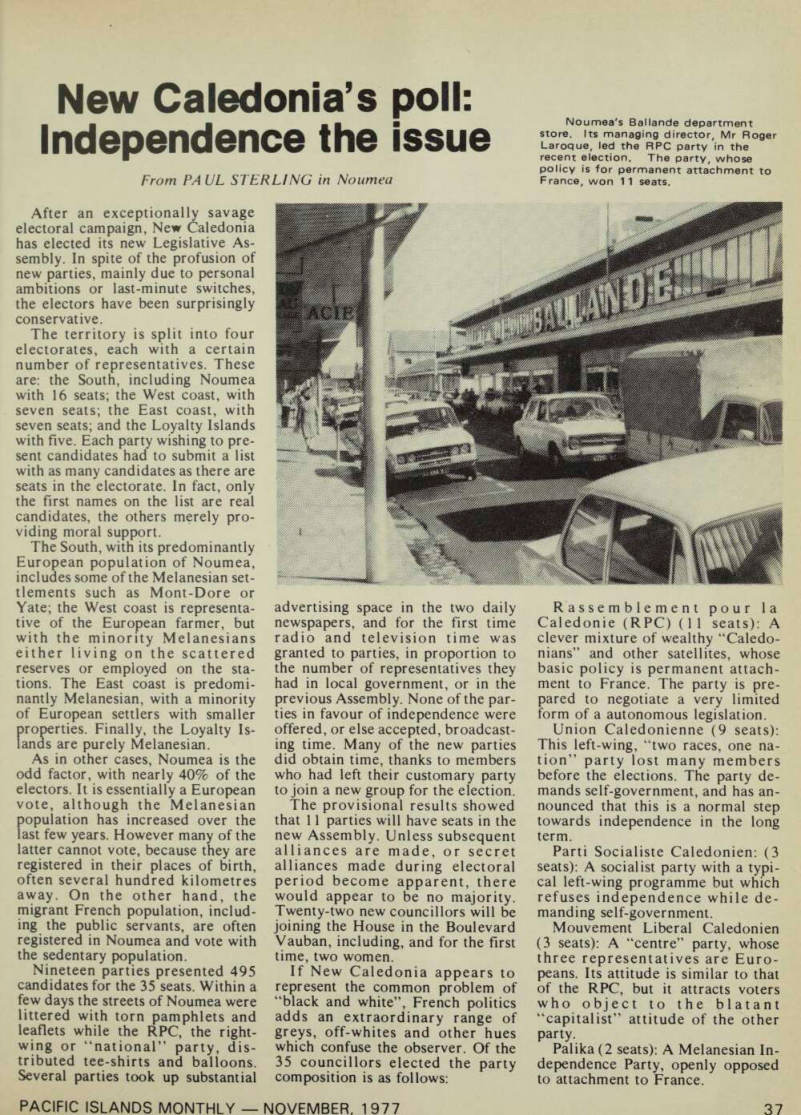
Noumea's Ballande department store. Its managing director, Mr Roger Laroque, led the RPC party in the recent election. The party, whose policy is for permanent attachment to France, won 11 seats.
Union Nouvelle Caledonienne (2 seats): A breakaway from Union Caledonienne, the major difference being their refusal to acknowledge that independence is inevitable in the long term.
Union Progressiste Melanesienne; (1 seat); Another breakaway from Union Caledonienne, which con siders that their are other problems more important than independence for the moment.
F.U.L.K.; (1 seat): A party whose attitude is similar to the Palika.
Union Pour le Renouveau Caledonien (1 seat); The right-wing “intelligensia”, a smattering of doc
tors, lawyers, company directors and college teachers, led by a woman, Dr Edwige Lagarde. This party is opposed to independence.
Union Democratique (1 seat); A breakaway from the RPC, but with an identical policy.
Emsemble Toutes Ethnics (1 seat); The only party in favour of creating a closer and more depen dent relationship with France.
As far as the important issue of in dependence is concerned, nearly a third of the electors voted for par ties who declared this as necessary or inevitable. Their representatives are the three Palika-FULK repre
sentatives and the nine Union Caledonienne councillors, just under a third of the Assembly. This was the first time that independence had ever appeared as an issue dur ing an election. On all other ques tions, it would seem that the Union Caledonienne could receive support from the UPM, UNC, and PSC, 18 seats out of 35. The local Socialist Party will be in a strong position to negotiate on giving its support to either group.