Editor’S Mailbag
pp. 33-35 · Read in the full issue
Facts On Norfolk Island
Norfolk Islanders will be grateful to you for the well-balanced report on the island community (PIM, August p 38) by Alan Gill.
On the other hand they will wonder why your other correspon dent, Francis Rolley, came to Nor folk, after reading his politically angled piece (Nimmo’s Norfolk; PIM, August p 14). Did he come with the preconceived idea of pre senting his fanciful description of ‘How the other half lives, and thinks’? Or did he, like so many other young New Zealanders, come here for a pleasant working holiday?
When he writes of Norfolk’s ‘unemployed’ it is those ‘itinerant workers’, like himself, that he refers to, because there is no unemploy ment among Norfolk Islanders.
Had he taken an unbiased view of the situation, he would have seen a very different picture from the one he paints. For instance; the dozens of Norfolk Island wives, working full or half-time for the business people he dislikes, adding their earnings to the comfortable incomes of their husbands, many of whom are administration employees enjoy ing a salary range at 90% of the Australian public service rate, and paying no income tax, beyond the Island’s own Public Works levy of $4O a year per family.
He could have learned of the difficulty of some employers, nota bly the builders, for instance, who frequently advertise in Australian and New Zealand papers for skilled labour, to build houses for Norfolk Islanders, because such labour is not available on the island.
Mr Rolley ignores the fact that the Immigration Ordinance, to which he slightingly refers (which admittedly is in need of amend ment), is designed to protect the Islanders’ way of life from being un derlined by an excessive influx of the ‘itinerant’ types he describes.
He shows his ignorance of the facts about Norfolk’s position vis-a vis Australia, and of the true feeling of Norfolk Islanders on the Nimmo recommendations, when he refers to
the ‘imposition of income tax at Australian rates so Norfolk Australians do not remain a pri vileged group subsidised by main land Australian taxpayers’. For. it is a fact that neither Norfolk Islanders in general, nor Australian members of the Norfolk community, are a ‘privileged group subsidised by the Australian taxpayer’. The meagre annual contribution the Australian Government makes to the cost of the island’s administration comes to no more than a third of the total cost, the balance of which is borne by the island’s own revenue.
It is also a fact that Australians make up only a small proportion of the island’s population, which in cludes almost the same number of New Zealanders, plus a variety of other nationals in addition to the ‘true Norfolk Islanders’ (those of ‘Pitcairn descent’) who make up at least a third of the total, and who represent the most ‘anti-Nimmo’ section of the community, and who challenge the right of the Australian Government to incorporate the is land into the Australian legal, taxa tion and social security system.
Norfolk Islanders know that the carrot of social service payments is the essential inducement of an ac ceptance of the imposition of in come tax which is the Australian bureaucracy’s real purpose, just as
they know that the ridiculous pro posal that the island should be in corporated in the electorate of Can berra (a thousand miles of ocean away) is the only way in which the principles of ‘no taxation without representation’ could be imple mented. Norfolk Islanders have lit tle knowledge and less interest in Australian politics, except those which are drastically likely to affect their own future.
Even Mr Rolley could do no more than damn this proposition with very faint praise.
Norfolk Island
Peter Middleton
Call To Pitcairners
I am writing, as President of the Society of Descendants of the Pit cairn Settlers, to see if you would kindly help us put out a call for peo ple of our race who may be willing to aid us in keeping our heritage alive. Accurate figures are not to hand but we believe that nearly one third of Pitcairn descendants, some 400 persons, live in Australia, some 200 persons live in New Zealand and many in the Pacific Islands.
Our objectives, in brief, are to promote knowledge of the condi tions under which the Pitcairn race agreed to abandon their island, in favour of Norfolk Island, in 1856; to foster the system of self-reliance that we have always had; to regain the self-government we lost in 1896; to work for Norfolk’s self-support and avoid expenses that the island cannot continue to carry; to co operate with the locally-elected council; to maintain the right of Pit cairners to come back to live on
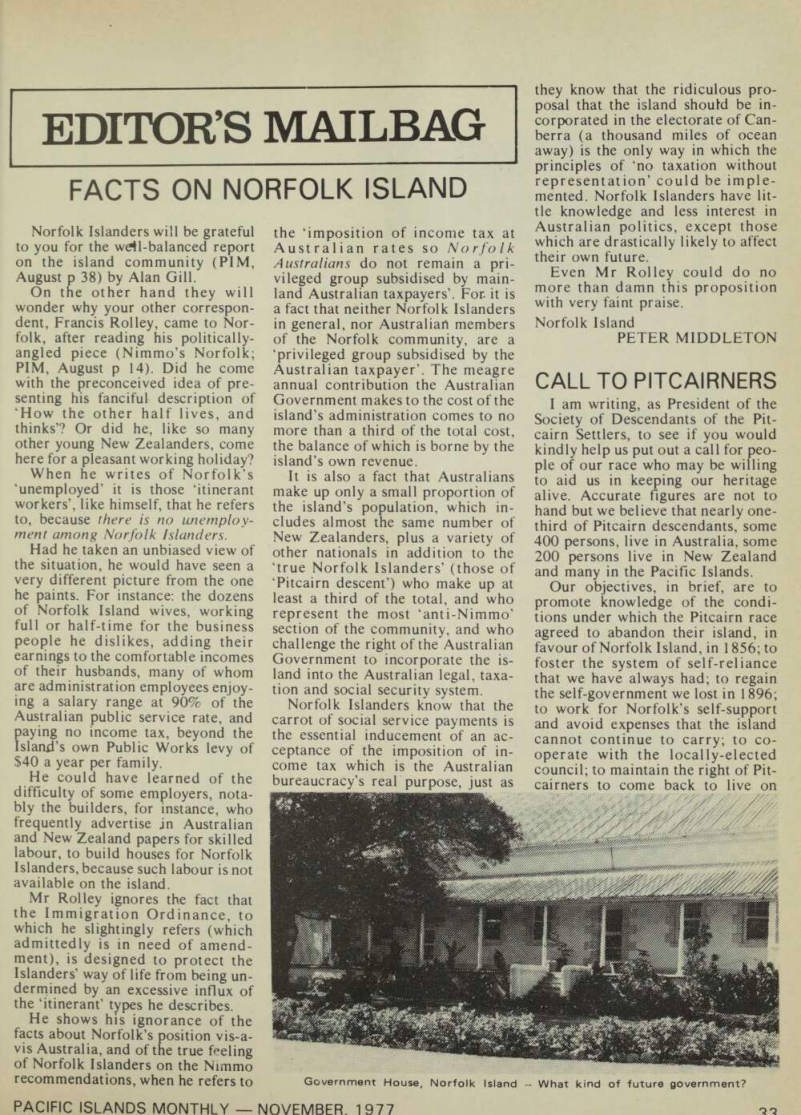
Government House, Norfolk Island What kind of future government?
Norfolk, unless their line has been away for two generations; and, perhaps most importantly, to restore a principle that we had on Pitcairn in the 1830 s that no govern mental officer should “assume any power or authority on his own responsibility or without the consent of the majority of the people”.
We are in no way opposed to Australia and hope our island will continue being a well-regarded ad junct to the Commonwealth but, like Australians, we want to have the say in forming a new kind of govern ment for ourselves. If Pitcairners amongst your readers wish to help us I would value hearing from them.
K. Nobbs
Norfolk Island (President)
Palauan Claim
Long forgotten German docu ments captured by Australian soldiers in World War I may be vital evidence in a multi-million dollar lawsuit being brought by a Palauan chief against the US and Trust Territory governments (PIM, August, p 25).
Chief Thomas Orrenges of the Ochedarechei clan claims that the people of Angaur have always own ed the island and that the Germans never bought it. Any “sale” of land by the Angaurese to the Germans, he says, was the result of duress and cannot be used to justify the present rent-free occupation of clan land by the US and TT governments.
Among the records of German New Guinea now in the Australian Archives are those of the “Island
ders might be removed from the is land altogether and resettled elsewhere in the Palau islands, and he added; “During the negotiations which I conducted for you over the sale of their land to the (colonial government) treasury, that is to say to the phosphate company, they were at first very resolute in their refusal, spurred on by the English man Sims. We succeeded in obtain ing their consent to surrender the land only after the deportation of Sims became known.”
The reports do not say who Sims was. But the implication is clear.
For as long as he stayed on Angaur, acting as the people’s adviser, the people did not want to part with their land. He had to be deported before they would sell. Left to face the Germans alone, the Angaurese may well have felt that they had no choice but to do what they were told.
Territory”, the name given by Ger many to her Pacific possessions north of the equator, the Carolines, the Marianas and the Marshalls.
Despatches from German colonial officials in Saipan, Ponape, Jaluit and other centres went to the Governor in Rabaul. They were found there by the Australians in 1914, and the story goes that many valuable German files ended up as toilet paper in Australian Army latrines.
But some files survived and were shipped back to Australia, including those concerning the phosphate-rich island of Angaur.
The existence of the “German deed” by which the Germans bought Angaur can no longer be disputed.
A copy of it, dated Saturday, November 20, 1909, lies today in Canberra in a bundle of papers filed under the heading, oddly enough, of “Native Taxation”.
The deed was signed by a German district officer and by eight Angaur chiefs; Ugerbalau, Ungerbunch, Gagelbai, Riguchel, Midechulsch, Gaithan, Thalowak and Guang. For 1200 marks or about £6O in the sterling of the day, the chiefs sold the entire island of Angaur “forever”, though they were granted a reservation of 150 hectares in the south-east of their homeland.
If this were all we knew, Chief Or renges’s case might seem shakier than before.
But another document in a different file supports his view that the sale of Angaur was forced upon the people.
Writing from Yap on August 14, 1909, the district officer Karlowa asked what was to happen to the Angaurese now that the phosphate company had commenced opera tions. He suggested that the islan-
Stewart Firth
West Pymble, NSW
Notonesia
In your May issue (p 31) your cor respondent suggested Notonesia as a name for Papua New Guinea. But there are Pacific Islands more southerly than PNG..
If it is still necessary to perpetuate Greek-derived names in this area (and I would say the need is now past) may I suggest a word that at one and the same time indicates that the inhabitants of the territory stand firmly in the present and suggest that all past difficulties, differences and misunderstandings are forgot ten Amnesia.
Or should we leave it to the peo ple of Papua New Guinea to decide for themselves.
Funafuti, Tuvalu D. MORTIMER
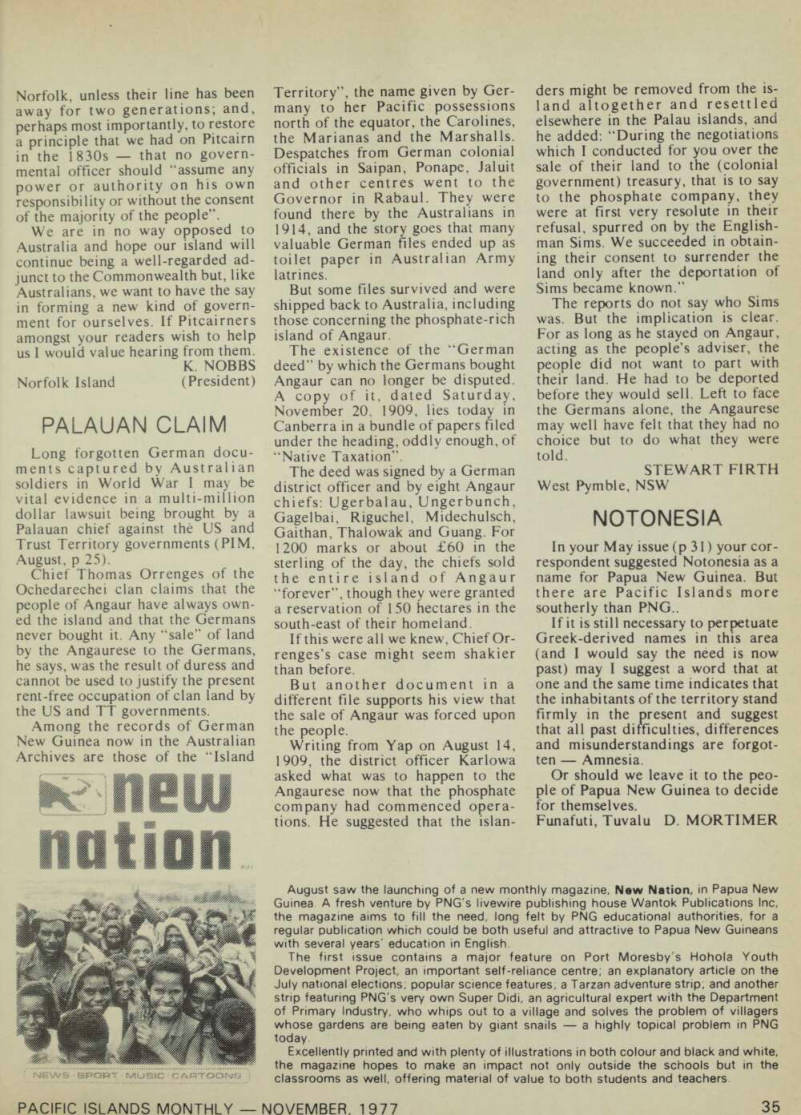
August saw the launching of a new monthly magazine, New Nation, in Papua New Guinea A fresh venture by PNG's livewire publishing house Wantok Publications Inc, the magazine aims to fill the need, long felt by PNG educational authorities, for a regular publication which could be both useful and attractive to Papua New Guineans with several years' education in English The first issue contains a major feature on Port Moresby's Hohola Youth Development Project, an important self-reliance centre; an explanatory article on the July national elections; popular science features, a Tarzan adventure strip, and another strip featuring PNG's very own Super Didi, an agricultural expert with the Department of Primary Industry, who whips out to a village and solves the problem of villagers whose gardens are being eaten by giant snails a highly topical problem in PNG today Excellently printed and with plenty of illustrations in both colour and black and white, the magazine hopes to make an impact not only outside the schools but in the classrooms as well, offering material of value to both students and teachers