The Marshalls: Untying a knot
pp. 25-26 · Read in the full issue
in the Micronesian tangle?
From SUSAN K. GRAFF on Majuro
For the first time since creation of the Congress of Micronesia in 1965, the senior member from the Marshall Islands, Senator Amata Kabua, missed a legislative session.
His absence from the special Con gress session at Ponape in August was one more event in an 18-month series resulting in reversal of the United States policy of unity in its troubled Micronesian trusteeship: the Marshalls in the East and Palau in the West are expected to separate from the four island groups of the Central Carolines.
Other highlights of the last year and a half have been a July 30 referendum in the Marshall Islands, with the people endorsing sepa ration by a margin of almost two to one, and two major United States/Micronesian conferences where the United States representa tives, although stating hopes for a unified Micronesia, admitted a willingness to deal separately with the Marshalls and Palau on the key issues of future relations with the United States military bases and financial aid.
Senator Kabua was not at Ponape because he was one of 48 delegates to the Marshall Islands Constitu tional Convention, which convened at Majuro on August 8. In the months ahead, these 48 delegates will struggle with the creation of a document and concepts of self government for implementation on termination of the trusteeship, scheduled for 1981.
The form of future government is uncertain, but it is interesting that the major constitutional adviser to the convention is Mrs Alison B.
Quentin-Baxter, a lawyer-scholar from New Zealand. She is assessing the difficulties of establishing a parliamentary form of government in a country without a parliamen tary tradition, and seems to be en joying the unusual situation.
Although the constitutional con vention is in its early days, with much debate and discussion ahead, one question about the future has been resolved the question of the Marshalls’ ties to the other five dis tricts of Micronesia. On July 30, the people of the Marshalls voted solidly, if not overwhelmingly, to seek a political status separate from the rest of the Trust Territory of the Pacific Islands (TTPI). The vote was about 63% in favour and 37% opposed to separation.
The separation advocates follow ed the lead of the Marshall Islands Political Status Commission (MIPSC), a powerful group of tradi tional and political leaders, led by Senator Kabua. The MIPSC was created in 1973, by act of the Marshalls’ district legislature (Niti jela) and since May, 1976, has ac tively sought US recognition of the concept of a political future for the Marshalls apart from Micronesia.
In June, 1976, a delegation from the MIPSC appeared before the Trusteeship Council of the United Nations, seeking that body’s support
for further fragmentation of the Micronesian trusteeship (the Mariana Islands by then had negoti ated a separate arrangement with the United States). The group cited an extensive list of grievances against the trustee and its ad ministering agencies and reiterated a long-standing Marshalls com plaint that Marshalls revenue was supporting Micronesia and a top heavy government administration without the Marshalls receiving a fair share of the money back for alleviation of their own substantial problems, many caused by the American presence.
The Trusteeship Council listened, but the Commission had a more responsive audience in the Ameri can press, which was intrigued by the idea of a US “colony” grumbling during the bicentennial celebration of the independence of the mother country. The press interest was con siderable (approximately 200 US newspapers covered the UN event) and was undoubtedly increased by the effective performance of a New York public relations firm, Richard Weiner Inc, retained by the commis sion to ensure its story would be told to the American people and to the American Congress.
Most of the described grievances related to the islands of Kwajalein Atoll, where the US Defence Department conducts a massive missile-testing programme. Kwa jalein Island is the central facility of the range, but a number of other is
lands are involved, either because they are part of the missile tracking system or because they are in the missile path, and human occupation of the islands cannot tee risked. The islands needed for the range have been leased by the US government, and their Marshallese inhabitants have moved elsewhere.
Although a number of Marshallese are employed by the missile range, and the taxes (3% on gross income) paid by American employees at the range are an im portant share of the money con tributed by the Marshalls to the TTPI government, the benefits do not offset the penalties.
The Marshallese workers at Kwa jalein are not allowed to live on or to use the shopping, educational, health or recreational facilities at Kwajalein Island. They, and their families, are crowded on Ebeye Is land, 5 km from Kwajalein 8 000 people on 23 ha of land. The result ing sanitation, health, delinquency and morale problems are serious and getting worse. The MIPSC and the Kwajalein Atoll landowners want equal treatment for Marshallese workers at Kwajalein they want access to facilities and pay scales and opportunities equivalent to those enjoyed by American employees at the range an ironic request from a US depen dency during the “human rights” era of the Jimmy Carter presidency.
A secondary, but equally impor tant, aspect of the “Kwajalein Prob lem” is the conviction of the Marshallese that the lease payments for their land are totally inadequate.
They want the lease agreements renegotiated by a Marshall Islands government, not a Micronesian government.
The American presidential elec tion, in November 1976, with the resulting change in administration, raised Commission hopes for a con current change in the attitude of the US government towards unity for Micronesia. Those hopes were realised during two series of meet ings (at Honolulu in May of this year and on Guam in July) among US government representatives and leaders from the six Trust Territory districts.
At Honolulu in May, the US for the first time officially recognised
both the MIPSC and the Palau Po litical Status Commission.
At Guam, tentative steps towards US recognition of the separation of the Marshalls and Palau ripened into reality. The US announced a proposal for two-tier negotiations in which multilateral negotiations among the US and all Micronesian districts will be directed to “those aspects of the relationship with the United States .. . common to all six districts”, and bilateral negotiations between the,US and a single district will add'resi “elements ... which are special or local, such as specific defence matters, and, in substantial part, provisions for US financial assistance”.
In the Marshalls, military means the US missile test facility at Kwa jalein, long a sore point between Marshallese people and the US Army which runs the base. At Guam, US representatives told Senator Kabua and other Marshalls representatives that the US is willing to renegotiate all US leases at Kwa jalein and to reconsider all aspects of US-Marshalls relations at Kwa jalein, such as the access to facilities described above. Thus, the long standing problems of Ebeye, in par ticular, may be heading toward solution.
US representatives have also agreed to consider Marshalls pro posals that another branch of the US military, such as the Navy or Air Force, replace the Army as operator of the Kwajalein Missile Range.
Heading the team of US negotia tors will be Peter Rosenblatt, a 44year-old Washington, DC, lawyer appointed by President Carter as his
personal representative for the talks.
Rosenblatt replaces Acting US Ambassador Philip Manhard.
Manhard, who took over the tough Micronesian assignment after ser vice as Ambassador to Mauritius, following five years in captivity in North Vietnam one of the few US diplomats captured during the Viet nam conflict had campaigned ac tively for the permanent Micro nesian assignment. His future role in the Micronesian status talks is unclear.
While the US prefers a post trusteeship relationship of “free as sociation” with Micronesia, there are strong supporters of outright in dependence in the Marshalls. As Senator Kabua stated in the Honolulu meeting; “Associated state status will tie us inexorably to this endless and troublesome quagmire [US prob lems with its varied dependencies with different and conflicting
needs], but independence, coupled
with mutually satisfactory treaty arrangements, could free the Marshalls and the United States from those uncertainties and ele ments of continuing discontent. As a separate nation state, we could tailor a relationship that meets our needs and the needs of the United States. In short, as an independent nation we may be able to enjoy a much closer and controversy-free relationship with the United States than we could possibly achieve as an associated state.”
The product of the constitutional convention will surely clarify the character of the future Marshalls- US relationship. And Marshalls leaders are eagerly anticipating the
upcoming US negotiations. The
work will be hard but now there is an assurance of bilateral talks, and the Marshallese alone will be negotiating the future of the Marshalls. • Japan Air Lines started its Japan- Saipan service in October, along with Continental Airlines. Both in augural flights were scheduled for October 1. • American Samoan fishermen, operating for the local trade, caught about 95 000 kg of fish in 1976, which grossed them about SUSIIS 077. There were 21 locally owned and built fishing dories in ac tion.
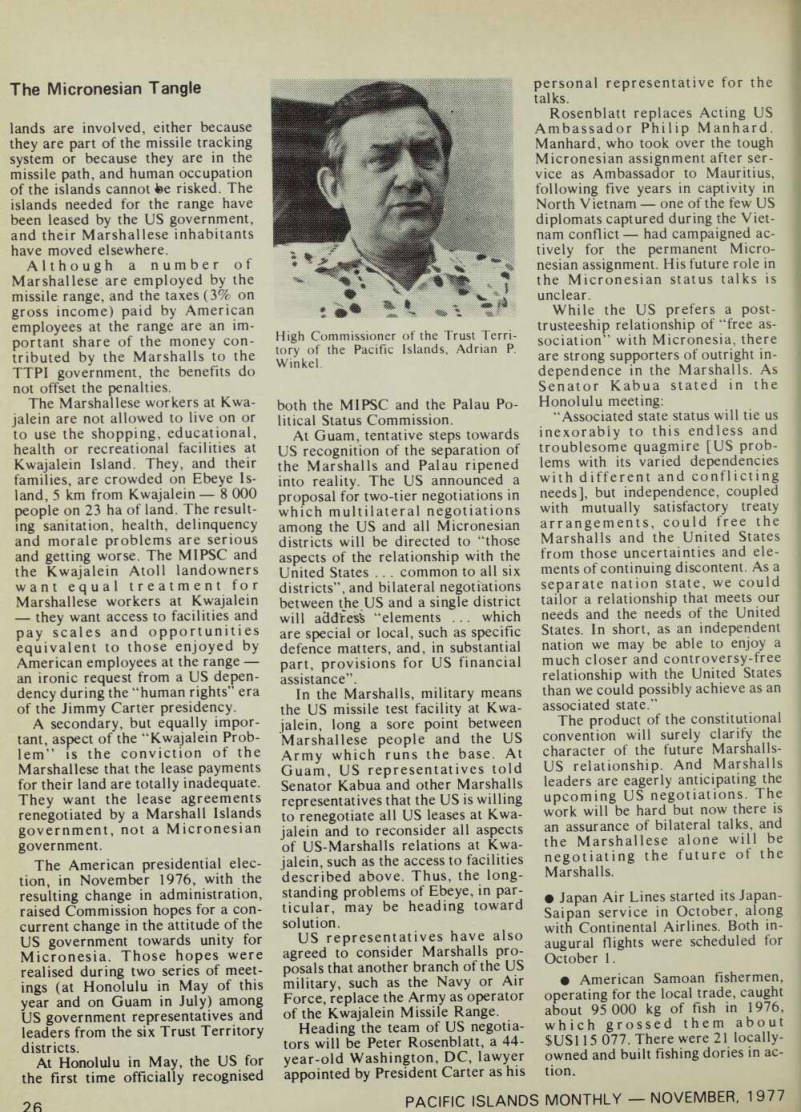
High Commissioner of the Trust Terri tory of the Pacific Islands, Adrian P.
Winkel.