than Caledonians
p. 20 · Read in the full issue
Polynesians win more than Caledonians
From a NOUMEA correspondent
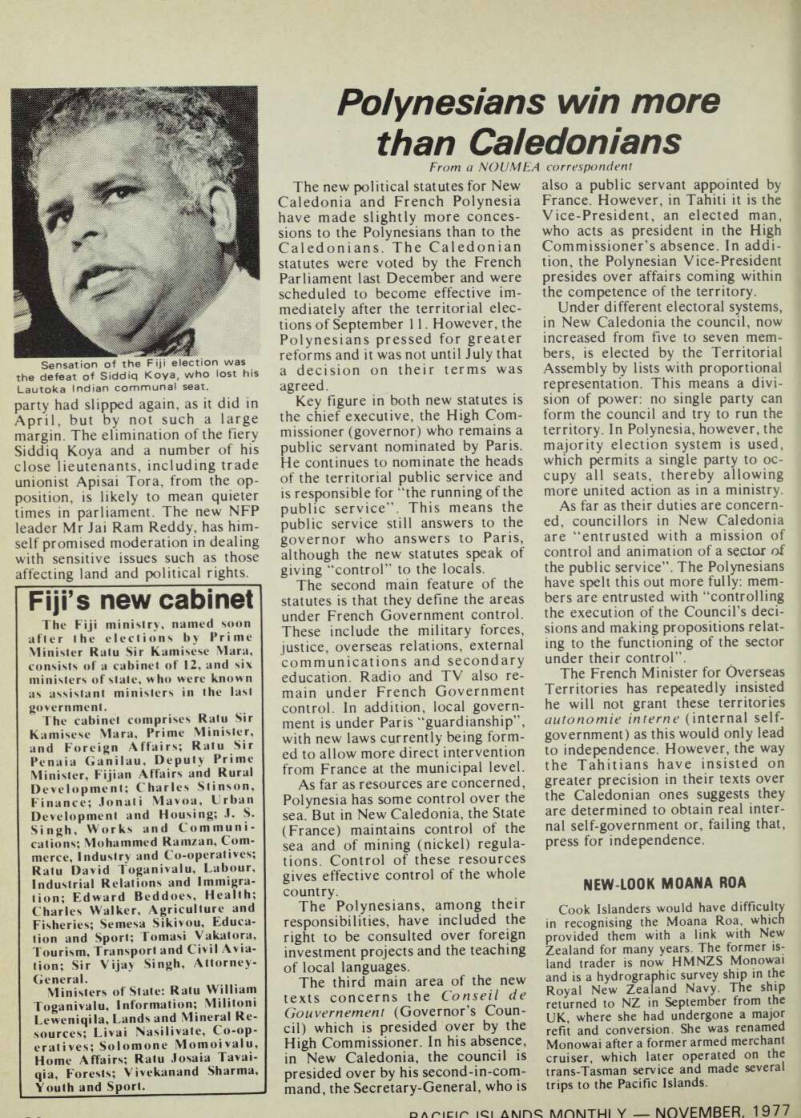
party had slipped again, as it did in April, but by not such a large margin. The elimination of the fiery Siddiq Koya and a number of his close lieutenants, including trade unionist Apisai Tora, from the op position, is likely to mean quieter times in parliament. The new NFP leader Mr Jai Ram Reddy, has him self promised moderation in dealing with sensitive issues such as those affecting land and political rights.
The new political statutes for New Caledonia and French Polynesia have made slightly more conces sions to the Polynesians than to the Caledonians. The Caledonian statutes were voted by the French Parliament last December and were scheduled to become effective im mediately after the territorial elec tions of September 11. However, the
Polynesians pressed for greater
reforms and it was not until July that a decision on their terms was agreed.
Key figure in both new statutes is the chief executive, the High Com missioner (governor) who remains a public servant nominated by Paris.
He continues to nominate the heads of the territorial public service and is responsible for “the running of the public service”. This means the public service still answers to the governor who answers to Paris, although the new statutes speak of giving “control” to the locals.
The second main feature of the statutes is that they define the areas under French Government control.
These include the military forces, justice, overseas relations, external communications and secondary education. Radio and TV also re main under French Government control. In addition, local govern ment is under Paris “guardianship”, with new laws currently being form ed to allow more direct intervention from France at the municipal level.
As far as resources are concerned, Polynesia has some control over the sea. But in New Caledonia, the State (France) maintains control of the sea and of mining (nickel) regula tions. Control of these resources gives effective control of the whole country.
The Polynesians, among their responsibilities, have included the right to be consulted over foreign investment projects and the teaching of local languages.
The third main area of the new texts concerns the Conseil de Gouvernement (Governor’s Coun cil) which is presided over by the High Commissioner. In his absence, in New Caledonia, the council is presided over by his second-in-com mand, the Secretary-General, who is
also a public servant appointed by France. However, in Tahiti it is the Vice-President, an elected man, who acts as president in the High Commissioner’s absence. In addi tion, the Polynesian Vice-President presides over affairs coming within the competence of the territory.
Under different electoral systems, in New Caledonia the council, now increased from five to seven mem bers, is elected by the Territorial Assembly by lists with proportional representation. This means a divi sion of power; no single party can form the council and try to run the territory. In Polynesia, however, the majority election system is used, which permits a single party to oc cupy all seats, thereby allowing more united action as in a ministry.
As far as their duties are concern ed, councillors in New Caledonia are “entrusted with a mission of control and animation of a sector of the public service’’. The Polynesians have spelt this out more fully: mem bers are entrusted with “controlling the execution of the Council’s deci sions and making propositions relat ing to the functioning of the sector under their control”.
The French Minister for Overseas Territories has repeatedly insisted he will not grant these territories autonomie interne (internal self government) as this would only lead to independence. However, the way the Tahitians have insisted on greater precision in their texts over the Caledonian ones suggests they are determined to obtain real inter nal self-government or, failing that, press for independence.
New-Look Moana Roa
Cook Islanders would have difficulty in recognising the Moana Roa, which provided them with a link with New Zealand for many years. The former is land trader is now HMNZS Monowai and is a hydrographic survey ship in the Royal New Zealand Navy. The ship returned to NZ in September from the UK, where she had undergone a major refit and conversion. She was renamed Monowai after a former armed merchant cruiser, which later operated on the trans-Tasman service and made several trips to the Pacific Islands.
Sensation of the Fiji election was the defeat of Siddiq Koya, who lost his Lautoka Indian communal seat.