Jaya copper project
pp. 14-15 · Read in the full issue
Guerrillas strike at giant Irian Jaya copper project
With the rebellion led by mem bers of the Organised Papua Mer deka (OPM) still in full swing in the highlands of Irian Jaya, the little heard-of liberation movement ap pears to have successfully stepped up its guerrilla activities with a series of attacks on Freeport In donesia’s copper mining installa tions in the southwest of the former Dutch colony.
The OPM guerrillas are spearheading an Irianese na tionalistic struggle whose ultimate goal is the removal of Indonesian suzerainty over the West New Guinea territory which was ceded to Indonesia in 1962 after a series of naval, military and diplomatic en counters.
The guerrillas are held responsi ble for the recent destruction of an Indonesian military forces' DC3 and the holing in August of an Australian Army Pilatus Porter engaged in mapping operations near the highland capital of Wamena.
Since July 23 when a concerted guerrilla raid caused damage esti mated at SUSI million to Freeport’s giant Mt Ertsberg copper project the rebels have continued sporadic at tacks on the SUSISO million mine which began exporting in early 1973.
In the initial attack during the pre-dawn hours of July 23 the guer rillas used explosives, believed stolen from the mine, to cut the 4 in. (10 cm) pipeline carrying copper concentrate 104 km to the coastal port of Amamapare and to demolish a fuel dump and pumping installa tions. The fuel pipeline, which runs parallel with the concentrate line for 28 km from the mine to the dump on the coastal lowlands, was severed simultaneously.
After the July 23 raid copper con centrate exports valued at $7.7 million a month have had difficulty reaching Amamapare because of continued sabotage of the pipeline.
Exports have had to be made up from the concentrate stockpiled at Amamapare.
The devastation caused by the raids and the ease with which the
This report has been written for PIM by DENIS REINHARDT, who recently . .. . , • „ i’ „ visited Irian Jaya as cor res-
pondenl for the Sydney-based
weekly, Nation Review.
OPM has continued to cut the mine's vital export link represents a major upsurge in the OPM's military activity.
There were suggestions, soon after the first raid, based on signs daubed on bridges and buildings, that the raids were led by one of the OPM’s insurgent commanders, Seth Rumkorem, who defected from the Indonesian army in the early 70s.
Rumkorem was previously thought to be holed up at Wutong 15 km inside the northern Papua New Guinea/Irian Jaya border and less than 50 km from Jayapura, the capital of Irian Jaya.
Following disclosures in Port Moresby that the Commander-in- Chief of the PNG Defence Force, Brigadier-General Ted Diro had
held secret talks with Rumkorem in early September it appears most unlikely that Rumkorem took part in the sabotage of the mine, which is four weeks’ walk overland from (he pNG border Air an( j te j ex jinks between the Freeport mine, which is 80% Amer ican-owned, remained open with the outside world in the aftermath of the raids although plane movements into Freeport’s airfield at Timika were restricted for the week follow ing July 23. Planes landing at Timika kept their engines running and disembarked passengers im mediately on landing. Troops spac ed at 100-metre intervals guarded the runway.
Though Freeport's operating sub sidiary, Freeport Indonesia, has its head office in Jakarta, it is through Cairns in north Queensland that most of the mine’s important air and communications traffic passes.
At the time of the OPM raid, mine manager Bob Weaver is understood to have been holidaying in Cairns.
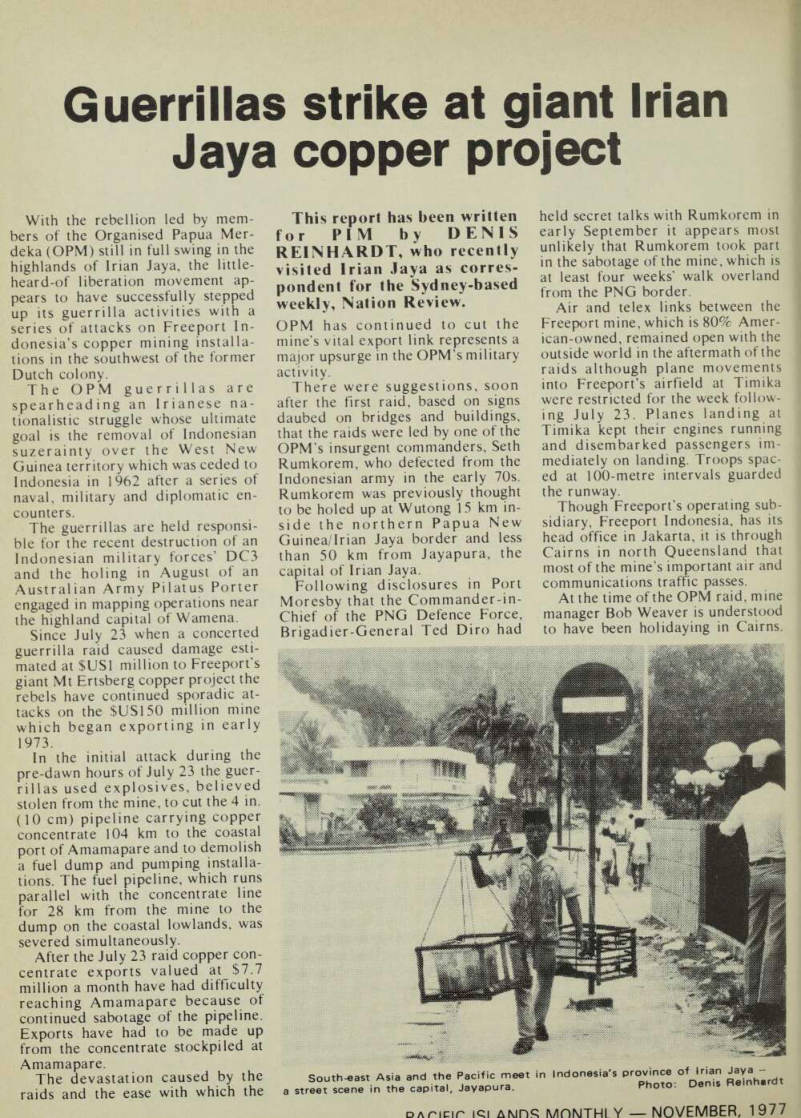
South-east Asia and the Pacific meet in Indonesia's province of Irian Jaya a street scene in the capital, Jayapura. Photo. Denis Reinhardt
In a daring return a day after the raid. Weaver was flown to Timika, landing just after dawn and jumped from the taxing plane into a waiting helicopter. Despite the precautions the guerrillas made no attempt to at tack Freeport’s large aircraft-fuell ing facilities at Timika.
When Freeport's head office flew out senior vice-president Milton Ward and another vice-president from the United States for a week long visit to assess damage, they also came via Cairns. Freeport maintains a large establishment in Cairns with a town office, and a base for a Fok ker Friendship and two crews. The *F27 normally flies twice weekly into the mining enclave.
Air connections within Indonesia are primarily via Ujang Pandang in Sulawesi from where fresh vegeta bles are flown in weekly. Indonesian workers recruited from other parts of the archipelago make up most of the non-European work force.
Before the OPM raids there were an estimated 250 Irianese in a work force exceeding 2 000.
Before the mine sabotage there was increased Indonesian military activity in the area. In the fortnight before July 23 two Indonesian air force Broncos, twin-engined mili tary aircraft equipped with Gatling guns, had been operating from Timika, reportedly against Irianese dissidents 75 km east in Akimuga village, where two provincial police officers had been forcibly evicted by tribesmen.
Indonesian troop-carrying aircraft attempting to land at Akimuga’s grass strip were pre vented from doing so by ditches and stakes driven into the runway a common sign of OPM-organised disaffection in the highlands where at last report 11 airfields were clos ed.
Early in May the Broncos drop ped anti-personnel”daisy cutter” bombs (which scatter shrapnel at body height) near the dissident village of Iluga on the other side of the mountain chain from Tem bagapura.
The Broncos Fairchild OBIO's of the type used in Vietnam, are now reported to have returned to Wamena where other OPM-inspired guerilla activity is troubling In donesian administrators. There, much of the discontent which origi nally came to a head during the In donesian elections in May is now
focussed on the disappearance of clothing, and medical and monetary aid for victims of the recent earthquakes in the Baliem valley. A sum of 43 million rupiahs has allegedly been misappropriated.
Irianese in the mine region appear to have been aware of the impending guerrilla raid and its likely consequences. In the week before July 23, most of the Irianese mineworkers and their families who lived in the shanty town outside the mine township at Tembagapura left the area.
Stocks of salt had to be flown in to replenish local stores when Irianese
bought out supplies before taking to the rugged mountain and coastal swamp country.
Three Irianese villages associated with the mine, the shanty town at Tembagapura, the encampments at Wa 5 km away and at Timika are re ported to have been levelled by In donesian troops in the days follow ing the sabotage.
However, more recent reports say that Irianese are gradually drifting back to the mine and that a new shanty town at Tembagapura is tak ing shape. • See PIIM Magazine, p 44.