independence gets “all clear”
pp. 12-13 · Read in the full issue
Still confusion as Solomons independence gets “all clear”
From GEORGE ATKIN in Honiara
The Solomons has become the first country administered by Bri tain to be given a large amount of money without having to repay it. A British protectorate for nearly 100 years, the independent Solomons will be given the money on indepen dence in grant forms.
The nation’s delegation at the September conference in London which discussed the independence constitution with the British Government won an agreement for a further s3m to be added to the orig inal s4om settlement.
This original lump sum was to be given in loans.
The conference, which lasted longer than expected, agreed that the Solomons will become indepen dent next July. An exact date has yet to be fixed, although it has been in dicated in reports from London that it will be sometime around the mid dle of the month.
Solomons independence will thus come about 11 months late in terms of the original plan, although there
has been no sign of disappointment in the country.
Even the independence con ference was about three months late when it finally got off the ground.
The conference was a success for the Solomons people although there were changes in the package of ideas the delegation carried to London.
There were severe difficulties, particularly over the citizenship clause in relation to non-indigenous Solomon Islanders.
The outcome after much heated argument is thought of as fair here, because this group of people, who include more than 2 500 settlers from the Gilbert Islands, will now be granted automatic citizenship on application. The period to apply has also been changed from one year to two.
The new emphasis on citizenship has ironed out worries felt by Gilbertese, Chinese and European expatriates. The clause as it stood before the delegation left for Lon don had it that they would be tre
ated as non-Solomon Islanders after independence, although most of them have been here for more than 20 years to qualify them to be given citizenship.
Another major change in the package is that the Solomons will re tain its links with monarchy and will become a member of the Common wealth.
This means that the conference rejected a proposal initiated by the Leader of the Opposition, Bartholomew Ulufa’alu, and ap proved by the Solomons Legislative Assembly earlier this year, for the country to become a republic a year after independence.
Although the announcement about independence is still very new here, there are already mixed feel ings about it. But at least the people are happy that their country won’t now become a republic.
Villagers, who make up 90% of the Solomons’ 196 000 population, have expressed their concern openly to the government about the idea of
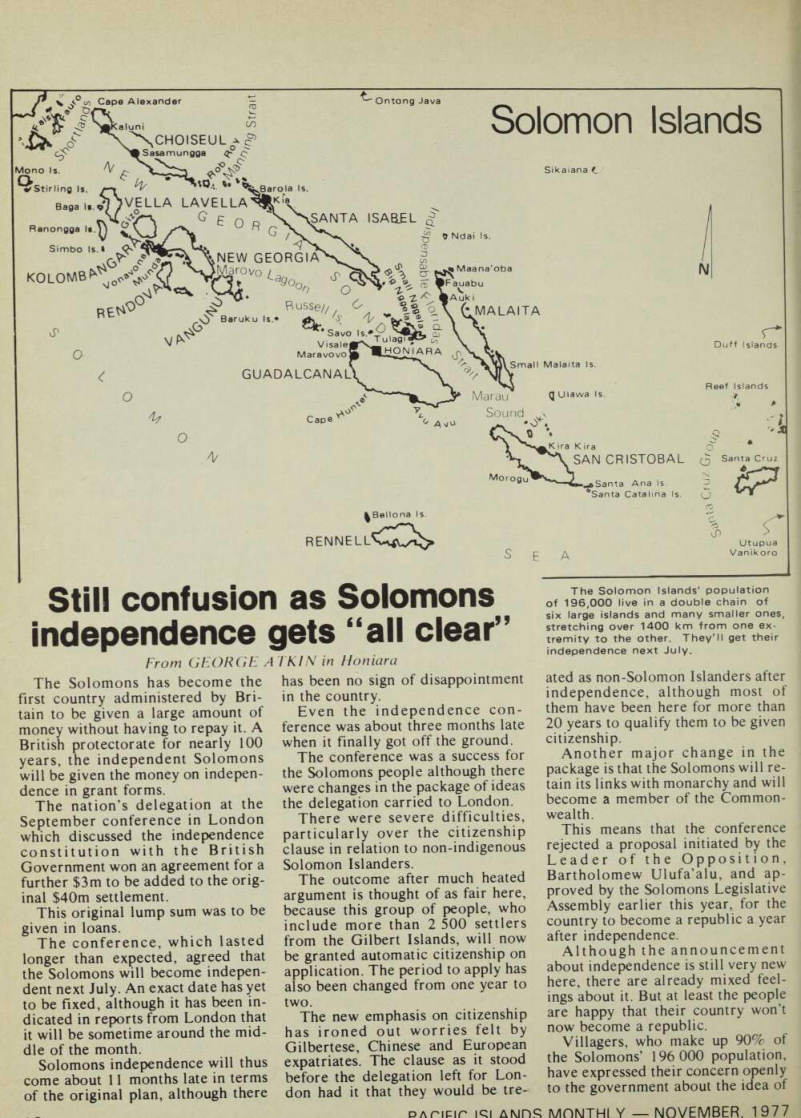
The Solomon Islands' population of 196,000 live in a double chain of six large islands and many smaller ones, stretching over 1400 km from one ex tremity to the other. They'll get their independence next July.
having a republic in the Solomons.
They pointed out that to in troduce a new system of government would just confuse them. “We don’t want a republican system because we just don’t understand or know anything about it,” they have been
reportedly saying.
In London, the chairman of the conference, Lord Goronwy- Roberts, was pleased with the agree ment reached. He said on the clos ing day that the agreement reached is excellent, constructive and hopeful. There had been severe difficulties but these had succumbed to “the wisdom of the Solomons”, he said.
Peter Kenilorea, the Solomons’
Chief Minister, said; “We are mov ing towards the threshold of a new era in relations between the two countries.”
But what does independence mean to many Solomon Islanders?
This is a very interesting question because not many understand what it means. Some think that it means the time when Europeans will leave the country.
The Solomons Government has not carried out enough political education. This has now resulted in the vast population being largely ignorant about the political changes that are under way in the country.
Cholera Deaths In Gilberts
The death toll from the cholera out break in the Gilbert Islands reached 17 by September 19, plus another 352 cases admitted to hospital. However, it was considered that the epidemic had peaked by then and that it was on the wane. The outbreak was confined to the islands of Abemama and Abaiyango.
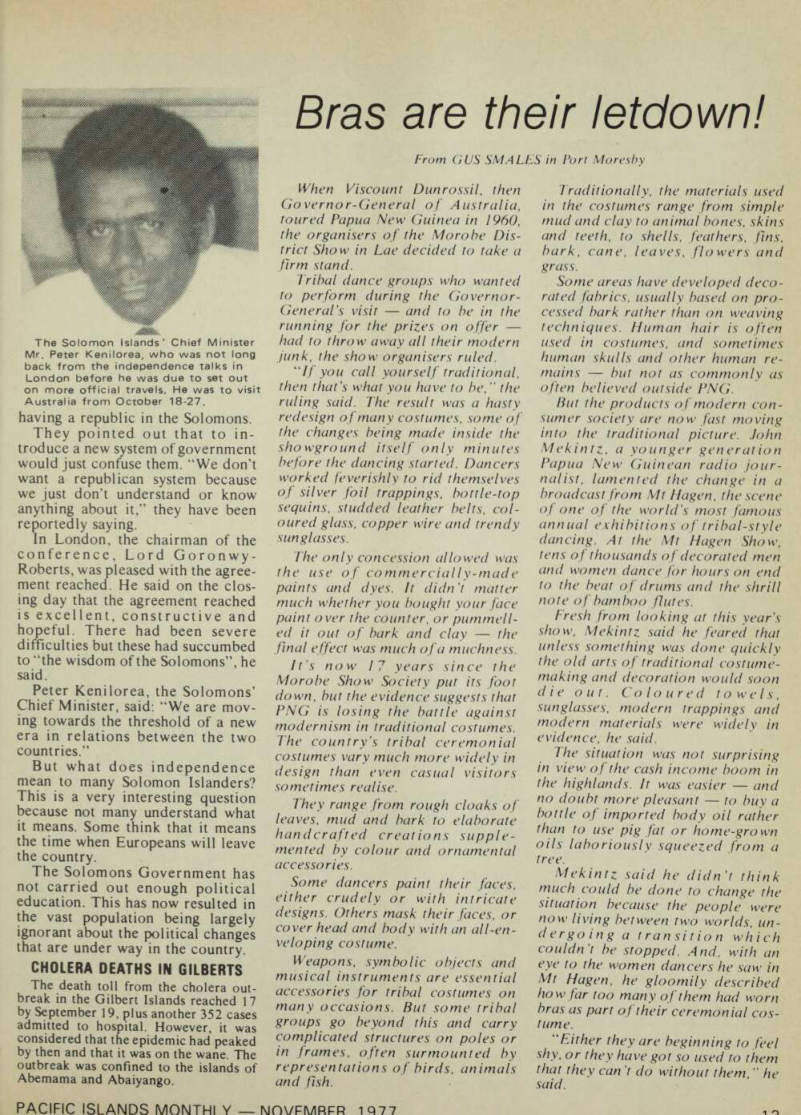
The Solomon Islands' Chief Minister Mr. Peter Kenilorea, who was not long back from the independence talks in London before he was due to set out on more official travels. He was to visit Australia from October 18-27.