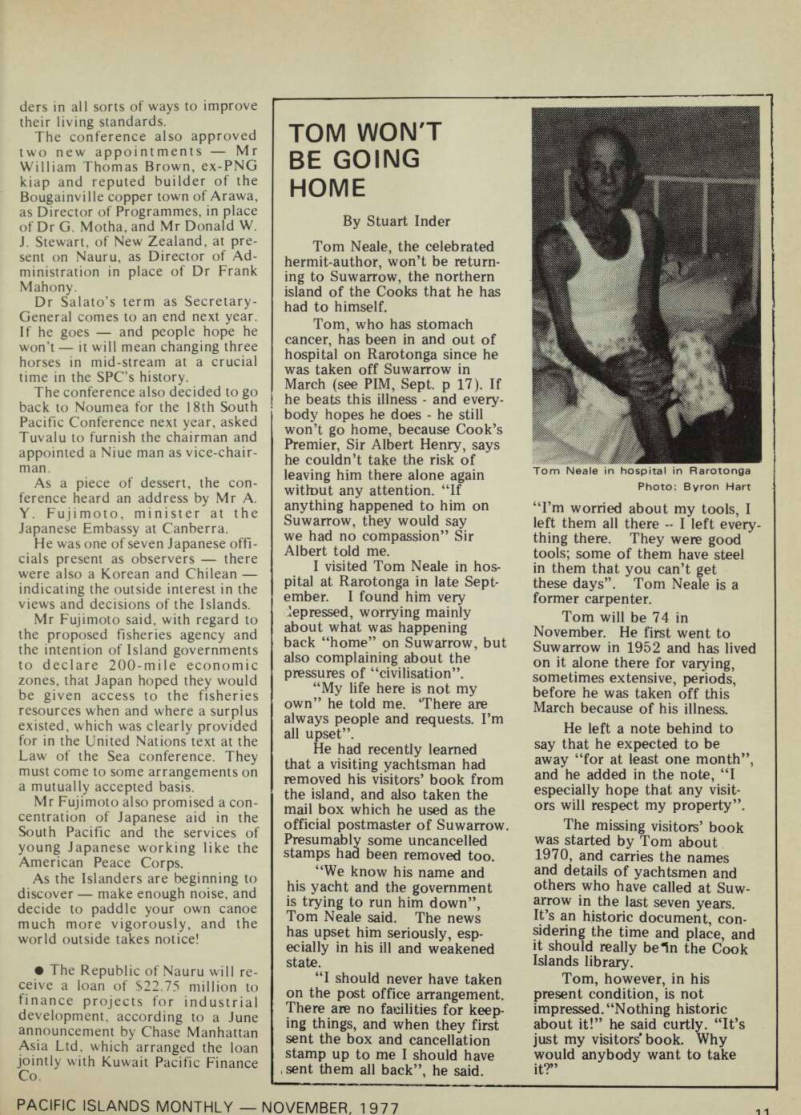
It's Niggling Or
pp. 10-11 · Read in the full issue
Nuptlals
(continued from previous page). wouldn’t get in the way if it were
constitutionally possible.
France's Mr Pierre Revol said their constitution would not allow, at the moment, territories to sign an international convention.
That was the view of all the
metropolitan powers.
Once again, however, PNG’s Mr Olewale was brutally frank.
“We are no longer in the 40s and 50s when the SPC was regarded as a rich man’s club, in which important decisions are made by a small group of people.” he said. “We can't afford to let this go on.”
He added that there was a consen sus among Pacific countries that the Canberra Agreement should be looked at again.
Australia’s Mr J. McLeay, Minis ter for Construction, described it as the most important issue the con ference had ever faced. It would probably affect the future of the Conference, he said.
Everyone agreed, and the next few months should see the metropolitans getting together on this.
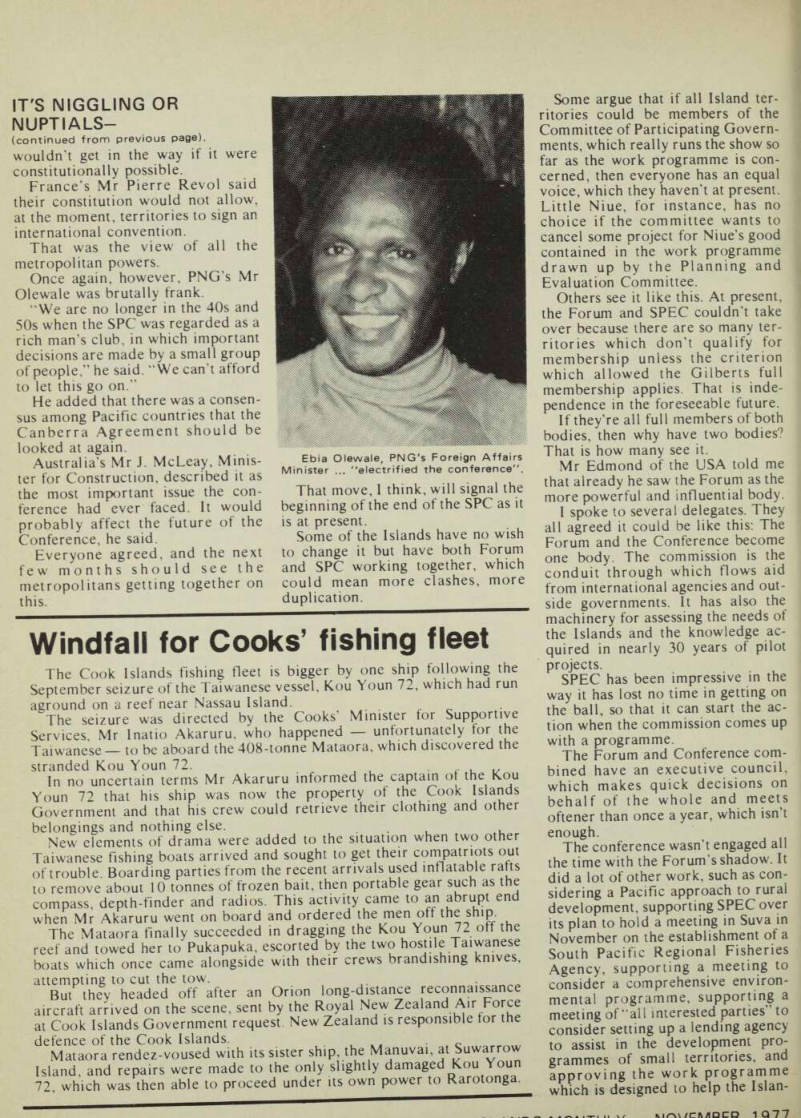
Ebia Olewale, PNG's Foreign Affairs Minister ... "electrified the conference".
That move, I think, will signal the beginning of the end of the SPC as it is at present.
Some of the Islands have no wish to change it but have both Forum and SPC working together, which could mean more clashes, more
duplication.
Some argue that if all Island ter ritories could be members of the Committee of Participating Govern ments, which really runs the show so far as the work programme is con cerned, then everyone has an equal voice, which they haven’t at present.
Little Niue, for instance, has no choice if the committee wants to cancel some project for Niue’s good contained in the work programme drawn up by the Planning and Evaluation Committee.
Others see it like this. At present, the Forum and SPEC couldn’t take over because there are so many ter ritories which don’t qualify for membership unless the criterion which allowed the Gilberts full membership applies. That is inde pendence in the foreseeable future.
If they’re all full members of both bodies, then why have two bodies?
That is how many see it.
Mr Edmond of the USA told me that already he saw the Forum as the more powerful and influential body.
I spoke to several delegates. They all agreed it could be like this; The Forum and the Conference become one body. The commission is the conduit through which flows aid from international agencies and out side governments. It has also the machinery for assessing the needs of the Islands and the knowledge ac quired in nearly 30 years of pilot
projects.
SPEC has been impressive in the way it has lost no time in getting on the ball, so that it can start the ac tion when the commission comes up with a programme.
The Forum and Conference com bined have an executive council, which makes quick decisions on behalf of the whole and meets oftener than once a year, which isn’t enough.
The conference wasn t engaged all the time with the Forum’s shadow. It did a lot of other work, such as con sidering a Pacific approach to rural development, supporting SPEC over its plan to hold a meeting in Suva in November on the establishment of a South Pacific Regional Fisheries Agency, supporting a meeting to consider a comprehensive environ mental programme, supporting a meeting of “all interested parties to consider setting up a lending agency to assist in the development pro grammes of small territories, and approving the work programme which is designed to help the Islan
ders in all sorts of ways to improve their living standards.
The conference also approved two new appointments Mr William Thomas Brown, ex-PNG kiap and reputed builder of the Bougainville copper town of Arawa, as Director of Programmes, in place of Dr G. Motha, and Mr Donald W.
J. Stewart, of New Zealand, at pre sent on Nauru, as Director of Ad ministration in place of Dr Frank Mahony.
Dr Salato’s term as Secretary- General comes to an end next year.
If he goes and people hope he won’t it will mean changing three horses in mid-stream at a crucial time in the SPC’s history.
The conference also decided to go back to Noumea for the 18th South Pacific Conference next year, asked Tuvalu to furnish the chairman and appointed a Niue man as vice-chair man.
As a piece of dessert, the con ference heard an address by Mr A.
Y. Fujimoto, minister at the Japanese Embassy at Canberra.
He was one of seven Japanese offi cials present as observers there were also a Korean and Chilean indicating the outside interest in the views and decisions of the Islands.
Mr Fujimoto said, with regard to the proposed fisheries agency and the intention of Island governments to declare 200-mile economic zones, that Japan hoped they would be given access to the fisheries resources when and where a surplus existed, which was clearly provided for in the United Nations text at the Law of the Sea conference. They must come to some arrangements on a mutually accepted basis.
Mr Fujimoto also promised a con centration of Japanese aid in the South Pacific and the services of young Japanese working like the American Peace Corps.
As the Islanders are beginning to discover make enough noise, and decide to paddle your own canoe much more vigorously, and the world outside takes notice! • The Republic of Nauru will re ceive a loan of $22.75 million to finance projects for industrial development, according to a June announcement by Chase Manhattan Asia Ltd. which arranged the loan jointly with Kuwait Pacific Finance Co.