Magazine
pp. 42-47 · Read in the full issue

Gold was the Brig ‘Maria’s’ goal but her crew found only death
Many people consider the New Guinea prospecting expedition of 1872 an ill-planned, hair-brained scheme, but it spelled adventure for young Lawrence Hargrave, who later became a celebrated inventor and aviation experimenter. He was one of a group who set sail from Sydney in the brig Maria, but the Maria never reached New Guinea. It foundered off the Queensland coast with great loss of life. The story is told by John Goode in The Rape of the Fly, an account of early explorations in Papua, which is to be released by Thomas Nelson Ltd in October. The following account of the ill-fated voyage of the Maria is taken from the book.
By the lime he was 20, Lawrence Hargrave was bored with work in a Sydney drawing office. As a distrac tion, he had begun to invent things and much has been made of his first design a pair of shoes for walking on water. Really, they were a form of toy (enclosed water skis) which demonstrated that he understood the Archimedes principle and had a somewhat adolescent sense of humour.
A friend,. Merrewether Busby, used to visit his workshop in what is now Potts Point and recalled: “Often at night, armed with a hur ricane lantern and wearing these floats, he played harmless but rather startling tricks near Rushcutters Bay on Sydney Harbour. He would ‘walk’ out on to the water and ap pearing from ‘nowhere’ would sud denly wave his lantern over a boat’s side, frightening the occupants".
Next year, he designed but did not build a one-wheeled velocipede.
However, this inventiveness was only a means of procrastination un til he discovered what he had been seeking since his voyage round Australia an opportunity to ex plore unknown places.
In 1871, a possible solution emerged with the announcement of the New Guinea Prospecting Ex pedition. Many considered it an ill planned, hair-brained scheme, but Lawrence Hargrave was blind to the project’s deficiencies, like many bored young men seeking some ex citement as a change from their monotonous lives.
The scheme was announced in the Sydney Morning Herald on Decem ber 2, 1871. A co-operative had been formed and was calling for volunteers to subscribe £lO each.
For this, they would be taken to New Guinea by ship where, the prospectus boasted, There exist rich deposits of alluvial gold'.
The plan for the expedition had evolved from a lecture given to the Royal Society of New South Wales by the Rev John Dunmore Lang. His ponderously-entitled text, ‘New Guinea a highly promising field for settlement and colonisation, and how such an object might be most easily and successfully effected’ was highly selective in the evidence pre sented. This was not surprising for Lang, a man obsessed with the con cept of immigration, was one of the most unscrupulous and controver sial politico-clergymen in the colo ny of New South Wales.
In his lecture, Dr Lang had sketched the known history of New Guinea and quoted John MacGillivray, naturalist on Captain Owen Stanley’s ship, HMS Rat tlesnake, ‘That gold exists in the western and northern portions of New Guinea has long been known.
Specimens of pottery procured (dur ing a very brief visit ashore) contain a few laminated grains of this pre cious metal’.
From Lang’s hypothesis, the New
Guinea Prospecting Co-operative
had continued where the clergyman had cautiously paused. One vital sentence in the prospectus read ‘lt
having been satisfactorily proved that in the vicinity of Redscar Bay, and along the south-eastern coast of New Guinea, there exist very rich deposits of alluvial gold Today, we know that the source of pottery collected by MacGillivray was not necessarily Redscar Bay; that up to 1871, no one had ever taken a gold pan ashore anywhere in the east of New Guinea; that the first gold to be discovered was at Laloki, 16 km inland from Port Moresby in 1878.
After the news item appeared, the organisers were besieged by appli cants. Many were men with mining experience on the goldfields of Australia and California. The Maria, an old collier plying between Newcastle and Sydney, was bought on terms for a down-payment of £SOO. The ship was leaky, its quar ters narrow and badly ventilated, and it was infested with cockroaches.
Although Lawrence, now 21, was inexperienced in any form of seamanship, he was accepted as a volunteer and appointed a member of the working committee. His diary shows that he was an enthusiastic worker when asked to help with the preparation and loading of supplies.
Meanwhile, the organising com mittee had received an official letter stating that under the Navigation Act, there were insufficient lifeboats for the number of passengers aboard the Maria. But the wily organisers buoyed the hopes of their subscri bers by revealing that under the act,
lifeboat provisions applied only to passengers, not the crew. It was sug gested that anyone who . wished to remain with the expedition should enrol as a crew member. Lawrence Hargrave agreed and was called ‘a sailmaker’; every other man was assigned to a nominal position.
Then the captain resigned without stating any valid reasons, and the Chief Officer, Thomas Stratman, volunteered to replace him.
Although several outspoken subscri bers questioned his qualifications to navigate the vessel more than 2 000 miles through some of the most treacherous reefs in the world, this minority was over-ruled by others whose sole concern was the ac celeration of their departure.
Finally, Dr Lang toured the ship, nodding his approval at the ‘crew’ men from England, Ireland, Scotland, Germany, France and Sweden. He beamed when he learnt that all spoke English and noted that there were ‘l6 to 20 gentlemen by birth and education very respon sibly connected in New South Wales’.
The clergyman seemed oblivious to the shortcomings of this half resurrected, unseaworthy hulk. He addressed the men on the endless opportunities that New Guinea offered, and even added that had he been younger, he would have been
their leader. After wishing them good luck, he returned to the safety of dry land.
In Sydney, Karl Thorngren, a well-known trader in Torres Strait, predicted that the expedition ‘Could not have chosen a more inopportune time for its first trip . . . There’s a prevalence of fever off the coast and the white population traders, pearl fishers and the like will all have left (Torres Strait) before the Maria can arrive. They’ll be on their own’, he added. He could also have mentioned that between January and April, the ship would face the adverse north-west monsoon, and it was the cyclone season. Unless the Maria had a superfluity of good for tune, the voyage would be long and violent storms were inevitable.
Lawrence Hargrave was on deck when the brig sailed late on January 25, 1872. At 7 pm, watchers on the South Head heard the faint sound of the crew giving three cheers for the customs officers.
In the minds of the people of Sydney, the question which remain ed unanswered was whether the organisers were rogues or fools? The men who conceived the scheme, and those who became subscribers, seemed certain that what they were doing was for the benefit of Australia. Yet their disregard of so
many elementary precautions was stupidity. But they were either too dazzled by the lure of gold, or too stubborn in their quest for adven ture, to heed the multitude of warn ings.
From the earliest days, there was little leadership or discipline. One man wrote; ‘The grub was not first class but on the whole, not so very bad. The biscuits and flour were good, the beef tainted and almost rotten at times, the pork excellent, the preserved fresh meat all sound and very good'. William J. Foster added, ‘This ought to have been enough to satisfy anyone, but of course .. . there were a few who grumbled at everything’. There was some liquor aboard, despite Dr Lang’s stipulation that the ship was to be ‘dry’. Everyone was armed and it was later revealed that they ‘were regarded as a filibustering expedi tion’.
Life aboard was bearable until it rained. Then the decks leaked and inky streams of water and coal dust drenched everything. After the weather cleared, the rigging looked like a second-hand clothes shop and every available rope was festooned with garments and blankets.
After 18 days at sea, a north westerly gale hit the brig when it was
Continued on p. 47
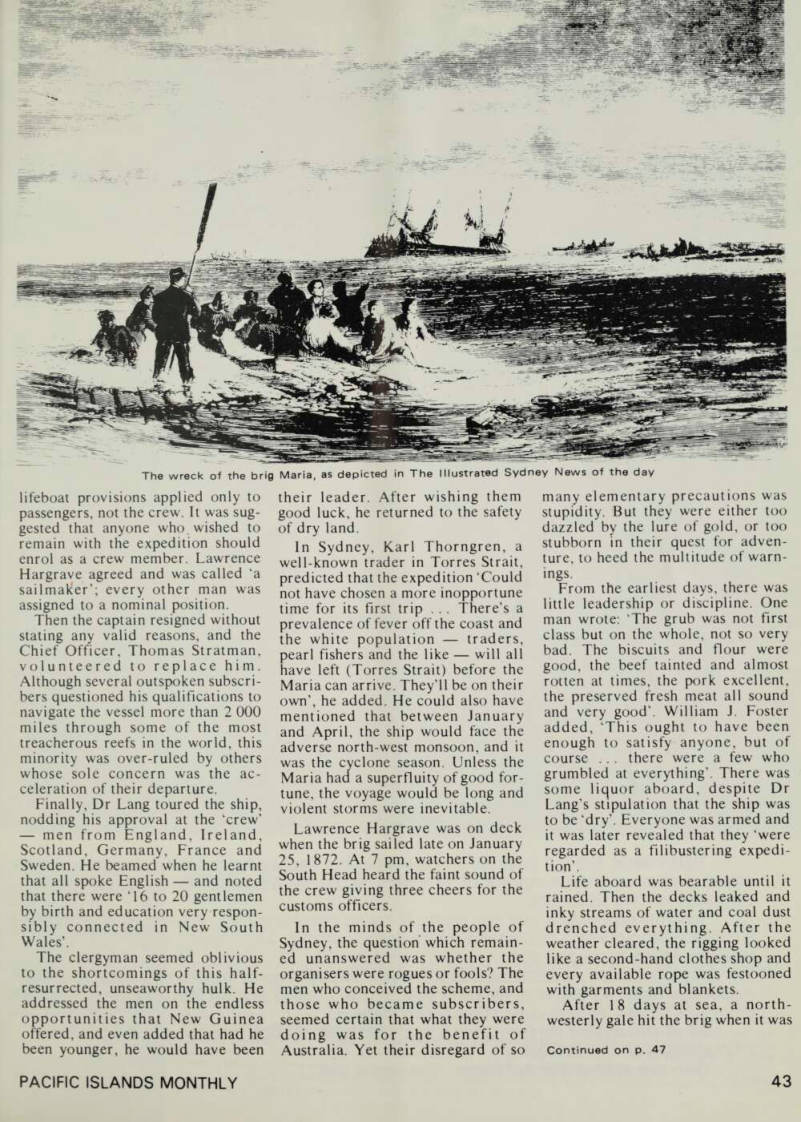
The wreck of the brig Maria, as depicted in The Illustrated Sydney News of the day
carrying full sail. The maintop gallant was carried away and the sails shredded. For eight days, the old ship was battered by pile-driv ing seas and carried south by the prevailing current. The planking was ‘so strained that I could put my fingers between the gaps in the deck timbers’, Hargrave wrote.
During the night of February 17, a wave made the Maria shudder from end to end. Bulwarks were washed overboard and the tiller swept away. Despite Hargrave’s claim that single-handed he had im provised a new tiller, Foster wrote that Hargrave designed a windlass block and ‘the carpenters, assisted by Hargrave, at once set to work to repair our disaster’. However, the steering was so much heavier that two men were needed thereafter.
Then a deputation approached the committee and their spokesman was succinct. ‘We’ve had enough.
We want to be landed at an Australian port and we’ve agreed that we’re prepared to resign our shares.’
The committee members were equally alarmed and told Stratman to sail for sheltered waters. But the storm continued, the ship became heavier with water and, while at the mercy of the waters, and drifting, ‘the captain seems to have been im becile or helpless’.
Buckets and pumps had to be manned constantly and on February
20, even Hargrave wrote: T thought we should founder’.
When the gale finally abated, the battered vessel limped northward and lookouts were posted to spot one of the few gaps in the Barrier Reef which would admit a sailing ship into the calmer waters between the reef and the Queensland coast.
Land was sighted on February 25, to the relief of all aboard, but no one ever explained why the ship did not anchor at nightfall. At 3 am, Hargrave was awakened by ‘A hor rible grating sound followed by a shock'. He rushed to the deck to find the ship grounded on the reef. The sternpost had been driven through the deck, the rudder was gone and the bottom vented by coral nig gerheads as though its timbers had been tissue paper. When the tide rose, the Maria still floated and drifted clear of the outcrop.
Then confusion resulted from another decision which no one, least of all Lawrence Hargrave, ever ex plained satisfactorily.
Stratman told the committee that he would take six men in the surfboat and row north to Townsville to obtain a rescue ship.
Inexplicably the committee agreed.
Only Sonnichsen, the mate, lost his head when he heard what had happened, grabbed a rifle and fired after the boat, claiming that Strat man was ‘leaving them for dead’.
Neither Stratman nor Hargrave realised that they were on Bramble Reef, opposite Cardwell and 160 km farther north than they had calculated.
Aboard, the second officer, Andrews, organised some men to rig two rafts while Goble, the storekeeper, brought up plenty of food and opened the cases of bran dy, port and sherry. Foster wrote ‘A few of. us, among whom were Coyle and Hargrave .. . adjourned to the roof of the cabin, set to work on some preserved meat and biscuits . . . one or two only drank too much’.
After the rafts were launched, the Maria subsided on to the reef and keeled over. Hargrave and 12 men retreated to the masthead with pro visions, fresh water and clothes to await the captain’s return. However, as the poorly-constructed rafts drifted northwards, the boats returned to the wreck and Hargrave and six or seven others were per suaded to go into the sternboat.
They rowed all day to reach a deserted beach at dusk and were joined next morning by the other boat.
There was a disagreement as to where they were. Some maintained, correctly, that they were on Hinchinbrook Island, while Hargrave insisted that they were on Magnetic Island. For three days they lived on periwinkles, waiting for the weather to abate. Finally, the boats left for the mainland and reached Cardwell six days after leaving the wreck. The survivors were badly sunburnt and most had dreadfully swollen feet and could barely hobble.
For three days, Hargrave sailed with the steamer Tinonee to seek survivors. When they went to the wreck he recorded, ‘Found nothing but Zimmermann’s coat. Tobacco, matches and some biscuits in the pocket’. Otherwise no trace remain ed of the men left in the rigging.
Lawrence Hargrave, photographed not long before the great adventure