Sigwu —Solomons Workers’
p. 39 · Read in the full issue
Uncertain Trumpet
From a Honiara correspondent
The Solomon Islands General Workers’ Union was formed early in 1975 in the midst of much activity and a fanfare of publicity. Now peo ple are asking questions about the union and its leaders. Is the SIGWU dying? Did union leaders use union money for election campaigns? Was the “defection” of Paul Belande to Solomon Taiyo Ltd a sign of a power struggle? Who and what is the SIGWU for?
The SIGWU was founded under the leadership of Bartholomew Ulufa’alu who, until July, 1976, re mained its General Secretary. Apa thy, caused by the failures of earlier unions, was a big problem for SIG WU leaders. They knew they had to overcome this if their union was to take root.
In July, 1975, the stevedores’ wage dispute was escalated into a seven-day general strike. It was ap parent from the tone of the claims and the aloofness of union negotiat ing tactics that the general strike had been engineered mainly for publicity.
It was reported that Mr Ulufa’alu and Mr Griffiths (Ports Authority) never met face to face to discuss the stevedores’ case. There were vague demands to deport businessmen for failing to show proper respect to their workers. Added to these were demands for wage increases that were often too high for either government or businesses to pay.
Some employers would have had to pay 240 per cent increases if union demands had been met.
As expected, the strike ended without achieving much. Workers returned to work (some were not allowed back) with relief.
Employers were given a month to act on union demands under threat of another strike, which didn’t even tuate.
But even if the strike failed to get action, Mr Ulufa’alu was successful in establishing himself as a public figure. He had been sent to prison for leading a demonstration against self-government. He became a mar tyr for the workers’ cause.
But, successful or unsuccessful, he failed to keep his promise that “he would never go into politics” but “would work for the union as long as it needed him, and then return to the village.”
In the general elections of July 1976, Ulufa’alu stood for East Honiara constituency and was elected. He is now Leader of the Opposition. Another union man, Nathan Wate, stood and was elected for West Honiara.
This aroused speculation. Did these men use the union to get them selves elected? Letters have been written to the News Drum ex pressing fears that union money was used. Replies from Ulufa’alu have adamantly denied this. It is hard to descover the facts because union re cords for 1975-76 were never pro perly kept.
When queried on the position of the union, Mr Ulufa’alu (speaking as union adviser) said the union is “dying for lack of funds”. Its sub branch offices in Gizo and Auki were closed for this reason, he said.
Paul Belande, the union’s prin cipal negotiator, was dismissed from his position. This was a union deci sion. It was alleged that he was mak ing deals with employers.
Asked to comment on this claim,
Mr Belande said that there were dif ferences between him and Ulufa’alu on union strategies. Whereas he wanted to seek a gradual rise in workers’ consciousness of the union, Ulufa’alu wanted to create disputes, if necessary, to gain attention.
Because of this, and Belande’s rising influence with the workers, Ulufa’alu had been looking for a chance to remove him, it was claim ed.
The situation is complicated by the fact that it is against the union’s constitution to conduct negotiations without both parties being rep resented. It is also against the con stitution for public-paid servants to interfere in union matters.
Paul Belande at the end of April 1976 joined Solomon Taiyo Ltd, and has become its acting president.
A labourer himself for 15 years, he has said he knows more about the workers’ situation than university educated Ulufa’alu does.
It remains to be seen whether or not the union has pruned off an unhealthy or a fruitful branch in Paul Belande. It also remains to be seen whether its aims to reorganise its machinery, and to encourage other unions to join it to form a Trade Union Congress, are realistic.
Certain factions among the workers believe that the union has a future and could do a lot of good. It has already helped some to raise their wages and obtain better work ing conditions. They are prepared to sacrifice money for union fees for the next financial year.
However, another group is very critical of the leaders and is likely to refuse to pay fees if the leadership remains and continues on in the old way.
A third group feel that they have been overlooked, and, coupled with their suspicions on the misuse of funds, will not be paying.
It seems that with fair play and honest leadership, the union has every chance of surviving and continuing its good work. Double dealing and disputes among the leadership, however, have not helped.
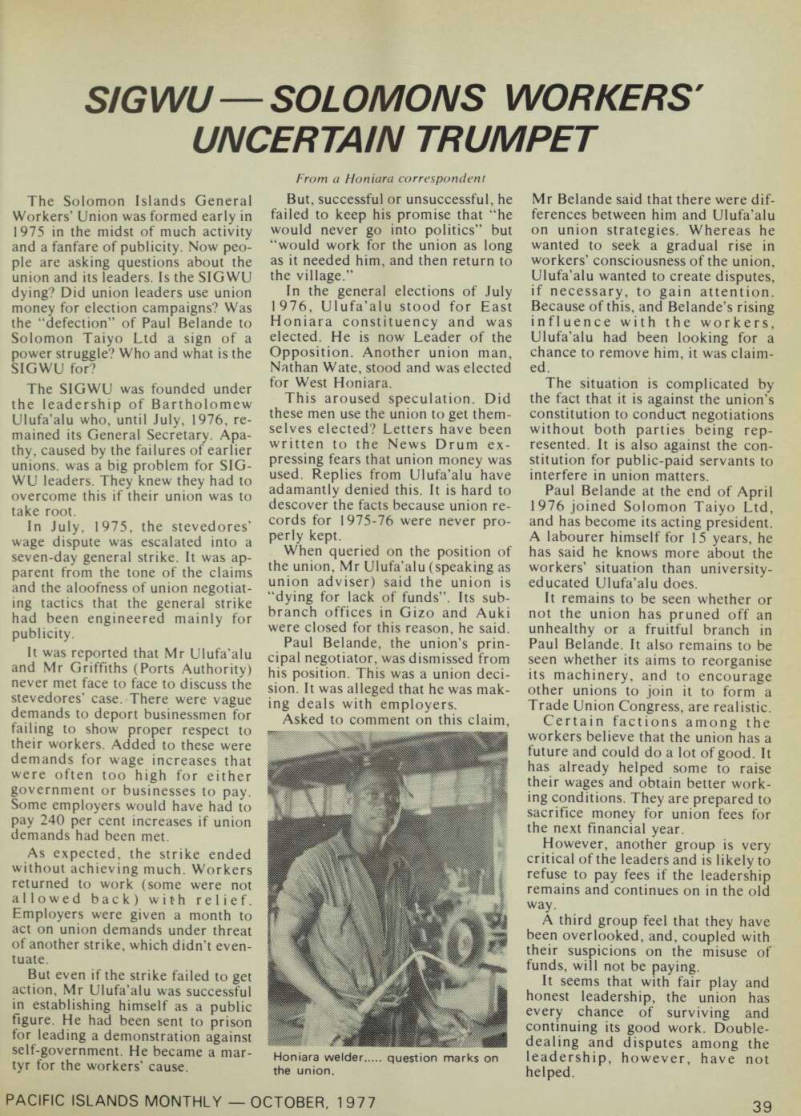
Honiara welder... question marks on the union.