Editor’S Mailbag
pp. 31-35 · Read in the full issue
The Pacific Way
In your June Issue (Islands Press, p 45), you report remarks made by Professor Max Hartwell of Oxford University while in Fiji on the in vitation of the USP’s School of Social and Economic Development.
Australian-born Dr Hartwell dis counted the Pacific Way as (1) a non-concept; (2) having no meaning in modern society; (3) that the thou sands of years of settlement in the Pacific had not produced any great cultural tradition; (4) that it is not unity but indeed diversity which characterises the Pacific way.
The Pacific Way is the great cultural tradition which thousands of years of settlement in cultural isolation evolved. This philosophy premises a “limit to growth” on an island’s finite resources and emphasises man’s survival through a balanced relationship with his en vironment. It is unfortunate, Pro fessor, that your naivete of our history and culture clouded your appreciation of its potential for modern society. For it offers the alienated man of your industrial millieu one of his few remaining links with humanity.
We offer the Pacific Way as an alternative to world development. It presents to the models, whose pro mises of delivery have gone awry, hopes of yet fulfilling man’s needs.
If he is to remain the focus around which progress is engineered, the Pacific Way views the objective of all development to be the enhance ment of human relations.
Global ideological polarity could be bridged by adopting the manners of the Pacific. International rela tions may learn from the conflicting 1 resolutions and thawing political detentes of our forefathers. The economic gaps of the world at large, and of each industrial society, can be minimised through the village economic principles of our cultures.
This Island way takes cognisance of the limitations of its ecology and, therefore, the need of its inhabitants to co-exist in interdependence. And Professor, is not the dawning of an
island concept of planet earth evolv ing a holistic perspective of our global village? Or are your dis cipline’s glasses fogged static in the pollution of industries and waste? it is true that diversity is a charac teristic of present Pacific cultures, But this is only so in the modern communication context, when view ed by outsiders. Yes we may dance and talk differently; observe rituals in various ways; structure kinship systems to a number of patterns; they all function for the same goal in fulfilling the highest general utility of society, Each social unit of the old Pacific was a whole in itself. There was no room for diversity nor individuality in pre-industrialised Pacific cultures. The fragility of the ecology and the frailty of man is a fact through which the Island philoso phy sees no man as an island, So if you will, please, Professor, confuse us no further. We are trying to hang on to the only piece of thread which seems to have meaning in our ever-changing surrounding, Modernisation appears a lizard-skin whose shades appear indeterminate.
But when all is said and re considered, in true Pacific spirit you are forgiven. We realise that you mea nt not what you said, Perhaps it was due to jet or modernisation-lag. That you came, saw and spake. That you knew not much of what you told,
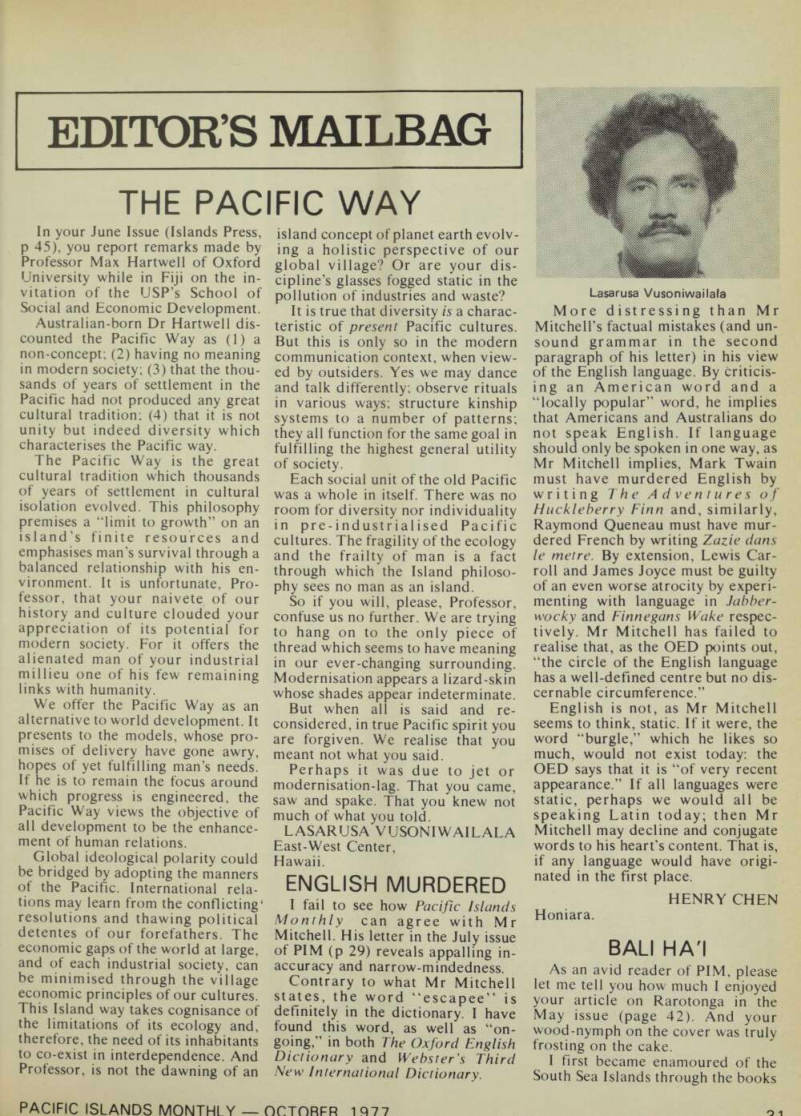
Lasarusa Vusoniwailala
East-West Center, Hawaii.
English Murdered
I fail to see how Pacific Islands Monthly can agree with Mr Mitchell. His letter in the July issue of PIM (p 29) reveals appalling in accuracy and narrow-mindedness.
Contrary to what Mr Mitchell states, the word “escapee” is definitely in the dictionary. I have found this word, as well as “on going,” in both The Oxford English Dictionary and Webster’s Third New International Dictionary.
More distressing than Mr Mitchell’s factual mistakes (and un sound grammar in the second paragraph of his letter) in his view of the English language. By criticis ing an American word and a “locally popular” word, he implies that Americans and Australians do not speak English. If language should only be spoken in one way, as Mr Mitchell implies, Mark Twain must have murdered English by writing The Adventures of Huckleberry Finn and, similarly, Raymond Queneau must have mur dered French by writing Zazie dans le metre. By extension, Lewis Car roll and James Joyce must be guilty of an even worse atrocity by experi menting with language in Jabber woe ky and Finnegans Wake respec tively. Mr Mitchell has failed to realise that, as the OED points out, “the circle of the English language has a well-defined centre but no dis cernable circumference.”
English is not, as Mr Mitchell seems to think, static. If it were, the word “burgle,” which he likes so much, would not exist today: the OED says that it is “of very recent appearance.” If all languages were static, perhaps we would all be speaking Latin today; then Mr Mitchell may decline and conjugate words to his heart’s content. That is, if any language would have origi nated in the first place.
Henry Chen
Honiara.
Bali Ha'i
As an avid reader of PIM, please let me tell you how much I enjoyed your article on Rarotonga in the May issue (page 42). And your wood-nymph on the cover was truly frosting on the cake.
I first became enamoured of the South Sea Islands through the books
Lasarusa Vusoniwailala
of Frederick O’Brien and Robert Dean Frisbie. I have all of Frisbie’s books in my library along with Dr Tom Davis’ Doctor To The Islands, Tom Neale’s An Island To Oneself, R. J. Dashwood’s Today Is Forever, Percival and Helm’s Sisters in the Sun, and Ronald Syme’s Isles of the Frigate Bird, and many others that touch on the Cook Group.
My pleasure through the years has been in surrounding myself with books about the South Pacific and I am very proud of my collection.
And on a visit to Tahiti in 1968 I was fortunate to meet and get to know the widow of James Norman Hall, a lovely lady known to all as “Lala”.
I first became acquainted with Tom Neale through his book about 10 years ago and since that time have kept up a fairly active corres pondence with him. I have also cor responded with Dr Tom Davis and Mr Ronald Syme. I have been retired from business for a number of years and have definitely made up my mind that I must visit Rarotonga. Up until just a few months ago the care of an elderly mother (92) kept me pretty close to home; however, she recently passed away and now I will be able to make some travel plans. Having waited this long I have lost forever the chance of meeting Andy Thompson and Robert Julian Dashwood.
Thanks for reassuring me that Rarotonga is, indeed, as lovely as I have come to believe.
Byron W. Hart
Boulder, Colo, USA.
Usr A Correction
While we welcome the publicity given by your magazine to the Cur riculum Resources Agency of the University of the South Pacific (PIM, July, p 25), we regret your choice of a title (Biting the hand that feeds it), and your suggestion that the agency is attempting to compete with commercial enterprises.
The Curriculum Resources Agen cy was established last year in re sponse to requests from ministries and departments of education in the region for a continuation of the teaching materials which were for merly provided by the Unesco Cur riculum Development Project based at the USP. Lacking the funds which were available to Unesco, the agen cy relies on the sales of material to
cover the cost of printing and developing new units. It is not mak ing any profit.
Island governments face a difficulty in developing locally bas ed curricula in that the number of potential sales of books developed is too small to attract a commercial publisher. In this case the agency may be able to help. Where books are already available, then there is no need for involvement by the agency. In English for example, materials for Forms 1 and 2 have re cently been developed in Fiji and are being published by The Fiji Times. So the agency refers all inquiries about English material to the publishers, and has stopped dis tributing English material itself.
You can see, therefore, that the agency complements rather than competes with, commercial in terests, and would ask you to pub lish this correction to your article.
Peter Sanders
(Chairman, Curriculum Resources Committee) School of Education USP, Suva.
Vailala Madness
The Vailala Madness was not the first recorded Cargo Cult, as stated in the August PIM (Book reviews, p. 51). In fact it wasn’t even the first in British New Guinea/Papua, and there had been other (mostly better described as millenarian move ments) elsewhere.
The usual list for BNG/Papua starts with Tokeriu (Tokerua), the Milne Bay Prophet, in 1893. In 1911 came Baigona in the Buna area on the north-east coast, follow ed by Taro in the same area from 1914. Vailala was the next.
There is evidence that Tokeriu was really only following in others’ footsteps, with much of his fame a consequence of official interest in his activities.
F.E. Williams discussed Taro (also Baigona briefly) in his book Orokaiva Magic.
There was also the German Wislin in the Torres Strait Islands from 1913.
John R. Horne
Dunedoo, NSW.
Joker Rescue
Referring to the rescue of JOKER in Vovo Bay in the New
Hebrides (PIM, April, p. 71), during the scheduled stop at Valesdir of Flight H 832 on January 23, a pas senger from the yacht Joker, which was stranded not far from the aero drome asked me to contact Mr Sapir of STAR Company in Vila and to let him know the extent of the damage and the position of the yacht. I was also asked to contact a second per son.
On my arrival at Vila I contacted Mr Sapir and proof of this is that the rescue ship FRANCIS did not know the exact position of the yacht until my report was received.
The second request could not be carried out as the telephone number I was given by the passenger was in correct.
Accordingly, as stated in the re port, Air Melanesiae has always en joyed a reputation for giving help in search and rescue work and its pilots, whether they are French or British, have always executed their missions with a maximum of profes sional conscientiousness.
Xavier Rossetto-Casel
flight Captain) Vila, New Hebrides.
Slugged Yachties
Following the yacht levy con troversy over the Solomons, in the past PlM’s (letters column), I would like to say that it is unbelievable to find a few yachtsmen from New Zea land and the United States who want special treatment. Those complain ing must be brainwashed by the sea
gales they encounter in the Pacific.
Can’t they stop and think; Yes!
It’s the regulation of the country (Solomon Islands) and so we have to abide by it.
In the same way, we Solomon Islanders have to abide by the very complex migration laws of NZ and the USA. Such people as Lawrence O’Brien (Aug, p 32) of USA and M.
J. Swinburn (Aug, p 33) of NZ should be more practical and reason out that SAIOO is reasonable.
Yachtsmen have free accommoda tion in their boats, so, no fuss, OK!!
The main point is, those com plaining are accusing our govern ment of being discriminatory but to whom? If L. O’Brien and M J.
Swinburn are short-fused “sailors”, then they should steer clear of the Solomons. Why accuse all Solomon Islanders?
Why accuse our Chief Minister (Peter Kenilorea) and make him a scapegoat? Why blame it on the Bri tish officials?
To complain because L. O’Brien fought in the Solomons in 1944 or M. J. Swinburn pays taxes (indirect or none) to the Solomons, is really an absurd manner of reasoning and very, very childish indeed!!
Let’s be childish then; who asked the Americans (including O’Brien) to fight the Japanese in the Solomons? Who asks M. J. Swin burn to pay taxes (a New Zealand Government decision)? The history of our country shows we did NOT. However, we enjoy both help
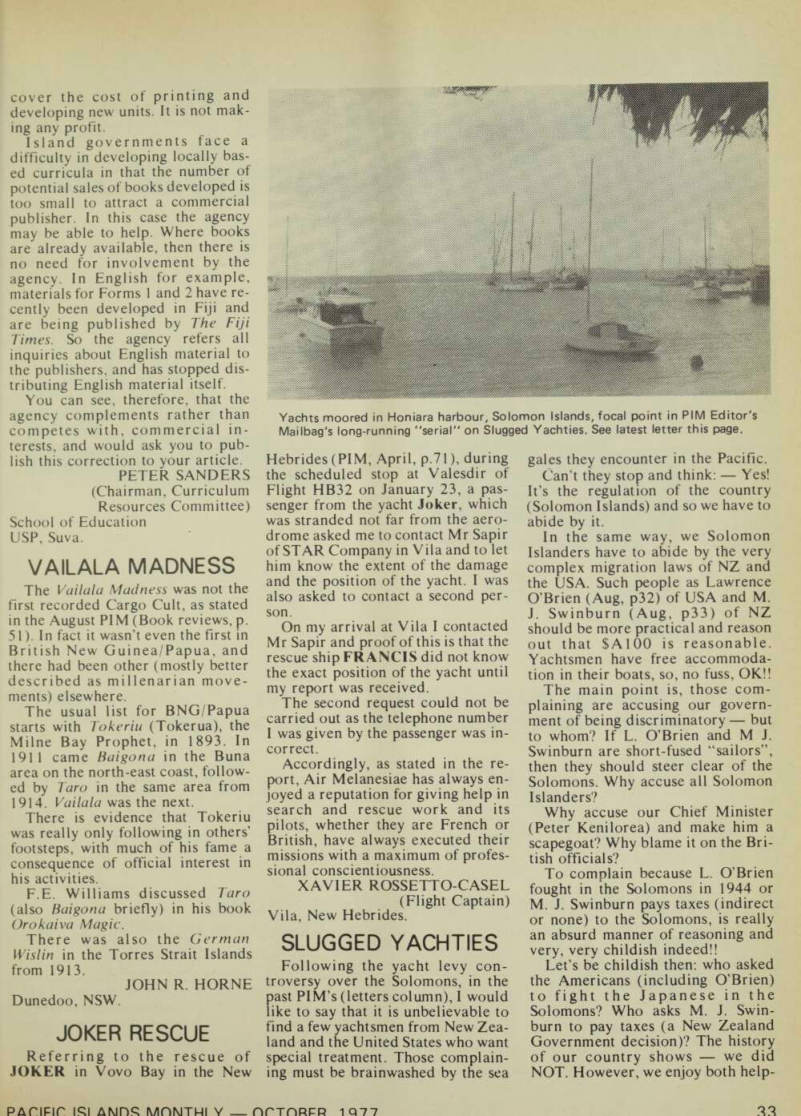
Yachts moored in Honiara harbour, Solomon Islands, focal point in PIM Editor's Mailbag's long-running "serial" on Slugged Yachties. See latest letter this page.
ing hands. Thank God, it’s US and NZ that should be grateful, as the Solomons is not ruled by the Japanese or become communist.
A hint for dissatisfied yachtsmen is: Think twice! All yachtsmen have the choice of cheap entry (whatever), either by plane or cruise boats. All yachtsmen are welcome to the Solomons. Complaining ones like L. O’Brien and M. J. Swinburn should not discourage those looking forward to the beautiful “Isles of Solomon”. Otherwise steer clear of the Solomons, it’s too expensive bah!! Grudging yachtsmen should bear in mind that “beachcomber days” should be over. Nor are we Solomon Islanders fools to any “globe-trotters” this goes for the complaining ones mainly.
Being patriotic makes me proud of my country.
Clemento Kengava
USP, Suva
Islands And Eec
In PIM (Aug., p. 55), your article “with water everywhere, Islanders are still tillers of the soil” needs up dating concerning information about the relations to the European Economic Community.
For the commodities in question (at the moment coconut products, cocoa, bananas), Fiji is reimbursed for shortfalls in earnings only for export to the EEC, while Western Samoa and Tonga receive for ex ports to all destinations in the world.
Contrary to your article, all Bri tish Dependencies and French Ter ritories are already included under the Stabex (stabilisation of ex port-earnings) system. Thus New Hebrides, Solomons, Tuvalu and Gilberts have already received or will receive reimbursement from the Stabex fund.
P. B. Christiansen
(Economic Adviser) Delegation of the Commission of the European Communities for the Pacific, Suva.
New Chapter On
Henderson
May and June issues of PIM have arrived, and I am in contact again after having been without my Pacific news for some years.
As I read the travail that Fiji, Papua New Guinea and the Solomons are going through I
wonder if independence is measur ing up to their expectations and if the result is worth the price. I have a notion they will learn much in the next decade and I have a hunch that they will reflect kindly on their
former “patrons”.
PlM’s publisher sits in the centre of such a great amphitheatre of cur rent political, economic and social action that I herewith nominate him as the best and most knowledgeable candidate for the next directing head of the United Nations. It will need him so badly by the time the present incumbent’s time expires, that he had better get ready to be drafted!
Peter John Young’s story in the June issue, “Henderson Field: Aftermath of a Bloody Holocaust”, is a smash-hit. He added a new and additional chapter to that great theatre of war. My congratulations to PJY!
Brig-Gen William J. Fox
Usmc (Ret.)
San Miguel de Allende, Guanajuato, Mexico • General Fox, now 80, was com manding officer of Henderson Field during the fierce battle for Guadalcanal during 1942-43, so he knows something about that bloody holocaust in which he was wound ed. The June issue of PI M told how he now trains horses at his ranch in Mexico. The publisher of PIM herewith declines nomination as the next directing head of the United Nations; he says he has enough un solved problems of his own, right here in Sydney.