Tropicalities
pp. 25-29 · Read in the full issue


Where time
is the boss
“Time is the boss here. It has to be, because of work. But we don’t need money in the Solomon Islands, except for tea and biscuits and clothes. So we’re masters of our own time.”
That’s how the Rev Willie Pwaisiho, the first Melanesian mis sionary to be stationed in New Zea land, compares the two regions.
Attitudes to time and money are the big differences, he says. They affect family life for him, his wife Kate and their eight-month-old daughter.
“We have no problems back home,” he says. “There’s always someone to bath the baby, put her to bed, baby-sit and so on. Here Kate has to do everything.”
Mr Pwaisiho, from Malaita, works as a curate in the Anglican parish in Kohimarama and studies Christian education at St John’s Theological College.
His parish duties include assisting the vicar, the Rev John Bro kenshire, in chaplaincy work in a large plastic packaging factory in Auckland.
“A lot of the workers there are Polynesian,” says Mr Pwaisiho. “I can understand some of their prob lems from their point of view.”
Helping New Zealanders to un derstand Melanesians, and Polyne sians, is fulfilment of a partnership in mission, he says.
He expresses his keen gratitude for the work of the church in freeing people in his own islands from headhunting, witchcraft, sorcery, hatred, and fear of evil spirits. “It is the power of Christianity which has done away with these things,” he says.
Stand up,
and dream!
There’s a shortage of beds in Pago Pago. The news bulletin of the Government of American Samoa re cently announced an auction of
“ nearly every type of household fur niture except kitchen sinks and beds”.
It said; “Items to be auctioned in clude dining tables, settees, lounge chairs, chairs, pillows, dressers, refrigerators, ranges, conventional range, head boards, mirrors, filing cabinets, tables, filing cabinet (with combination lock) and cushions. All transactions will be conducted on a cash basis.
“Getting back to beds. The Office of Material Management is still very badly in need of some. If you occupy a government house and have a bed which is not being used, please call 633-5200 and Material Man agement will arrange to pick it up.”
So much for beds. But what about kitchen sinks?
The Captain
on the screen The programme This is your life is very popular with many Australian television viewers and on at least one previous occasion it has honoured a person with Pacific Is lands connections, choreographer Beth Dean.
Captain Brett Hilder has now been added to the list of notable people, whose deeds and life-stories have been brought to the notice of the Australian public.
There was a great deal of real in terest in the show to those who know the Pacific. Brett Hilder’s days at sea tell much of the story of the Burns Philp ships from the mid
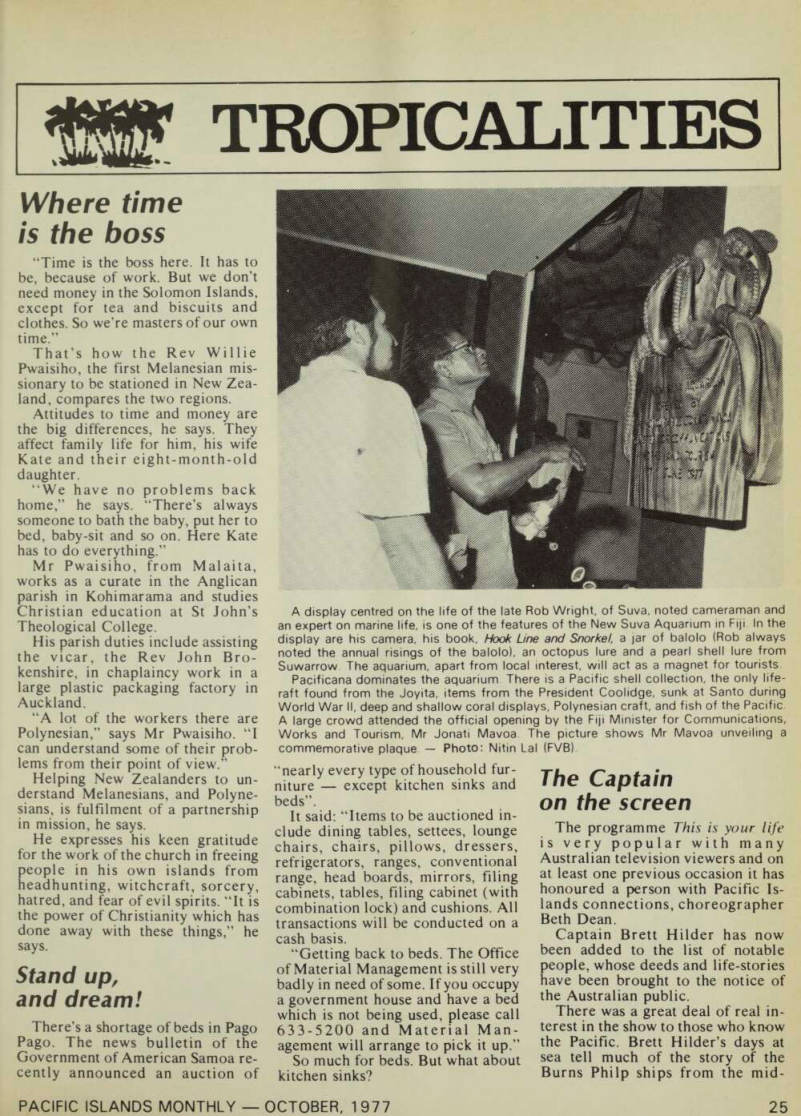
A display centred on the life of the late Rob Wright, of Suva, noted cameraman and an expert on marine life, is one of the features of the New Suva Aquarium in Fiji In the display are his camera, his book. Hook Line and Snorkel, a jar of balolo (Rob always noted the annual risings of the balolo), an octopus lure and a pearl shell lure from Suwarrow. The aquarium, apart from local interest, will act as a magnet for tourists.
Pacificana dominates the aquarium There is a Pacific shell collection, the only life raft found from the Joyita, items from the President Coolidge, sunk at Santo during World War II, deep and shallow coral displays, Polynesian craft, and fish of the Pacific.
A large crowd attended the official opening by the Fiji Minister for Communications, Works and Tourism, Mr Jonati Mavoa The picture shows Mr Mavoa unveiling a commemorative plaque -Photo; Nitin Lai (FVB).
twenties on, and his exploits as a wing commander in the RAAF relate very much to the campaigns in the waters to the north of Australia. Above all in “This is your life” there is a tribute to the very significant contributions made by Captain Milder to the charting of the reefs, passages and the islands of Papua New Guinea, the Solomons and the New Hebrides.
Two other of Brett Hilder’s at tainments were also recognised.
There was acknowledgment of his achievement in graduating MA from Macquarie University at the age of 65, having written a substantial thesis on the voyage of Torres. Then for all lovers of the colour and visual joy that is part of the Pacific scene there was a kaleidoscopic pre sentation of the artistic talents of this remarkable man, his water col ours, sketches and carvings. In their own right these visual memories of a career devoted to working in the Pacific served as an accolade to their creator.
PIM, which has printed many contributions from the captain, in cluding his sketches of Island characters, got more than a mention.
For several seconds, its front cover on last October’s issue showing some PNG youngsters, filled the screen.
Singing in
the Cooks
Parents all over the world suffer these days from the volume of noise produced by their offspring who are devotees of pop stars, soul singers and other mutilators of the sound waves. It is often asserted that to day's youth is destined to a future of eternal deafness, or perpetual hoar seness of voice, as a result of the ultra-decibel assault to which they have subjected their hearing ap paratus.
The Cook Islands must be famous for the level of sound production of their people, especially when they get together and sing in unison.
There cannot be many more musically-stirring moments than to sit in a Cook Islands Church and listen to the congregation singing a European hymn or joining together in the pouring forth of an imene. An imene is a religious song which, somehow or other, seems to join together the pagan and Christian practices everybody joins in and
many of the women carry the “melo dy” in an ear-piercing falsetto.
Perhaps there was a note of warn ing sounded for Cook Islanders in 1894 when O. W. Andrews, a surgeon in the Royal Navy, while re porting on health conditions in the Cook Islands, wrote about diseases of the respiratory system.
He said “Chronic laryngitis is fre quently met with, in fact, it is rare to meet with a native whose voice is not hoarse and strident. It arises from any of the following causes, which are given in order of relative frequency; (1) Over-exertion of the voice, the result of too early and too prolonged use of the voice. It is a common thing on the death of an
important personage for the young people to sing from 8 o’clock in the evening till 6 o’clock the next morn ing, with only short intermissions, during which they take such refresh ments as tea, coconut-water, or orange beer, and biscuits. These sing-sings, or, as they call them, Hy menies, are kept up for several months. But singing and dancing are not confined to obsequious ceremo nies; they are carried on more or less every evening; though it is after a death, or some important national event that singing is conducted with more spirit and energy. (2) Tuber cular laryngitis, or laryngeal phthisis (3) Syphilitic laryngitis. All these three causes are frequently combined in the same individual.”
The modest
Australian?
In Western Samoa for the 15th Anniversary celebrations of inde pendence, Australia’s Minister for Industry and Commerce, Senator Robert Cotton, had this to say about his country’s aid policy: “We ge nuinely give, we don’t lend the bloo dy stuff. We’re so far ahead it isn’t funny ...”
On the Australian aid project to build the Public Works workshop near Apia, on which Australia will spend $A4.6 million over the next five years. Senator Cotton said: “This is a beauty. It’s a logical thing to do.”
Describing Australian aid to the project as “seed money”, the minister said the workshop would establish pre-conditions necessary for a World Bank loan for future bigger projects.
An anti-brothel
demonstration
A crowd of women protesting against prostitution danced the hula in Port Moresby in mid-July to the tune of the PNG National Anthem.
Two generously-built women per formed the limbo rock using an old umbrella as the limbo stick. Police put up barricades while the women danced and made speeches outside the central government offices.
A few of the demonstrators car ried babies and some waved placards saying, “We don’t want brothels”. Public servants working in the big office block watched from the windows, many seeing their mothers, wives, sisters and aunts in the crowd of women.
There were women of all ages, some well-dressed and some roughly-dressed. Many wore red hats which had been handed out at the recent Port Moresby Show.
The whole deal was like a car
nival day.
The 400 women had marched for two hours in the hot sun to reach the government offic.es, making speeches along the way and carrying drinking water in plastic bot tles. They wanted the Prime Minister, Mr Somare, but had to be content with the head of his depart ment, Mr P. Bouraga, who used a loud-hailer to speak to them. He told them the government had no plans to legalise prostitution.
The campaign against prostitution was sparked off several months ago whem two community planners in Rabaul tentatively proposed that prostitution should be legalised.
Although neither the government nor any statutory authorities have given the recomendation any con sideration— and apparently don’t intend to a huge public campaign has developed.
Entente (lemon!)
cordiale
’Twas ever thus in the con dominium of the New Hebrides.
The English-language text re ceived by PIM of the statement released by the French and British Ministers following the July talks in Paris on the political future of the New Hebrides contained the follow ing paragraph: “The British Minister (Lord Goronwy Roberts) emphasised the fact that the parallel use of the French and the English languages (bilingualisme) was a major asset for the archipelago and far from being a handicap would allow it to play a unique role among the nations of the Pacific. The minister expressed the view that any discrimination in education, employment and the use of language would be deplorable.”
Laudable sentiments, and ob viously directed against the policy of the Vanuaaku Party that English would be the language of the educa tion system in an independent New Hebrides, with French continuing to be taught in private schools.
It would have been more convinc ing, however, if the minister had got it right when he made his little parenthetical stab at the French language. “Bilingualisme” is not French but an English word with an “e” tacked on. The French word is bilinguisme.
Still, nobody could say the French are unready to return the com pliment by getting English wrong when they have a go at it.
A Hebridean
spectacular
When the New Zealand Red Cross appealed for spectacles for people in the New Hebrides the response was overwhelming. More than 1 000 pairs arrived. The Red Cross wanted 500.
The medical superintendent of the New Hebrides. Dr Spooner.
wrote recently that the spectacles had been distributed throughout the hospitals in the New Hebrides and would be matched to individual
needs by a visiting optician.
The size of the selection had meant that everyone had been catered for who could not afford
spectacles. Apparently a pair in the
islands costs about a month’s wages.
Red Cross field officer, Moya McTammy, who made the appeal, recently visited the islands to see for herself the success of the project.
New Zealand Red Cross secre tary-general, Mr Jerry Talbot, said; “We were amazed at the response.
We now have plenty of spare specta cles to meet any foreseeable require ments.”
And, as an afterthought, he added the Red Cross didn’t need any more.
You can fuel
some folk often!
There was a part-European trader in Polynesia who made something of a fortune during World War II by selling hula skirts and strings of shells to American servicemen. This shrewd headed dealer went on to found a
shipping line.
He was always one who kept an eye open for the chance to make a profit and he came to hold the franchise for the sale of petroleum in his island home. All the petrol came in 44-gallon drums.
However, the drums were usually used on more than one occasion and they became contaminated with water, rust and various other foreign substances. Eventually the voices of protest grew loud and there were strident demands that our trader take measures to correct the situation.
Away went one of his schooners to pick up another load of petrol in drums and when these were put on sale a notice was posted to the effect that the petrol being offered for sale was in clean drums. For the unfortunate motorists and other users the results, if anything, were more disastrous than ever it was quite clear that the petrol was at least as dirty as it had ever been.
The guilty party was asked to explain why so much trouble was being experienced with his petrol when he had claimed that the petrol was clean.
Not so was the reply. What was all the fuss about? Hadn’t he said that the petrol was in clean drums? Well, he had had the drums thoroughly scrubbed on the outside before they were filled.