New Caledonian
pp. 12-13 · Read in the full issue
Non-Nuclear
Fissions
From a Noumea correspondent
New Caledonia’s territorial elec tions scheduled for September 11 probably held few surprises for the French, since Mr Olivier Stirn, Minister for Overseas Territories' visited Noumea in August and was able to see the island split into no less than 10 different political par ties.
Most significant split on the eve of the elections was the collapse of the Union Caledonienne, the longest surviving opposition to the French administration. Following recent stands in favour of the Kanaka Liberation movement, several European leaders quit the party to form the New Union Caledonienne (UNC) and the Union for the Renaissance of Caledonia (URC).
Autonomist parties called on their members to boycott Mr Stirn’s visit. But the minister wanted to visit Lifou Island in the Loyalty group, a Melanesian autonomist stronghold. He thus risked finding the town hall door closed to him.
Suddenly, it was announced that a head chief of the island was to be a special guest at a military dinner in Noumea. Then the French national convention of Jaycees meeting in Noumea announced the formation of a new branch in the territory Lifou, whose members thus shared in the impressive convention.
So, when Mr Stirn went to Lifou he was greeted not by the mayor but by a great hougna (Melanesian feast) given by a head chief. So the minister was able to confidently an nounce that if the Caledonians really wanted independence they could have it. This episode sym bolises the whole situation in New Caledonia.
The record proliferation of par ties Jostling for the 35 seats in the Territorial Assembly meant one thing for the French Adminis tration. No matter which side may claim to win the elections, the frag mentation of parties makes it just so much easier for the administration to get its own way, as a majority vote can always be manoeuvred by in fluencing just a small number of
“swinging” assemblymen. In any event, under the French system it is the bureaucracy which rules, deriv ing its power from its permanency and by encouraging personal rival ries to keep factions divided and squabbling.
Since the Caledonian municipal elections last March, when an unusually large proportion of seats inland and on outer islands went to Melanesians and anti-adminis tration groups, there has been in creasing publicity given to the Kanaka Liberation movement.
During this time, the French Government sought to introduce new electoral boundaries and a new voting procedure. But these reforms were not carried in time for the Sep tember elections. Some claim this was a victory for the Roman Catho lic and Protestant Churches in Noumea which made strong protests to Paris. They are supported by the Pacific Conference of Churches in Suva which has issued several docu ments on these problems. Other ob servers would perhaps see that the increasing party splits are sufficient to assure the French Government of continued local control without changing the electoral laws.
The malaise in the territory prompted the Archbishop of Noumea, Monsignor Klein, to issue
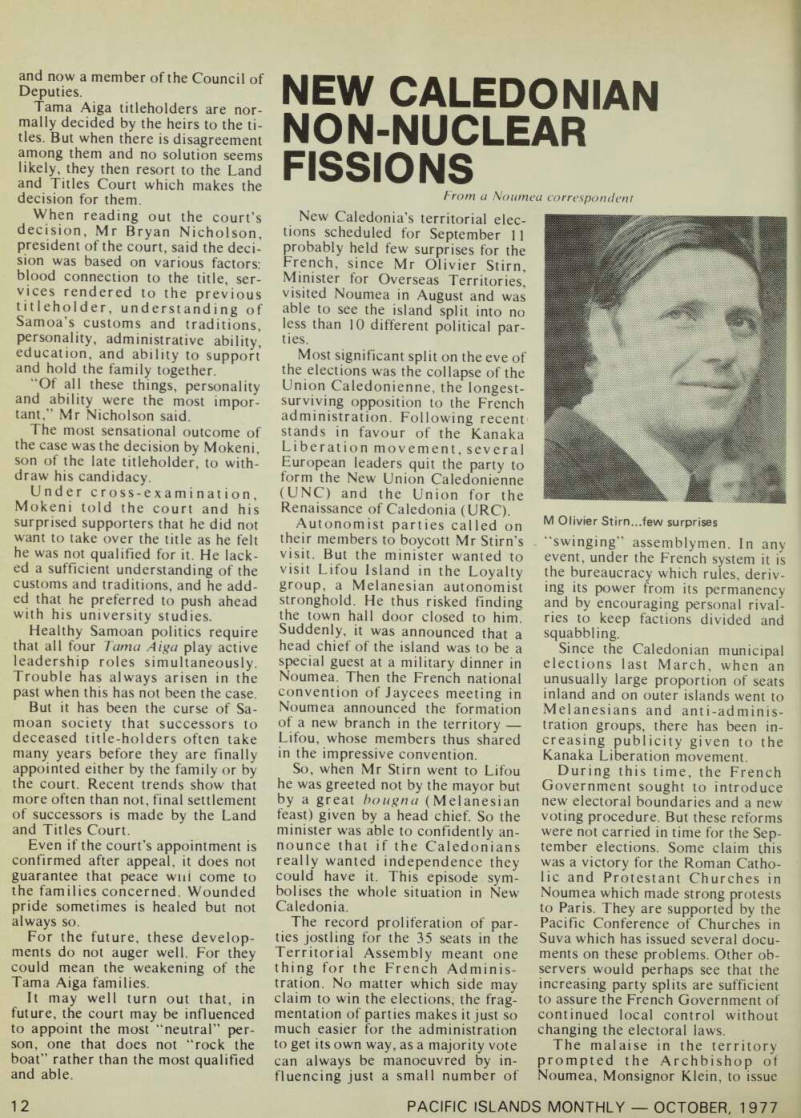
M Olivier Stirn...few surprises
a public statement in which he ap pealed for equality and fraternity.
Tension in the territory has been running high, particularly since the successes of Kanaka liberationists in the March elections. However, this must be seen as part of a typical French pattern, as in metropolitan France the growing strength of anti government forces traditionally swells up at municipal elections.
Also in French elections, when the electorate sees a lot of power swing one way at the municipal level, they get worried. The other side then frightens them with threats of public disorder, loss of jobs, etc and hey, presto, the electorate swings back into place, voting right wing, for the government.
On the Caledonian scene, the public disorder issue is kept well alive with threats of violence bet ween the ethnic groups. Some say the conflict is deliberately provoked to sustain the “divide and rule” policy. As far as the job threat is concerned, inequality among jobs is already causing misery, but what can be seen as an electoral.“carrot” are the repeated Paris promises that plans are progressing over new nickel factories for the north and south of the island.
During his August visit Mr Stirn indicated that the new political statutes for New Caledonia voted by the French Parliament last Decem ber would come into force on Sep tember 12. He also repeated the oft stated remark that if the Caledo nians really want independence they could have it.
However, as long as rewards and penalties are handed out to “good” and “bad” Frenchmen, and the islanders are educated in the French system of depending on a bureaucratic elite, there seems little likelihood of a majority seeking in
dependence.
In the end, Paris controls the is land’s wealth its nickel mines besides justice and the military forces.
From New Caledonia in mid- August, Mr Stirn flew to Tahiti where the islanders’ firm protests have resulted in new statutes with greater concessions than the Caledonian ones. Mr Stirn also visited Wallis and Futuna, where he promised a radio station for 1978 “to bring the islanders closer to New Caledonia and to France”.