countries listen - and worry
pp. 8-76 · Read in the full issue
The Forum speaks, and faraway countries listen - and worry
From JOHN CARTER in Port Moresby
For the first time in its seven years, the South Pacific Forum has made its presence felt outside the confines of the South Pacific. In its three-day meeting at the Administrative College at Waigani it made decisions which will invite reactions from Japan, the United States, the Philippines and, perhaps, even Russia A decision to establish a South Pacific Regional Fisheries Agency coupled with the planned declaration of Forum members to claim a 200-mile economic and fishing zone is already causing anxiety in Tokyo and, before this report is read, there could be strong reaction from the United States via the South Pacific Conference in Pago Pago at the end of September.
The Forum is also planning to stretch out a hand to the member countries of ASEAN, the Association of South-East Asian Nations and it may not stop there. It is beginnine to flex its political muscles— politics was the first consideration when the Forum was first thought of as a political platform denied to them by the South Pacific Commiss j on y Somebody else thinks it should do a bit of muscle-flexing the National Revolutionary Council of
West Papua which endeavoured, without success, to get the Forum to react to a petition it tried to cir culate among the members which alleged “untold atrocities” by In donesians in Irian Jaya.
The Forum let well alone, as it did over another demonstration mounted by young members of Papua Besena, the Papuan separatist party, who paraded with banners outside the delegates’ hotel. The banners asked for a third of Australian aid to be given to Papua and sought the Forum’s aid in the “struggle for independence” by the peoples of Papua and West New Guinea.
But these demonstrations and the presence for the first time at the Forum of a covey of Japanese jour nalists underlined the growing im portance of the Forum in world affairs. Not that most Forum leaders saw the meeting as any more impor tant than the previous seven.
But my own view is that this Forum has stirred things up to the extent that its members might have to decide that an annual meeting isn’t often enough (even though its hard-worked SPEC the South Pacific Bureau for Economic Co operation usually takes care of most things in between forums).
Fiji at this meeting wasn’t very satisfied with the Forum s decision to admit the Gilberts to full mem bership, and the absence from the formal agenda of the establishment of a regional airline, The admission of the Gilberts to full Forum membership was done at an unfortunate time. At present, there’s no love lost between the Gilberts and Fiji over the matter of Ocean Island and the desire ot the Banabans, living in Rabi in Fiji, to have Ocean Island declared inde pendent from the Gilberts and ad ministered by Fiji .
The fact that Fiji opposed tu membership for the Gilberts on the grounds that no one could give a tix ed date for Gilbertese independence was genuinely be! leved by the Gilberts’ Chief Minister Naboua Ratieta to be flak from the 1 " agreement on Ocean Island, He told me as much at the end ot the first session although 1 had pointed out, as Fiji pointed out, that Fiji was worried that a change in t e criteria on which membership is based would bring applications from other territories like Frenc Polynesia and New Caledonia.
“Membership of SPEC does not automatically confer tull membe ship of the Forum, Fiji s ueputy
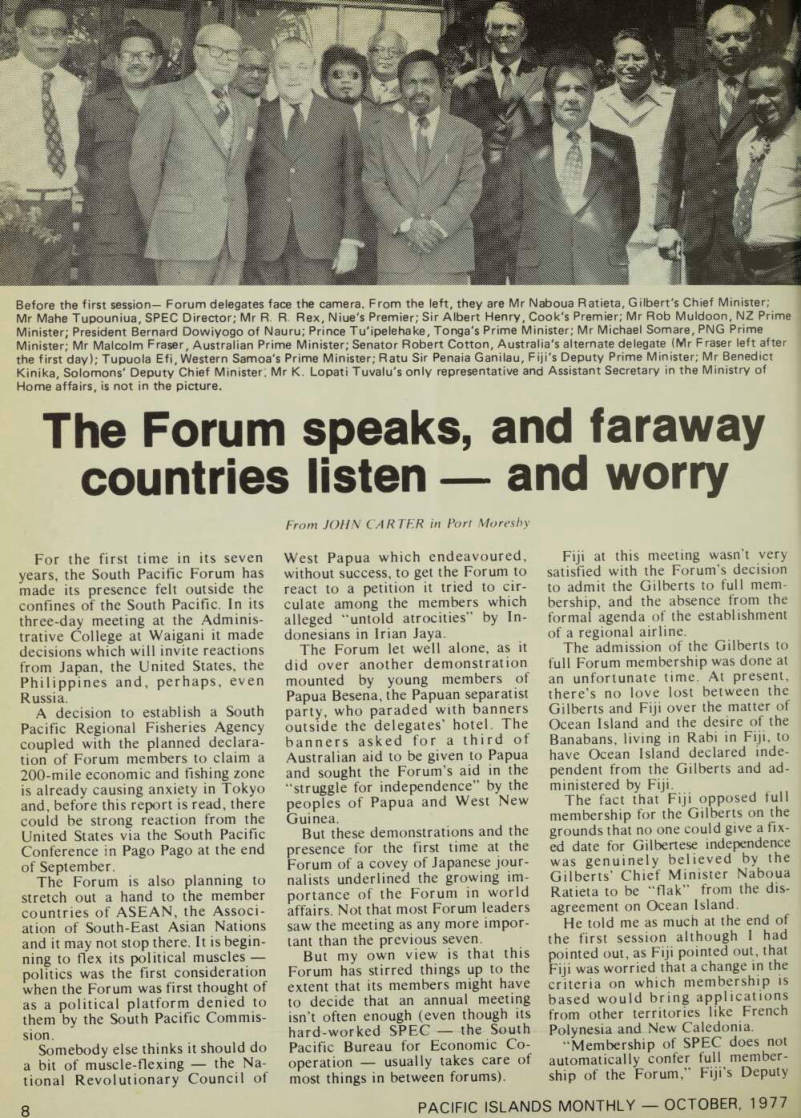
Before the first session— Forum delegates face the camera. From the left, they are Mr Naboua Ratieta, Gilbert's Chief Minister; Mr Mahe Tupouniua, SPEC Director; Mr R. R. Rex, Niue's Premier; Sir Albert Henry, Cook's Premier; Mr Rob Muldoon, NZ Prime Minister; President Bernard Dowiyogo of Nauru; Prince Tu'ipelehake, Tonga's Prime Minister; Mr Michael Somare, PNG Prime Minister; Mr Malcolm Fraser, Australian Prime Minister; Senator Robert Cotton, Australia's alternate delegate (Mr Fraser left after the first day); Tupuola Efi, Western Samoa's Prime Minister; Ratu Sir Penaia Ganilau, Fiji's Deputy Prime Minister; Mr Benedict Kinika, Solomons' Deputy Chief Minister; Mr K. Lopati Tuvalu's only representative and Assistant Secretary in the Ministry of Home affairs, is not in the picture.
Prime Minister, Ratu Sir Penaia Ganilau, told the members. “Con versely, membership of the Forum is not a pre-requisite to membership of SPEC. The Forum sets its own criteria for admitting countries to full membership of the Forum.
“Fiji’s understanding is that these criteria are; (a) That a country must be independent, or (b) that a coun try must be internally self-governing but with a clear date on which it will achieve independence.”
Ratu Penaia said Fiji regarded membership of the Forum by the Cooks and Niue as special cases because of their peculiar constitu tional arrangement with New Zea land.
Earlier, on the first day, Ratu Penaia had expressed the fear that “if countries are admitted to full membership of the Forum only on the basis of a general statement of intention to move to independence, we shall have to accept applications for membership from other coun tries in the region, including the French territories even though they may not actually achieve indepen dence until after three, five or 10 years or even longer. In this event, we doubt whether the Forum will remain a forum of decision-makers as it is today.
One can foresee the danger of Fiji, or someone else, failing to support the Forum if it becomes a body without the power to make deci sions. Fiji was a prime mover in the Forum’s creation.
Mr Ratieta assured the Forum that the Gilberts was truly self governing and was definitely mov ing to independence within a year or so.
The Forum accepted his assurance and voted the Gilberts in.
The Solomons and Tuvalu, almost in the same boat, made no applica tion.
Fiji got some satisfaction. It was agreed that a group of member countries’ officials should meet and discuss the re-definition of the cri teria for full membership, and re port at the next Forum.
The two decisions regarding fish eries, the establishment of a South Pacific Regional Fisheries Agency and the agreement to declare a 200mile fishing or economic zone, could run into heavy weather.
The Law of the Sea conference hasn’t come up with anything yet in the way of framing international
laws or zones but the Forum felt that as many countries had already declared such zones, the South Pacific should protect its own in terests.
The resolution said that “in view of the action taken by a large num ber of countries including distant water fishing countries exploiting the valuable highly migratory spe cies in the region, the countries in the region should move quickly to establish fishing or exclusive eco nomic zones and should take steps to co-ordinate their policies and ac tivities if they are to secure more than a very small part of the benefits from their resources for their peo ples”.
SPEC was told to call a meeting of officials of all interested countries by the end of November. Their job will be to prepare a draft convention establishing the agency, and to make arrangements for setting up an in terim office and a staff who will pre pare guidelines for gathering all the information, biological, economic, etc, needed to make sure the Forum countries are in a position to harvest their own seas. The deadline is March 31 next year.
The temporary office will be, at the invitation of the Australian Government, at the CSIRO centre at Cronulla in New South Wales, which has already gathered much information on fisheries and has a computer. The Solomons has offered to put the permanent head quarters at Honiara. SPEC’s Direc tor, Mr Mahe Tupouniua, has the task of seeking funds from govern ments and international agencies for the agency operations.
The agency will negotiate with countries like Japan and other “dis tant water fishing nations and other extra-regional interests” and will also facilitate “without detriment to the sovereign rights of coastal coun tries, a regional approach to man agement and to licensing including agreement on generally applicable policies and measures, pooling of information and standardisation of procedures and forms”.
They’ll also grapple with the mammoth task of finding resources and means for surveillance and policing the areas.
It may not be as hard as people think to police the millions of square miles of ocean in the South Pacific. Papua New Guinea has six patrol vessels and it’s surprising,
since they began work and roped in a few illegal fishing vessels, how much the incidence of illegal fishing in PNG waters has been cut.
The Forum didn’t take long to agree to most of the proposals on the agency, but one clause held them up.
It went through eventually, in this way: “... to establish a South Pacific Regional Fisheries Agency open to all Forum countries and all countries in the South Pacific with coastal state interests in the region who support the sovereign rights of the coastal state to conserve and manage living resources, including highly migratory species, in its 200 mile zone”.
The key is in the words “including highly migratory species, in its 200 mile zone”. That’s likely to cause great concern to countries like Japan, Russia and the United States, and it was with regard to these, and especially the USA, that there were two camps. Japan takes 300 000 ton nes of fish a year out of the South Pacific. The United States, it is believed, is, over all the Pacific, the biggest operator.
According to the terms of the resolution, the US will be excluded from the agency because it opposes any sovereign rights being exercised with regard to “highly migratory species”. It believes those resources belong to everyone.
Western Samoa and Fiji were not happy over the US being excluded.
American Samoa, with its large fish ing fleets and fish canneries, is not far away from Western Samoa and only recently Prime Minister Tupuola Efi of Western Samoa, and Governor Rex Lee of American Samoa, agreed to more brotherly co-operation.
Western Samoa thought it was better to have the United States within the fold than outside, where it wouldn’t have to respect the views of those inside.
Fiji thought that if surveillance and supervision were to be really effective, the agency must have the widest possible membership.
Papua New Guinea was among those who took the opposite view that those countries which did not recognise the right of sovereign countries to control all the resources in their own areas should not be admitted to membership.
The view prevailed, but it will be interesting to see the United States’
• Continued on p. 78
reaction when the South Pacific Conference gets around to discuss ing the matter at Pago during the last week in September, as it will be invited to do.
Another regional hot potato to come up was environmental man agement. Both the Forum and the SPEC last year agreed on joint ac tion to formulate a programme reflecting the environmental in
terest of all countries in the region.
The SPC sent the Forum a paper on the proposals, the Forum decid ed it didn’t contain enough informa tion and has sent it back for more work.
On the question of a regional airline Ratu Sir Penaia Ganilau said that the continuing problem in the field of regional civil aviation was that the regional partners in Air
Pacific had not really committed themselves to recognising that they i had a regional service. If there was no collective commitment to sup port the concept of developing Air j Pacific as the regional carrier, there was really no point in continuing with a common regional carrier.
Fiji, Ratu Penaia said, had always supported the development of a designated regional carrier because she felt they must avoid the situation where Island governments in the region were competing against each other at great expense to themselves but to the definite advantage of the established trunk route carriers operating across the Pacific.
As Western Samoa, Nauru and Papua New Guinea with Tonga thinking of coming along— have all got their own airlines and intend to keep them, Fiji got no response.
The only apparent interest in a regional airline was contained in the SPEC director’s report as just another item.
The report of SPEC’s activities over the last 12 months was approv ed, as was Fiji’s view that the Telecommunications Training School in Fiji should be run as a Fiji institution but would provide facilities and places for students from other countries in the region in the same way as that operated by the Fiji School of Medicine and the Fiji School of Agriculture.
Some members had taken the view that the school should be regionally owned, with Fiji as ad ministrator. Fiji opposed that idea and the Forum agreed to regard it as a Fiji national institution with places guaranteed for students from outside.
Ratu Penaia told members the school was flourished with 108 stu dents— four from the Cooks, seven from the New Hebrides, three from Niue, 10 from Tonga, 17 from Western Samoa and 67 from Fiji.
There were no opponents of the proposal to establish “informal con tact on matters of common interest” with ASEAN, and members ac cepted two invitations for the Third South Pacific Festival of Arts to be held in late June/early July, 1980, in Papua New Guinea, and for the 9th South Pacific Forum to be held on Niue next year at a date to be fixed.