Business
pp. 58-59 · Read in the full issue
Noumea’s citizens have their ups and downs
By PAUL STERLING in Noumea
New Caledonia is often classified into the two major ethnic groups; the Melanesians and the Europeans.
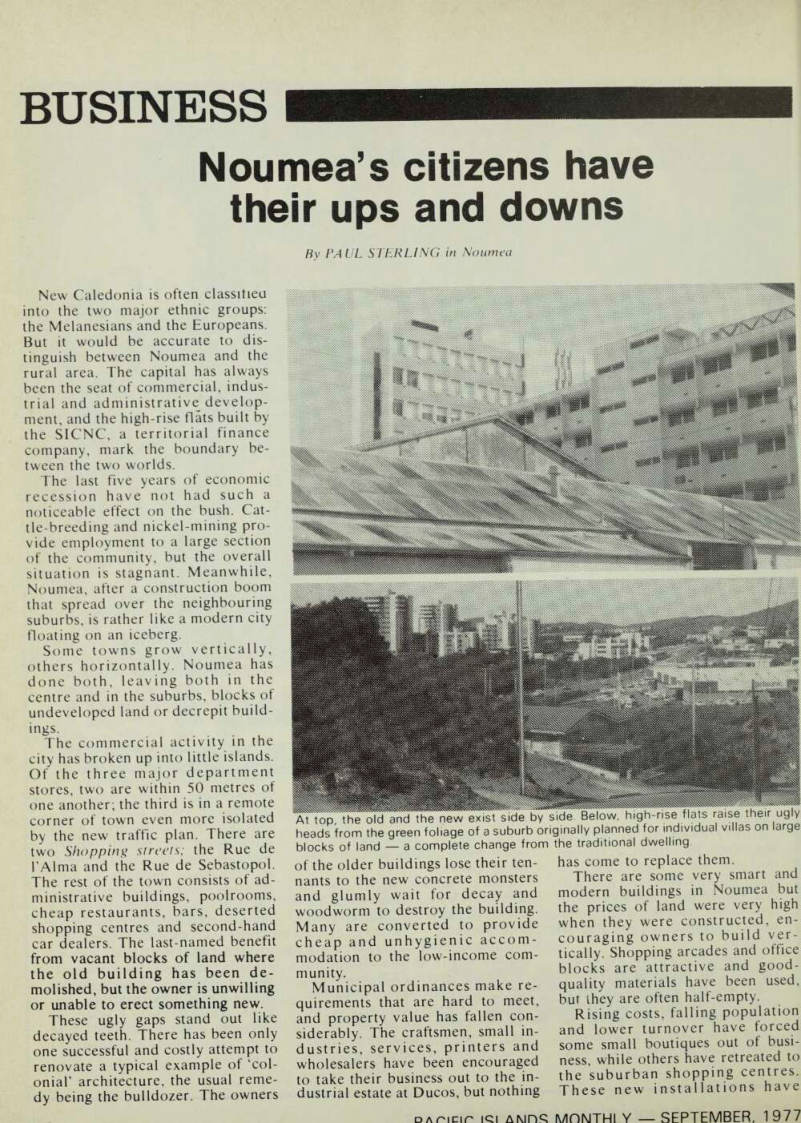
But it would be accurate to dis tinguish between Noumea and the rural area. The capital has always been the seat of commercial, indus trial and administrative develop ment, and the high-rise flats built by the SICNC, a territorial finance company, mark the boundary be tween the two worlds.
The last five years of economic recession have not had such a noticeable effect on the bush. Cat tle-breeding and nickel-mining pro vide employment to a large section of the community, but the overall situation is stagnant. Meanwhile, Noumea, after a construction boom that spread over the neighbouring suburbs, is rather like a modern city floating on an iceberg.
Some towns grow vertically, others horizontally. Noumea has done both, leaving both in the centre and in the suburbs, blocks of undeveloped land or decrepit build
ings. . , . ,
The commercial activity in the city has broken up into little islands.
Of the three major department stores, two are within 50 metres of one another; the third is in a remote corner of town even more isolated by the new traffic plan. There are two Shopping streets; the Rue de I’Alma and the Rue de Sebastopol.
The rest of the town consists of ad ministrative buildings, poolrooms, cheap restaurants, bars, deserted shopping centres and second-hand car dealers. The last-named benefit from vacant blocks of land where the old building has been de molished, but the owner is unwilling or unable to erect something new.
These ugly gaps stand out like decayed teeth. There has been only one successful and costly attempt to renovate a typical example of ‘col onial’ architecture, the usual reme dy being the bulldozer. The owners
of the older buildings lose their ten nants to the new concrete monsters and glumly wait for decay and woodworm to destroy the building.
Many are converted to provide cheap and unhygienic accom modation to the low-income com munity.
Municipal ordinances make re quirements that are hard to meet, and property value has fallen con siderably. The craftsmen, small in dustries, services, printers and wholesalers have been encouraged to take their business out to the in dustrial estate at Ducos, but nothing
has come to replace them.
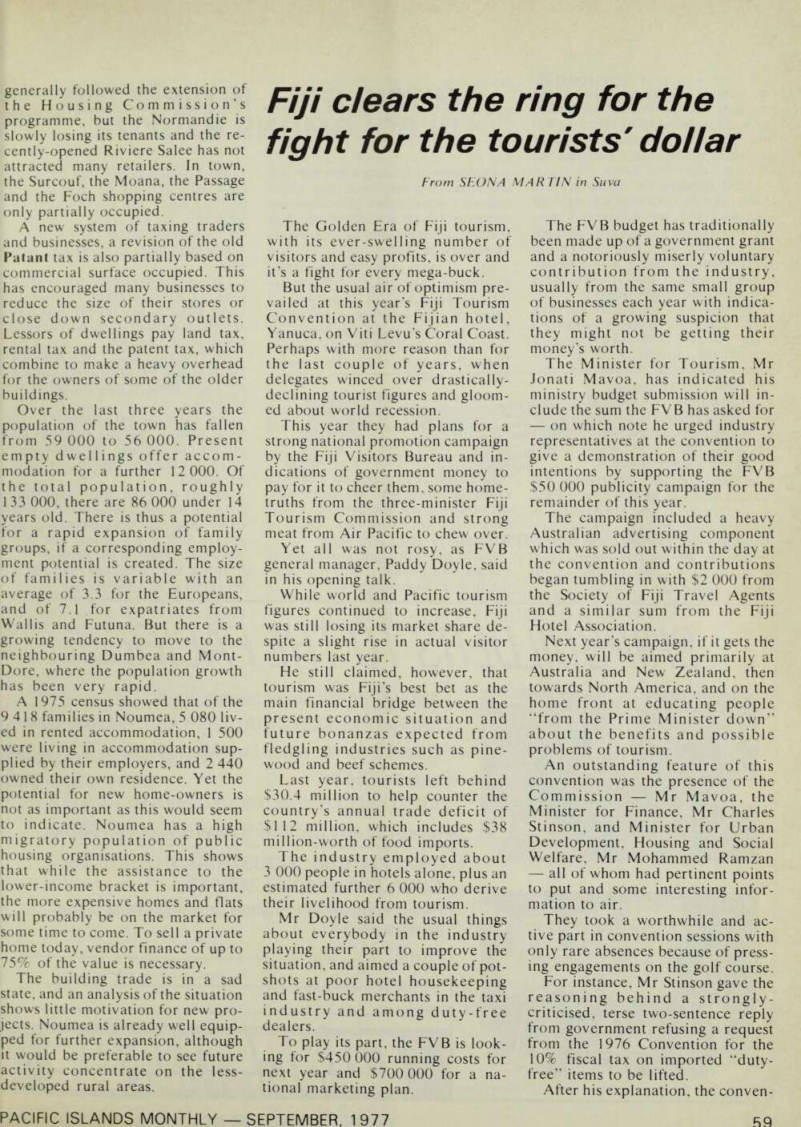
There are some very smart and modern buildings in Noumea but the prices of land were very high when they were constructed, en couraging owners to build ver tically. Shopping arcades and office blocks are attractive and good quality materials have been used, but they are often half-empty.
Rising costs, falling population and lower turnover have forced some small boutiques out of busi ness, while others have retreated to the suburban shopping centres.
These new installations have
At top the old and the new exist side by side Below, high-rise flats raise their ugly heads from the green foliage of a suburb originally planned for individual villas on large blocks of land - a complete change from the traditional dwelling.
generally followed the extension of the Housing Commission’s programme, but the Normandie is slowly losing its tenants and the re cently-opened Riviere Salee has not attracted many retailers. In town, the Surcouf, the Moana, the Passage and the Foch shopping centres are only partially occupied.
A new system of taxing traders and businesses, a revision of the old Patant tax is also partially based on commercial surface occupied. This has encouraged many businesses to reduce the size of their stores or close down secondary outlets.
Lessors of dwellings pay land tax, rental tax and the patent tax, which combine to make a heavy overhead for the owners of some of the older buildings.
Over the last three years the population of the town has fallen from 59 000 to 56 000. Present empty dwellings offer accom modation for a further 12 000. Of the total population, roughly 1 33 000, there are 86 000 under 14 years old. There is thus a potential for a rapid expansion of family groups, if a corresponding employ ment potential is created. The size of families is variable with an average of 3.3 for the Europeans, and of 7.1 for expatriates from Wallis and Futuna. But there is a growing tendency to move to the neighbouring Dumbea and Mont- Dore, where the population growth has been very rapid.
A 1975 census showed that of the 9 418 families in Noumea, 5 080 liv ed in rented accommodation, 1 500 were living in accommodation sup plied by their employers, and 2 440 owned their own residence. Yet the potential for new home-owners is not as important as this would seem to indicate. Noumea has a high migratory population of public housing organisations. This shows that while the assistance to the lower-income bracket is important, the more expensive homes and flats will probably be on the market for some time to come. To sell a private home today, vendor finance of up to 75% of the value is necessary.
The building trade is in a sad state, and an analysis of the situation shows little motivation for new pro jects. Noumea is already well equip ped for further expansion, although it would be preferable to see future activity concentrate on the less developed rural areas.