French Scholar's Tribute
p. 51 · Read in the full issue
To Founder Of Pim
Professor Raymond Goy, of the Faculty of Law and Economic Sciences, Rouen, France, has writ ten (in French) a comprehensive study of the development of regional organisations in the South Pacific.
Entitled The Evolution of Regionalism in the South Pacific, it appeared in the 1975 edition of the French Yearbook of International Law sent to PIM by Professor Goy.
Professor Goy’s account makes generous acknowledgment of the pioneering role played in the development of Pacific regional or ganisations by PlM’s founder, R. W.
Robson, citing on its first page an article of his published in PIM as far back as January 1931.
It was entitled Need for a Closer Relationship Between Territories: Plan for a Pacific Islands Asso ciation. Other articles by Mr Rob son on the same theme which are examined by Professor Goy were published in PIM in 1936 and 1943.
He also notes that a 1943 PIM article recalled that as early as 1921
the Fiji Legislative Council had pro posed the founding of a Con federation of British Peoples in the Pacific.
Professor Goy’s essay provides a number of insights into French at titudes to the policies of Com monwealth countries in the region.
He writes of the founding of the South Pacific Commission at the Canberra conference in 1947; “The United States and France showed the greatest reserve. They were tak ing part in the conference by reason of their presence in the South Pacific, and on grounds of prestige and realism. But they would not accept that a regional organisation should be allowed to compete with their preferential relationships with their territories, or throw into ques tion their major interests and poli cies (for example, as to the status of territories and nuclear testing) ...
The members of the Commonwealth the United Kingdom, Australia and New Zealand were more favourable to the rise of the Com mission. They brought to it their lik-
ing for regional autonomy and separate development, and the em piricism of their methods. They wished to promote the participation of the Islanders, and to strengthen the powers and the means of action of the Commission. Further, the young decolonised States, the ter ritories, and Island opinion were pushing for the development of the Commission and giving it their sup port, in their own ‘Pacific Way’, compounded as it is of dignity and
generosity...”
M.S.
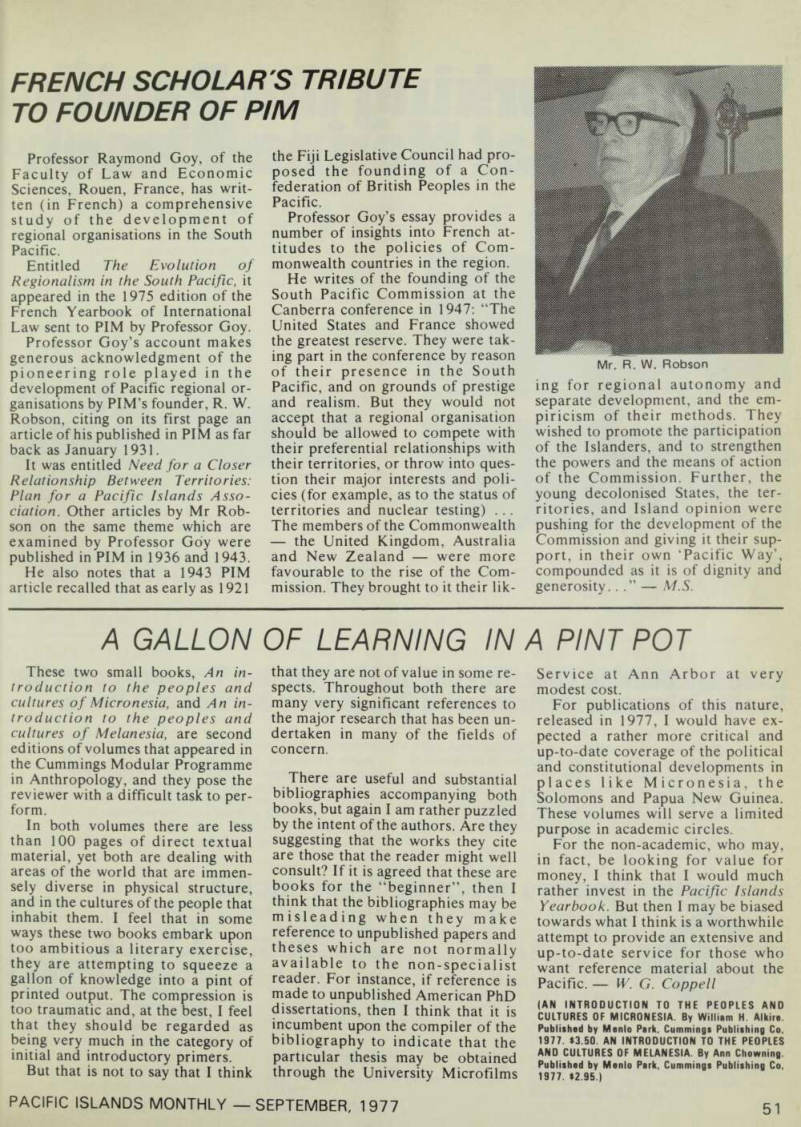
Mr. R. W. Robson