Magazine
pp. 36-39 · Read in the full issue

When wings of gold first flew over a stone-age Papua New Guinea
On a still morning in October, 1922, a single column of men set out from a crude bush camp deep in the interior of the Western Division of Papua. At their head walked a white man; then came a grizzled veteran sergeant of the Armed Constabulary, commanding the seven constables of the force who walked behind, swags strapped to their sturdy backs, their single shot carbines held carelessly, muzzle-first, across their shoulders as
they encouraged the eighteen laden
carriers of this little expedition to greater efforts. Four half naked Papuans scouted ahead, seeking a path. Leo Austen, an Assistant Resi dent Magistrate of the Magisterial Service, was looking for the source of the Tedi River and a pass through which he could lead his men into the fabled Star Mountains.
With food for a month, if carefully husbanded tinned meat, fat, sugar, tea, salt, tobacco and rice in mats they had worked their way up the Tedi, hauling their supplies and meagre camp equipment on crude rafts, constantly soaked by rain and mist. The people they encountered
were primitives, bushmen, wearing
the curved stem of the “kamenkor” calabash on their penises, bands of pig skin around their foreheads and pig’s tusk neck aces across their scaly chests. The country, wild, tangled, broken, was unexplored a blank on the map. They were on their own, out of communication, feeling their way with infinite caution, spending each
long day in weary foot-travel, patient
and enduring in the face of hardship.
Austen had made many such patrols, exploring new territory: the methods he was employing were those in use in the manv other remote corners of
This article, on the beginnings of aviation in Papua New Guinea more than half a century ago, is taken from the book, Wings of Gold, written by Papua New Guinea old hand James Sinclair and due for publication by Pacific Publications later this year.
this land. In 1922, and for years after
wards, the long, grinding foot patrol
was the accepted, the only way in which New Guinea could be
explored.
But even as Leo Austen and his little band were pushing their way towards the Star Mountains, a strange new sound was being heard along the swamps and deltas of the Papuan coast; the high, urgent note of an engine resounding from the sky. The rush of a graceful winged machine
startled the sleepy fishing villages and
frightened the big-eyed children into yells and tears, for never before had they seen such a wonderful, terrible thing. The twentieth century was about to catch up with this stone age land. The aeroplane had come to New Guinea.
The history of exploration in New Guinea contains some bizarre chap ters, surely one of the strangest a plan to use airships. In October, 1913, a committee was formed in Germany under the patronage of the Grand Duke of Hesse, its members drawn from influential financial and scien tific circles. The Graf von Zeppelin, soon to become notorious throughout the English-speaking world when the giant rigid dirigibles bearing his name made history’s first bombing raids against a city London was
a member, as was the celebrated ge ographer, Professor Richard Neuhauss. It was proposed that diri gibles and ships be chartered for two years, and great airship sheds con structed, two on the Sepik River and one in Dutch New Guinea. The cost, some three million marks, was to be shared between the Governments of Germany, Holland and Australia.
Nothing came of these daring pro posals; soon afterwards came World War I. It is very doubtful whether air ships could have been successfully employed in New Guinea. The story of general airship development is a tragic one, and by the time of World War II all giant dirigible construction had ceased throughout the world after a series of disasters, with great loss of life.
In November, 1914, two seaplanes a Maurice Farman, originally owned by Sydney businessman and pioneer aviator, Lebbeus Hordern, and presented by him to the Aus tralian Government, and a BE2A from the Central Flying School of the Australian Army at Point Cook were sent to New Guinea with their pilots, Captain Eric Harrison and G.
P. Merz, and four mechanics. They accompanied an Australian naval force which was on the trail of a Ger man commerce raider, but the air craft were never uncrated.
In 1916 the Swedish scientist and aviator. Dr. Erik Mjoberg, sought permission to establish bases in Papua and from these to employ air craft to explore the Territory. Sir Hubert Murray, the Lieutenant- Governor, would have nothing of this proposal; in 1920 he wrote ... it is our plain duty to assist the natives in
their rapid transit from the Stone Age to the Twentieth Century, and to see that they should at least not be injured by the change in their life brought about by the arrival of Europeans ...” But he feared the possible effect of aviation upon his people and Mjoberg was forced to abandon his plans. He could well have succeeded in using aircraft in Papua, for Sweden had a small avi ation industry by 1916 and the war had by this time forced the develop ment of some relatively efficient air craft types.
In 1917 two young French mis sionaries who had been training for service in Papua with the Sacred Heart Mission based at Yule Island, joined the French Air Force. One, Father Garin, was killed in action but the other. Father Leo Bourjade, ended the war as France’s seventh ranking fighter ace with 28 confirmed victories and the highest decorations for valour that his country could bestow. Father Bourjade took up his vocation at Yule Island after the war, planning to use his flying skill to advance the work of the church in Papua, but in 1924 he died of black water fever at the early age of 35, without again taking to the air. It would be many years before a Chris tian Mission would employ aircraft in New Guinea, but before he died it is likely that Father Bourjade at least had the satisfaction of hearing the beat of an aircraft engine in Papuan skies, for in 1921 the traveller and
photographer, Captain Frank
Hurley, came to New Guinea, seized with the ambition to cross the island by air.
Hurley had had an adventurous life. A member of the Antarctic Expeditions of Sir Douglas Mawson
and Sir Ernest Shackleton, Hurley had been planning a New Guinea expedition when World War I inter vened. In 1921 he made a preliminary visit and the following year he re turned. Considering the state of development of aviation in 1922, his plans were bold and ambitious. He would establish fuel and storage bases at Yule Island, Kaimare village, near the mouth of the Purari River, and at Kikori by means of an auxili ary ketch and would make explora tory flights from these bases while the ketch was proceeding up the Fly River to Lake Murray, and on to the junction of the Alice River with the Fly. From the Alice an attempt would be made to fly across the Central Range to the Sepik River headwaters and down to the sea. Two aero planes* would be employed, both
generously provided by Lebbeus
Hordern: an American Curtiss
Seagull biplane flying-boat with a
hull of mahogony, fitted with a Cur tiss K 6 engine of 160 hp and with open cockpit accommodation for the pilot and two passengers, and an
English Short Shrimp biplane sea
plane on Fairey floats, with a Beard more engine also of 160 hp.
Originally Hurley planned to base the
Shrimp at Daru, to explore the coast line to the Dutch New Guinea border and survey the Torres Strait while the Seagull made the crossing to the north coast, but this plan came to nothing and so far as can be now determined, the Shrimp served as a backup aircraft and did not actually
fly in New Guinea. Certainly only
one pilot. Captain Andrew Lang, ac companied the expedition. A number of scientists were included, among them the Assistant Papuan Govern ment Anthropologist, F. E.
Williams.
The Seagull arrived in Port Moresby on board the Burns Philp ship Marsina on 17th August, 1922.
The pilot, Captain Lang, was an ex fighter pilot, and the first commander of No. 4 Squadron, Australian Flying Corps. His rigger and mechanic was A. J. Hill. They spent the following
days in assembling and testing the
aircraft, awaiting the leader, Frank Hurley, who was due to arrive on the Morinda on 6th September with the Shrimp and with other members of the expedition. The flying-boat com pleted its water trials on 4th Sep tember, and at 10 a.m. on the following day Lang and Hill took off from the calm blue waters of Port Moresby harbour on the historic first flight of an aircraft in New Guinea.
They wore flying helmets and goggles, and to the great crowd of native onlookers the fliers and their fragile wood-and-fabric craft must have appeared creatures from another world.
“The machine taxied down breeze”, wrote Hurley in his book, Pearls and Savages, “and then about and into the eye of the wind. Lang opened the throttle, the engine roared its glad challenge to the skies. The
Seagull speeded in triumph and
cleaving aside the sea in frisky exul tation, like a graceful bird that skips the crests before taking wing, rose into the air. Not a word fell from the onlookers. They seemed as if hypno tised by the preternatural, until like a whirlwind blast that wrecks all within its path, the machine headed directly towards them. Then there was a scamper! Yells of terror, and the song of the Seagull sounded over the town and great was the com motion thereof. The native servants fled from the houses, the court was
forcefully adjourned, as prisoners,
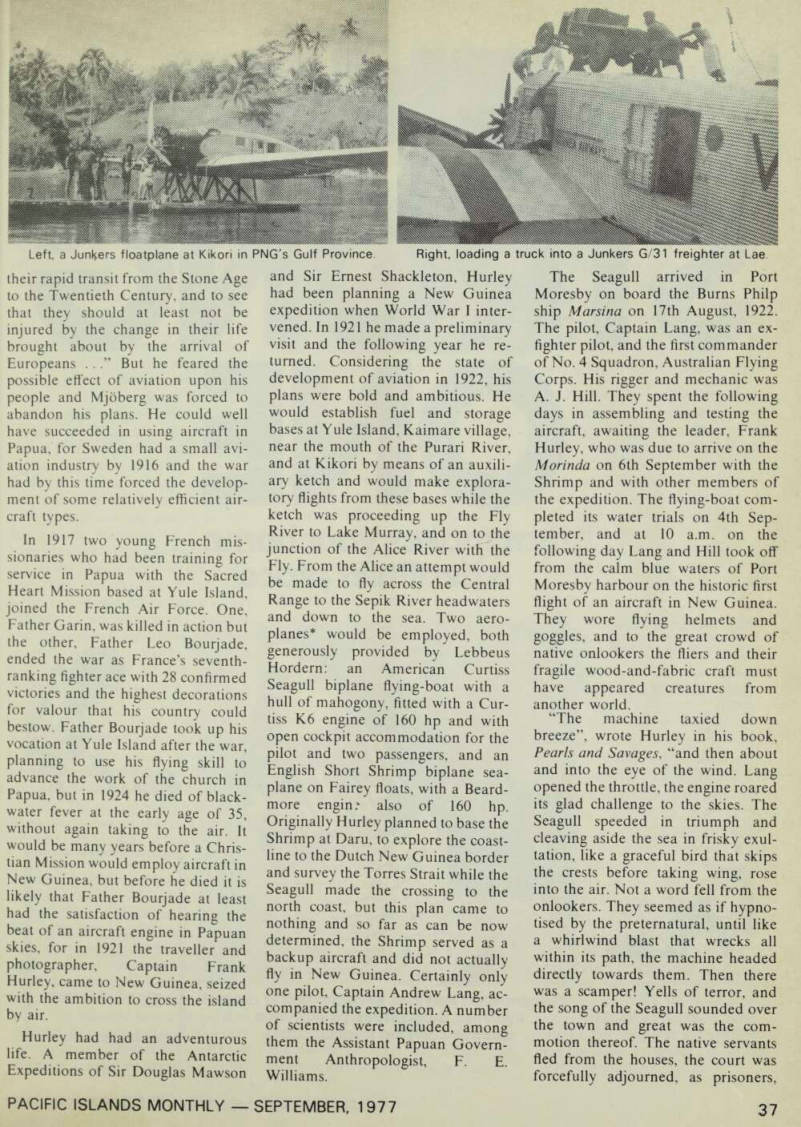
Left, a Junkers floatplane at Kikori in PNG's Gulf Province.
Right, loading a truck into a Junkers G/31 freighter at Lae.
plaintiffs and police rushed for the open ... such a happening had never occurred in Port Moresby before. All stood in the streets, craning their necks to the skies. Wildest enthusi asm prevailed; cheers went up, yells ot gladness and enthusiasm ... so the first flight in Papua was made amidst
much rejoicing ..
Despite the success of the first flight, the Seagull failed to deliver the
performance expected of it, prin
cipally because of its flimsy construc tion, for it was certainly capable of
long-distance flights (a Seagull was
flown from Sydney to Launceston in 1922). From Port Moresby Lang flew the machine with Hurley as passenger to Kaimari, in the gloomy, sodden delta of the Purari River. It was a perilous flight of some 250 miles, and all the way Lang and Hurley were lashed in their open cockpit by sting ing rain and heavy mist. This was dif
ficult, risky flying; no aeroplane had
ever before ridden these skies; there were no safe landing places, for the
finely-made mahogany hull, would
have been quickly gutted by the float ing debris common along the coast line; there was no radio contact with a shore base and little chance of as sistance in an emergency; weather and atmospheric conditions were un charted. But Lang was both skilled and brave, and the K 6 engine never faltered. The expedition spent a month at Kaimari, plagued by the in cessant rain, and Lang made many flights, usually in the mornings when conditions were most favourable, while Frank Hurley took the first aerial photographs ever made in New Guinea. The valiant Seagull never let them down, but all the time the evil tropical climate was at work.
The second major flight of expedition was from Kaimari lagoon to Daru, in the Western Division.
Lang’s first attempt to coax the heavily-laden Seagull into the air failed, and he taxied back and tried again. “Again we swept past the vil
lage,” Hurley wrote. “Fifty, fifty-five,
sixty miles per hour; then the keel just lifted, but we were now at the end of the lake. The only exit was by a very tortuous creek 200 feet wide, with tall walls of mangrove trees on either
bank. Into the creek we burst like a whirlwind, racing a mad race with death at our wingtips. The trees were a blur, and the roar of the engine was hurled back, reverberating through the jungle like a tornado ... slowly we climbed, but when Lang banked and the machine swept around the bends, we lost the gain again and the trees seemed to brush our wingtips.
We had now flown three miles and were just level with the mangrove tops. There was scarcely time to con template a vast plain of uniform tree tops that stretched like an emerald sea to the featureless horizon, before we cleared the creek entrance and swept out over the broad, free expanse of Port Romilly.” Such was flying in Papua in 1922!
Over the vast Fly delta the little flying-boat was menaced by black rain squalls and towering banks of dark, lightning-slashed cloud. At one
point the Seagull dropped from an
altitude of 1,500 feet to 300 feet in seconds and then was swept so violently aloft by the rush of the air currents that only Lang’s great skill saved them from disaster. They landed safely at Daru, to Hurley’s open relief. But the constant rain and humidity to which the Seagull had been subjected now took their toll.
Commencing an overhaul of the flying-boat before flying to the Alice Junction, Lang and Hill found that the fabric covering the wings had badly rotted; the machine was unair
worthy. Repairs in this remote place
were out of the question, and with great regret Hurley abandoned his ambitious plan to use the flying-boat to cross the island. It was decided that Lang and Hill would fly to Thursday Island, and from there return by sea
to Sydney, leaving the expedition to
cover what ground it could by water and on foot. The Seagull safely made the flight across the Torres Strait and passed from the New Guinea scene forever.
The Shrimp, with Captain Lang at the controls, was completely de stroyed in a crash into Rose Bay, Syd ney Harbour, in 1923. Lang himself was killed the following year. Nor did
Hurley achieve any significant
ground discoveries in the final phase of his expedition. He had returned to
Brisbane by February, 1923.
It cannot be claimed that the flights of the Seagull directly led to the dawning of the air age in New Guinea. In 1922, air pilots were heroes to the general public, but aero planes themselves were too perilous a novelty to be taken seriously by officialdom and few could have dreamed of the incredible achieve ments in aviation that were soon to come. But the Seagull was the first, and proved that aeroplanes could be operated in tropical New Guinea.
Although Hurley’s vision of employ
ing aircraft in exploration came to naught, the fault was not in the con cept but in the primitive nature of the available machines.
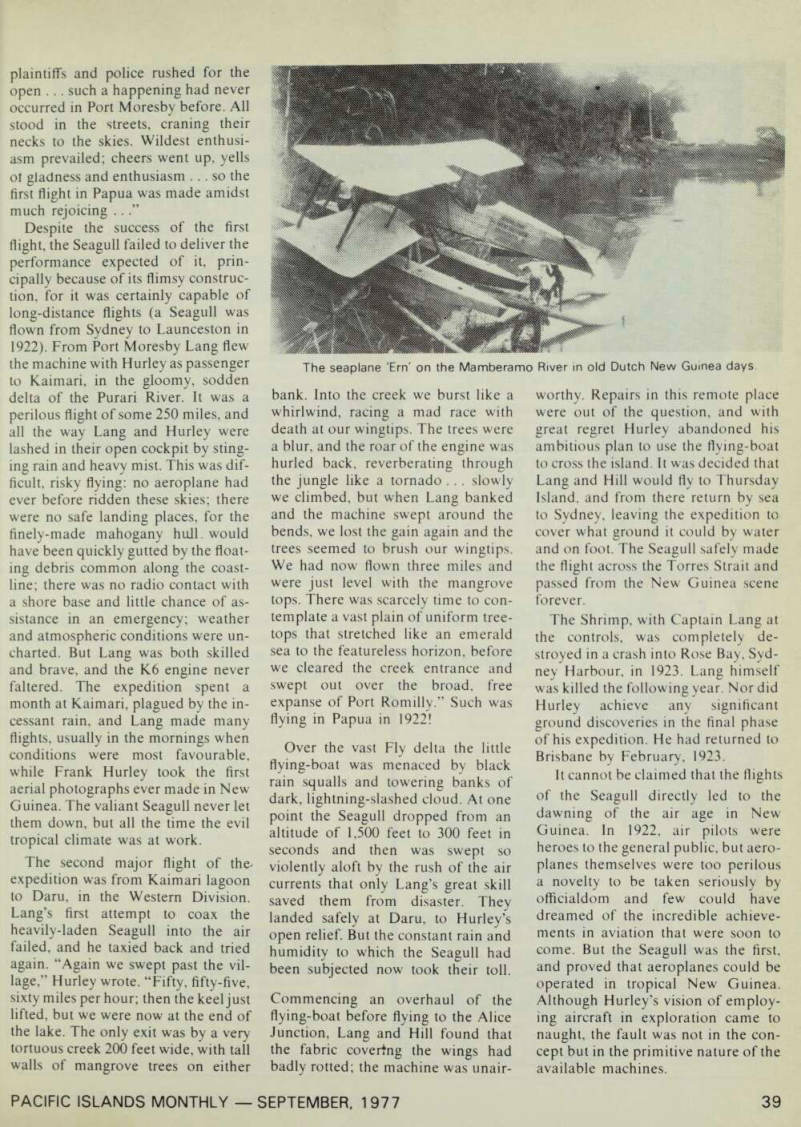
The seaplane 'Ern' on the Mamberamo River in old Dutch New Guinea days.