Australian MPs’ hectic tour-
pp. 15-77 · Read in the full issue
Australian MPs’ hectic tourwith Pacific aid in mind
By SENA TOR JOHN KNIGHT, a delegation member
A five-member Australian Parlia mentary delegation made an exten sive tour of the South Pacific region from June 29 to July 20. The delega tion was led by Senator Durack (Lib, WA) and included Senator Bill Brown (ALP, Vic) Senator John Knight (Lib, ACT), Mr Les Johnson (ALP, NSW) and Mr David Thompson (NCP, Qld).
In a hectic and intensive three weeks, the delegation visited 10 countries and territories. This in cluded stopovers for talks with senior administrators and political leaders in the Solomon Islands, Gilbert Islands and Tuvalu.
A visit by the all-party delegation again emphasised Australia’s in creasing awareness of the impor tance of the South Pacific and the rapid changes occurring there.
One impression gained was that Australia’s standing with its South Pacific neighbours is somewhat bet ter than it was around 1970. There are, no doubt, many reasons includ ing the effective and co-operative work of the South Pacific Forum and SPEC and Australia’s new development assistance efforts.
Australia’s growing interest in the South Pacific has been recently demonstrated by the decisions to open new diplomatic posts in the New Hebrides and Western Samoa.
It has also been illustrated by rapidly-increasing development
assistance in recent years. This will total $6O million in the current three-year programme.
This process can be seen, in part at least, as demonstrating a growing awareness of the importance of pro posals for a new international eco nomic order and the growing com plexity of international economic relations.
These factors, together with grow ing interest in the region by a num ber of other countries, including the Soviet Union and China as well as Japan and the United States, has contributed to Australia’s greater involvement in the South Pacific. It is perhaps worth noting that Australia’s closer direct involve ment in regional issues (beyond the SPC) began in the late 1960 s and early 19705, predating the recent greater activity of the Soviet Union and China.
But recent Australian government policies (since about 1970) build on the association which developed from the Canberra Agreement of the 19405; a very different relationship to that which existed before World War 11. But the pace of change is ac celerating and 1970 probably marks as significant a “watershed” as 1947.
During its three-week tour, the delegation visited the headquarters of the South Pacific Commission in Noumea and met senior officials of the organisation.
Perhaps the most significant issue to arise from these talks was that of the skipjack tuna study to be under taken by the South Pacific Commis sion.
Australia has already committed $750 000 to this project and much of the research so far has been car ried out by an Australian, Dr Bob Kearney.
The prospects seem encouraging for the development of skipjack fisheries as a source of substantial wealth to the Island nations of the region. But there are potential prob lems, particularly with such a migratory species, with the likely declaration of 320 km economic zones and the licensing and control of fishing activities by regional and “distant water” fleets, I n the Ne w Hebrides, the delega lion met with leaders of the main political groups including the Vanuaaku Party and the Tan Union, One thing that seems especially important is establishment of a con sulate in Vila as the pace of political change in the New Hebrides in creases. The delegation heard, after i* s visit, of Vanuaaku’s withdrawal from the July Paris talks. There must be growing concern at the ap patently increasing polarisation of political groups in the New Hebrides.
Continued on page 79
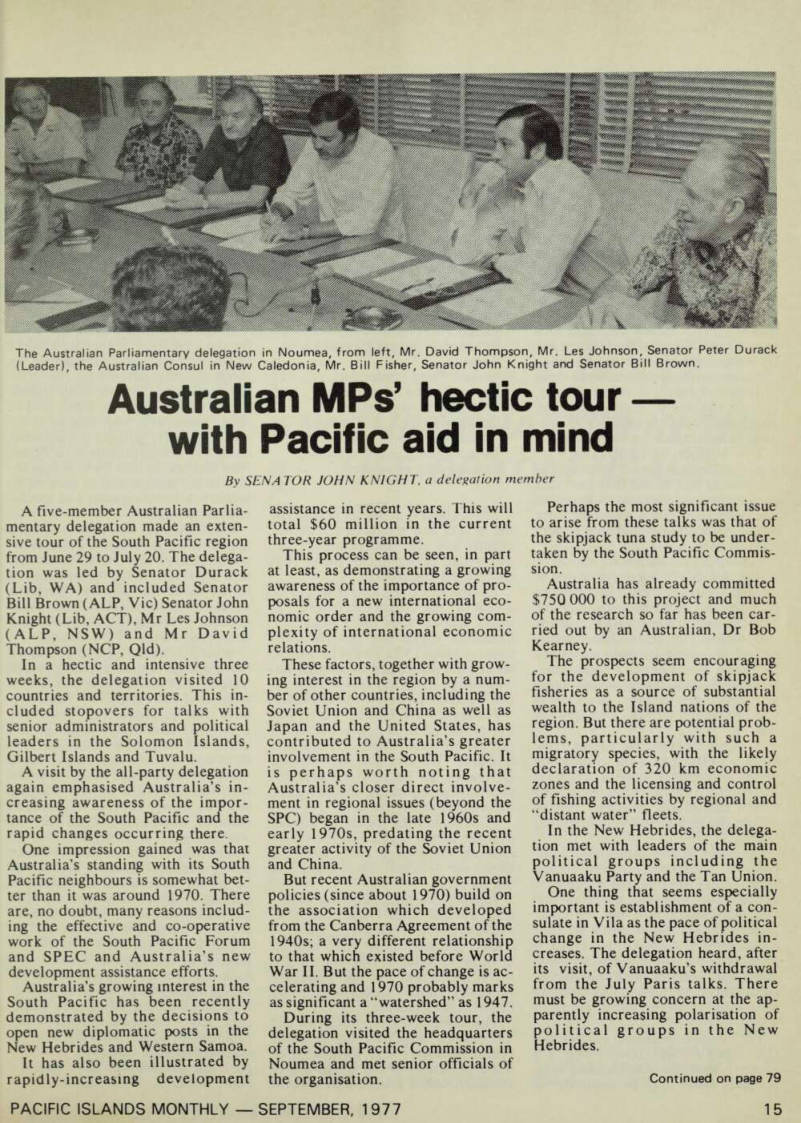
The Australian Parliamentary delegation in Noumea, from left, Mr. David Thompson, Mr. Les Johnson, Senator Peter Durack (Leader), the Australian Consul in New Caledonia, Mr. Bill Fisher, Senator John Knight and Senator Bill Brown.
In Nauru, the delegation met and ad meetings with several of the [embers of the Government of resident Dowiyogo. In the speech elcoming the delegation at a din er shortly after their arrival, the resident was critical of the .ustralian Government’s failure to ike up space in Nauru House in lelbourne.
In Tuvalu, the delegation was in armed of the importance of the onstruction of a wharf through
Australian development assistance,
lerhbers of the delegation express d their interest in seeing that this roject is completed as soon as ossible as it will be of great sig ificance to Tuvalu. (A delegation
from Tuvalu, led by Commissioner Tom Layng, has recently visited Australia to pursue this.) In Western Samoa, the parliamen tarians met with the Prime Minister and senior ministers. They examin ed and were impressed by the work of the Snowy Mountains Engineer ing Corporation in establishing a public works depot in Apia and on an important road project on Upolu.
The delegation also visited the important timber project on Savaii in which an Australian company is now working in partnership with the Western Samoan Government. The mill there is exporting hardwood to Australia.
In Tonga, members of the delega tion were able to inspect some of the results of the recent earthquake, and assess the need for assistance to
alleviate its economic impact in Tonga. Damage has been estimated as high as $2 million, substantial by any standards but posing particular problems at this stage of Tonga’s
development programme.
The delegation arrived during the dock strike in Fiji. There was a good deal of criticism of both Australian and New Zealand trade unions for their involvement in the strike. The Fiji Government and citizens ob viously saw this as an infrigement of Fiji’s independent national status.
There are new possibilities, trom skipjack to regional shipping; and considerable problems including in dustrial relations, tariffs and civil aviation. There are important polit ical, as well as social and economic, changes occurring in the South Pacific.