Air Pacific is the meat in a
pp. 67-73 · Read in the full issue
Pacific Transport
Air Pacific is the meat in a New Zealand-Samoa sandwich
By Norman Baxter
Political and social considera tions, rather than cold economic facts, dictated the way Air Pacific worked and caused its failure as a regional airline, the airline’s chair man, Mr Don Aidney, Suva busi nessman and accountant, told the annual Fiji tourist convention.
He also spelled out just how Air New Zealand has a tremendous ad vantage over Air Pacific on flights between Fiji and NZ, even though Fiji has unrestricted rights for as many services as it wishes between Fiji and Auckland, a matter which has rather exasperated the Fiji Prime Minister, Ratu Sir Kamisese Mara.
Mr Aidney’s comments about the failure of Air Pacific as a regional carrier came only a few days after Western Samoa and New Zealand reached agreement in principle for a service from Western Samoa to New Zealand, via Tonga. The Tonga- Auckland leg of such a service would eat into the monopoly Air Pacific enjoys, with two operators a profit for each would be problematical.
Mr Aidney hit the nail on the head when he said the original regional concept was slowly being eroded by member countries setting up their own flag airlines. Some of those operators, although hardly successful for their owners, had vir tually driven Air Pacific out of the market in some sectors.
Air Pacific had to operate as a Fiji-based airline through the region where regional operations were via ble or complementary to Fiji’s needs and development. It also had to run its operations on a viable financial basis. There were restraints on Air Pacific, including limited facilities which had not kept pace with the rapid development of aircraft re quiring more demanding standards for airfields and equipment.
Because of finance and other difficulties, almost all regional air
fields, including Nausori, were barely adequate even for the aircraft which Air Pacific now operatfd.
Some airfields had load restrict! ms.
For that reason, flights f.om Nausori to Auckland had to sacrifice six passengers, which rep resented about $1 000 a flight.
Delays could prevent a flight going at all because of the risk of being caught in darkness at Nukualofa.
Firm passenger bookings out of Tonga and Tarawa were difficult because there were no telephone connections and no telex.
Small aircraft services were ex pensive. The Trislanders used on in ternal services would run at a loss of $l7O 000 this year. Air Nauru was charging about half what Air Pacific regarded as the minimum economic fare it could offer and had effec tively driven Air Pacific out of the Fiji-Tarawa and Fiji-Nauru trade.
Air Pacific had been accumulat ing losses for the last three years. In the last financial year it lost $1.2 million, but this year was budgeting to break even. Air Pacific also plan ned to re-equip as the BAC 11 1 was reaching the end of its technical development life. He believed the trend for airlines to switch to bigger aircraft and overfly Fiji would favour Air Pacific which would pro vide some regular connections with
Australia and New Zealand. Air Pacific was now studying what its next generation of traffic would be. [Ratu Sir Kamisese Mara, speak ing after the mini South Pacific For mum in Rotorua in March, 1976, said Fiji was at a disadvantage in having Australian and New Zealand partners in Air Pacific. She had to exchange her national rights for airline co-ordination. Fiji had tied up her civil air rights for the sake of a regional airline associated with Air NZ and Qantas.] Mr Aidney described the agree ment on rights between NZ and Fiji as looking fine on paper, and prob ably suiting Air Pacific’s needs and abilities at the time it was signed (four years ago). But it was a very carefully-negotiated agreement in deed for NZ.
It gave Air NZ, as the nominated carrier for NZ, unrestricted rights to fly from any point in NZ, any number of passengers, any number of times, in and out of Nadi. Air NZ could pick up as many passengers as it wished from Fiji or put down as many as it wanted there for all Air NZ’s important onward destinations such as Honolulu, the US, Canada, the UK, Hong Kong, Japan, etc.
In return the agreement gave Fiji unrestricted rights to fly as many services as it wished between Fiji and Auckland provided the aircraft called on the way at any one base in Tonga, the New Hebrides, New Caledonia or Norfolk Island.
Mr Aidney did not say so in so many words, but it is not hard to im agine how many passengers from Fiji would want to go to NZ via the New Hebrides, New Caledonia or Norfolk Islands.
Mr Aidney said that Fiji, to fly through any of those countries would have to negotiate rights, and he considered NZ knew that France was most unlikely to give Fiji rights between Noumea and New Zealand.
The Norfolk Island airstrip could
not accommodate the BAC 111, and the New Hebrides was in the wrong direction.
Fiji also had rights to fly to Niue and Rarotonga and through those is lands to American Samoa, French Polynesia, Easter Island and San tiago.
“This not only ensured that because of the limitations at the air fields they required us to call at, we could operate nothing bigger than a BAC 111 or an HS 748, but also re quired us under international rules to charge a higher fare than the direct Nadi-Auckland fare because of the extra milage involved”, Mr Aidney said.
The operation of the service at all (to Auckland) was entirely depen dent on the goodwill or the policy of some other country. Yet that agree ment was described by NZ during recent talks as being “The most general bilateral agreement Fiji has”.
“If this is so, God help us with the rest”, Mr Aidney said.
It was fairly easy to spell out the effect. Air Pacific’s revenue on its Auckland run was a little more than $1 million a year. Air NZ’s was something like $l2 million, plus more than another $5 million earn ed from traffic put down and picked up in Fiji for onward destinations.
Air Pacific had no more than 7% of the traffic.
NZ must have been feeling in a generous mood about the time of the tourist convention because an Air Pacific representative. Mr Kit Naidu, was able to announce that from August there would be six flights a week from Nausori to Auckland three direct and three through Tonga.
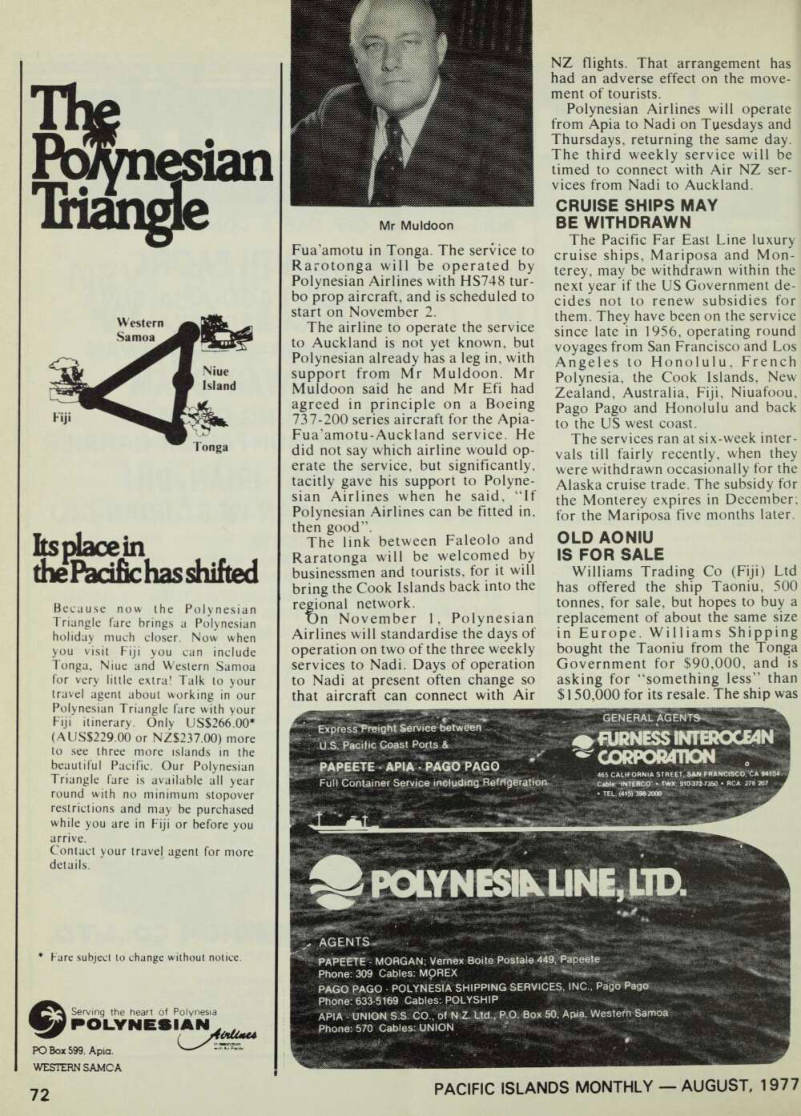
The NZ Prime Minister. Mr Mul doon. stopped off in Western Samoa in June for the independence celebrations while on the way to London for the Commonwealth conference. He took time out from the festivities to talk about air ser vices with the Western Samoa Prime Minister, Mr Tupuola Efi.
After this conference it was an nounced that Western Samoa would be the base for two new services with at least one of them operated by Polynesian Airlines in which the Western Samoa Government has an equity of more than 70% . The ser vices will be from Faleolo Airport, about 40 km from Apia, to Rarotonga, and to Auckland, via
Fua’amotu in Tonga. The service to Rarotonga will be operated by Polynesian Airlines with HS74B tur bo prop aircraft, and is scheduled to start on November 2.
The airline to operate the service to Auckland is not yet known, but Polynesian already has a leg in, with support from Mr Muldoon. Mr Muldoon said he and Mr Efi had agreed in principle on a Boeing 737-200 series aircraft for the Apia- Fua’amotu-Auckland service. He did not say which airline would op erate the service, but significantly, tacitly gave his support to Polyne sian Airlines when he said. “If Polynesian Airlines can be fitted in. then good”.
The link between Faleolo and Raratonga will be welcomed by businessmen and tourists, for it will bring the Cook Islands back into the regional network.
T)n November 1. Polynesian Airlines will standardise the days of operation on two of the three weekly services to Nadi. Days of operation to Nadi at present often change so that aircraft can connect with Air
NZ flights. That arrangement has had an adverse effect on the move ment of tourists.
Polynesian Airlines will operate from Apia to Nadi on Tuesdays and Thursdays, returning the same day.
The third weekly service will be timed to connect with Air NZ ser vices from Nadi to Auckland.
Cruise Ships May
Be Withdrawn
The Pacific Far East Line luxury cruise ships, Mariposa and Mon terey, may be withdrawn within the next year if the US Government de cides not to renew subsidies for them. They have been on the service since late in 1956, operating round voyages from San Francisco and Los Angeles to Honolulu. French Polynesia, the Cook Islands, New Zealand, Australia, Fiji, Niuafoou, Pago Pago and Honolulu and back to the US west coast.
The services ran at six-week inter vals till fairly recently, when they were withdrawn occasionally for the Alaska cruise trade. The subsidy for the Monterey expires in December; for the Mariposa five months later.
Old Aoniu
Is For Sale
Williams Trading Co (Fiji) Ltd has offered the ship Taoniu, 500 tonnes, for sale, but hopes to buy a replacement of about the same size in Europe. Williams Shipping bought the Taoniu from the Tonga Government for $90,000, and is asking for “something less” than $150,000 for its resale. The ship was
Mr Muldoon
known as the Aoniu when owned by Tonga, which bought her in 1958.
Tonga had operated her on trade routes covering Samoa. Tonga and Fiji. Williams Shipping kept her on the same run for about two months, but found this unprofitable, and confined her to operations within Fiji.
Pending sale of the Taoniu and acquisition of a new ship, Williams Shipping Co is operating that ship and another cargo-passenger ship, the Komaiwai, from Suva to Rotuma, northern Lau and Taveuni ports.
New Ships
For Micronesia
Micronesia celebrated United States Maritime Day by having the keel laid in Kobe, Japan, for the first of seven new field trip ships. The ceremony was in the Hashimoto yard where the ships will be built.
The first ship should be launched late in August and delivery is ex pected in November.
The ship. 66 tonnes dwt with a displacement of 1219 tonnes will be 56.4 metres long. It will be powered with twin screws and GM diesel motors 0f'455 hp, providing a speed of 1 1 knots. She will carry 660 ton nes of tuel, water, cargo, etc, and has accommodation for passengers and their baggage.
Roading Costs
Worry The Tongans
Finance is an inhibiting factor in the development of good, hard wearing roads in Tonga. With bitu men now costing more than $5O (or P5O) a barrel, compared with about P2O four years ago. there is not the same mileage as there was for the money.
Increasing traffic is demanding good roads, otherwise there is a hea vy bill for maintenance. Tonga’s Director of Works, Mr Chris Wilford, says there is little purpose in surfacing a road with bitumen unless the road is rebuilt and drain ed to a standard which will not un dermine the bitumen. A reseal coat of bitumen is needed on a busy road every six years, and it costs about P 5,625 a kilometre.
That is beyond the resources of Tonga, which finds it difficult to maintain coral roads. Under its 1965-70 development plan, Tonga spent P294,0000n roads. Under the
second plan, 1970-75, road ex penditure was $198,516.
About the only hope of getting a decent internal system lies with a grant from the UK. With that in mind, the Tonga Cabinet has ap proved an approach to the UK for permission to use a substantial part of the next grant for road construc tion. Then there might be some progress in alleviating the road dust problem.
New Centre For
Samoan Airline
Pago Pago-based South Pacific Is land Airways is building a new maintenance and administrative centre at Tafuna airport. American Samoa, on 280 square metres of land leased from the government.
The company will be able to un dertake round-the-clock main tenance of its fleet of aircraft, which now operates more than 140 scheduled flights weekly to nine is lands and four countries. SPIA will soon increase the number of flights to Tonga, and expects to open up new routes, possibly between Pago Pago and Rarotonga.
Launching Near For
Forum Line?
The South Pacific Regional Ship ping Council has called on the Pacific Forum Line to start op erations before the end of 1977, with one or more ships. The line came a step closer to realisation at Suva on June 16 when rep resentatives of eight governments signed a memorandum of unders tanding and company documents to set up the line, which will have its headquarters at Apia.
Ministers from the Cooks, Fiji, the Gilberts, Nauru, New Zealand.
Tonga and Western Samoa, and the acting High Commissioner for Papua New Guinea in Fiji, signed the documents. The new company members pledged to take an equal number of shares. The documents were signed during the fifth meeting of the council, which comprises ministers responsible for shipping in the countries of the SP Forum. It was set up in 1975 to find out how to improve shipping services in the South Pacific.
The Suva meeting was conducted by'the Nauru Minister of Island Development and Industry, Mr Kenas Aroi. Apart from Nauru and the other signatories to the docu
ments, Australia and Niue were also represented at the meeting.
Twenty-five members of the staff of Nauru Pacific Line have been told to find other jobs, which sig nifies that Nauru Pacific is closing down, at least so far as an Australian administration base is concerned.
PIM has heard that the Nauru Is land Council, which runs the ship ping line, is disposing of the ships.
This, thinks PIM, means that Nauru, as well as signing the memorandum setting up the Forum Line, is closing down its operation and placing its ships under the Forum Line’s flag.
Trimming Union
Sails For Forum Line
New Zealand maritime unions are likely to be more friendly to the Pacific Forum Line following a visit to New Zealand by a two-man delegation from Western Samoa Mr Vaovasamanaia Filipo, the Finance Minister, and Mr Neroni Slade, the Attorney-General. They met the president of the NZ Federa tion of Labour, Sir Thomas Skinner, representatives of five maritime unions, and the NZ Transport Minister, Mr McLachlan.
On their return they reported the unions had accepted, and had given support to, the concept for the op erations of the line. Mr McLachlan assured them there would be no trouble from the unions against any ship of the line. That attitude was also adopted by Sir Thomas
Fruit And Veg
Downed An Aircraft
A Nomad aircraft crashed sec onds after climbing from Wewak runway in Papua New Guinea because fruit and vegetables placed in the rear compartment without the pilot’s knowledge put the centre of gravity outside specified limits. The pilot had previously checked the loading.
The weight was insufficient to overload the aircraft, but it was enough to put it off balance. The aircraft stalled into the ground after take-off and became a total loss.
An investigation was carried out by the PNG Civil Aviation Agency, Australian Government aircraft fac tory experts and Douglas Airways.
The upshot of the investigation was a recommendation that warning signs in English, Pidgin and Motu be placed over the appropriate com partments of light aircraft operating in PNG. The signs should indicate that nothing should be loaded there without permission from the pilot
Another Ship
For The Cooks
The 407-tonne Mataora. ex- Fiducia, a steel-hulled. Dutch-built vessel, arrived at Rarotonga in June from Antwerp (Belgium), Vigo, in northern Spain, and Panama to enter the inter-Cook Islands trade.
Mataora was acquired by the Cook Islands shipping company of Silk and Boyd Ltd under an arrangement with the Cook Islands Government.
Suva Firm’S
3Ig Repair Job
One of the biggest ship repairs un iertaken in the Pacific Islands has ?een carried out by Millers, of Suva, m a Japanese tuna fishing boat, the Daio Maru, 437 tonnes. The Daio Vlaru had run aground on a reef in he Gilbert Islands in November, 1976, and had been towed 1,980 km o the ship-repair yard.
Millers engineers and repair yard itaff had to make a complete over laul of the engine room, refrigera ion unit, electrical system, propul ;ion machinery and steering gear.
Major repairs were required to the teel. The job cost $200,000 in abour and materials.
Marine Pacific Ltd and Salvage s acific Ltd refloated the Daio Maru n January, and the tow to Suva was mdertaken by Marine Pacific, fhere was one stop on the way at farawa.
Mjstralia-Png
R Ares Are Up
A new structure of air fares be ween Australia and Papua New Guinea came into force on July 15. fhere were increases in normal first md economy class fares to about the lame level as those applying on limilar short-haul routes in the South Pacific, while group rates vere reduced. A new excursion fare s lower than normal economy fares This new fare, an advance >urchase excursion fare, offers a iiscount of about 30% off the nor nal economy class fare, and ranges fom $143 return between Cairns md Port Moresby to $236 return between Brisbane and Port Moresby md S2BB between Sydney and Port Moresby.
The discount for group travel for 15 or more passengers has been ifted from 10% to 33% .
The new first class, economy class md advance purchase excursion ares, with the kina equivalent in are: Sydney-Port Moresby-Sydney Ist class, $648 (K 574): economy :lass. $4 06 (K 360); advance purchase. $2BB (K 255).
Brishane-Port Moresby-Brisbane Ist class. $530 (K. 470); economy ;lass. $3 32 (K 294); advance purchase. $236 (K 208).
Cairns-Port Moreshy-Cairns Economy class $194 (K 1 72); ad /ance purchase. $143 (K 1 27).