Noumea’s smelter
p. 63 · Read in the full issue
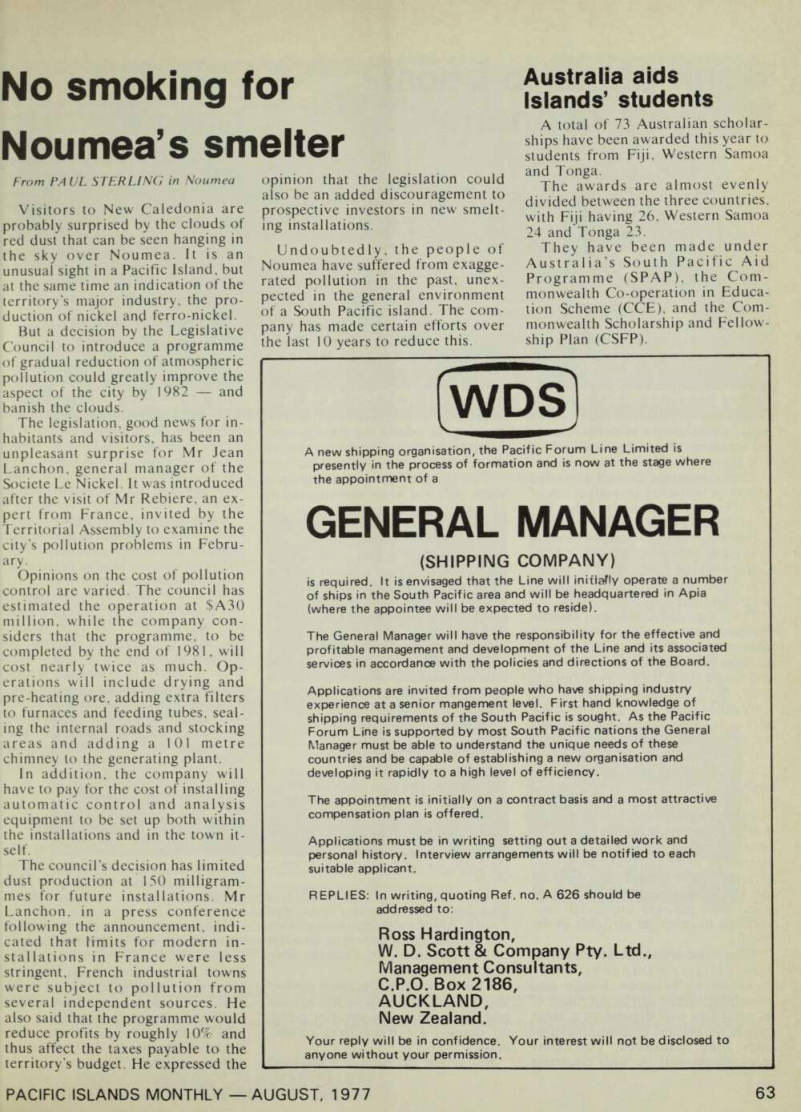
No smoking for Noumea’s smelter
From PAUL STERLING in Noumea Visitors to New Caledonia are probably surprised by the clouds of red dust that can be seen hanging in the sky over Noumea. It is an unusual sight in a Pacific Island, but at the same time an indication of the territory’s major industry, the pro duction of nickel and ferro-nickel.
But a decision by the Legislative Council to introduce a programme of gradual reduction of atmospheric pollution could greatly improve the aspect of the city by 1982 and banish the clouds.
The legislation, good news for in habitants and visitors, has been an unpleasant surprise for Mr Jean Lanchon. general manager of the Societe Le Nickel. It was introduced after the visit of Mr Rebiere, an ex pert from France, invited by the Territorial Assembly to examine the city's pollution problems in Febru ary.
Opinions on the cost of pollution control are varied. The council has estimated the operation at SA3O million, while the company con siders that the programme, to be completed by the end of 1981, will cost nearly twice as much. Op erations will include drying and pre-heating ore, adding extra filters to furnaces and feeding tubes, seal ing the internal roads and stocking areas and adding a 101 metre chimney to the generating plant.
In addition, the company will have to pay for the cost of installing automatic control and analysis equipment to be set up both within the installations and in the town it self.
The council’s decision has limited dust production at 150 milligram mes for future installations. Mr Lanchon. in a press conference following the announcement, indi cated that limits for modern in stallations in France were less stringent. French industrial towns were subject to pollution from several independent sources. He also said that the programme would reduce profits by roughly 10% and thus affect the taxes payable to the territory’s budget. He expressed the
opinion that the legislation could also be an added discouragement to prospective investors in new smelt ing installations.
Undoubtedly, the people of Noumea have suffered from exagge rated pollution in the past, unex pected in the general environment of a South Pacific island. The com pany has made certain efforts over the last 10 years to reduce this.
Australia aids
Islands’ students
A total of 73 Australian scholar ships have been awarded this year to students from Fiji, Western Samoa and Tonga.
The awards are almost evenly divided between the three countries, with Fiji having 26, Western Samoa 24 and Tonga 23.
They have been made under Australia’s South Pacific Aid Programme (SPAP), the Com monwealth Co-operation in Educa tion Scheme (CCE), and the Com monwealth Scholarship and Fellow ship Plan (CSFP).