Sugar Rules The Economy
pp. 59-61 · Read in the full issue
In Fiji And Queensland
Fiji and Queensland have had a common interest sugar for close on 100 years. Sugar, more than anything else, has built up the Fiji economy to what it is today.
Queensland, on the other hand, with a variety of natural resources, has never had to rely largely on the one
commodity or product.
Nevertheless, sugar has made an important contribution to the development of tropical and sub tropical Queensland and the north eastern area of New South Wales.
Australian sugar exports in 1975, for example, were worth about $690 million. A big percentage of about 300,000 people in the sugar pro ducing areas north of the Tropic of Capricorn look to sugar for their livelihood.
Most sugar farms are fully mechanised. Machines are used for ploughing, plartting, harvesting and transport. Here, too, there have been big savings in costs and time.
Farm mechanisation and bulk handling are probably envied by those in the sugar industry in Fiji.
But these methods are not likely to be introduced on any large scale, now or in the foreseeable future Apart from the huge capital invest ment required, which, of course, would make the industry much more efficient, the human factor is too closely involved.
Many Fiji families depend on earnings from farm work, cane-cut. ting and loading ships’ holds from jute bags. Fiji is just not in a position to absorb, in other industries, the
labour surplus which would result from the introduction of modern methods. In Australia there are so many alternative employment opportunites that a change from manual work to mechanisation can be achieved with relatively little disruption and without disastrous economic effects.
The Australian cane farmer, like his Fiji counterpart, is a small farmer, although his holding is bigger. Most Australian cane farms are about 45 hectares (110 acres) while in Fiji most farms are about 4.04 ha (10 acres).
Australian cane yields to the hectare, generally speaking, are higher than in Fiji, and in a good season a farmer could gross about $60,000 on which, of course, he would have to meet heavy charges and taxes.
Before the cane is harvested it is burned to remove leaves, weeds and other trash among the stalks. Burnin g simplifies harvesting and, by saving time, reduces harvesting costs.
In Fiji, the millers did their best to deter farmers from burning their cane before harvesting as the unburned cane yielded a better-quality sugar. Cutting burned cane is a dirty job, but the cutters themselves preferred it for burning destroyed the hornets. But the main reason for burning was that the cane farmer needed his money quickly. Burned cane has to be harvested and milled quickly before it deteriorates and it received a priority at the mill.
On yield of sugar, there is not
much difference between Australian and Fiji cane. In Fiji it takes about 7.8 tonnes of cane to make a tonne of raw sugar. In Australia, in 1976, the average was 7.08 tonnes of cane to make a tonne of sugar. The Australian yield has varied from 6.94 tonnes to 7.69 tonnes since 1971.
The area under cane in Australia harvested for milling in 1976 was 288,227 ha, which yielded 23,343,- 662 tonnes of cane for crushing. The 1976 yield of sugar was 3,295,558 tonnes. The area planted and the yield have increased each year since 1971, except for 1973.
There are 33 raw sugar mills in Australia. Twelve are co-op eratively owned by cane farmers, 10 by CSR Ltd and 11 by other com panics. There are bulk terminals at Cairns, Mourilyan, Lucinda, Townsville, Mackay and Bundaberg with a total capacity of 1,475,000 tonnes. This is the biggest bulk storage capacity in the world, CSR Ltd has refineries in Brisbane, Sydney, Melbourne, Adelaide and Perth and refines about 96% of Australian sugar. The Millaquin refinery at Bundaberg refines about one-third of the sugar required for the Queensland market.
Cane crops extend along about 2,100 kilometres of the coastline from Mossman, north of Cairns, to Grafton about 650 kilometres north of Sydney. There are about 7,200 farms.
For many years, Australian sugar
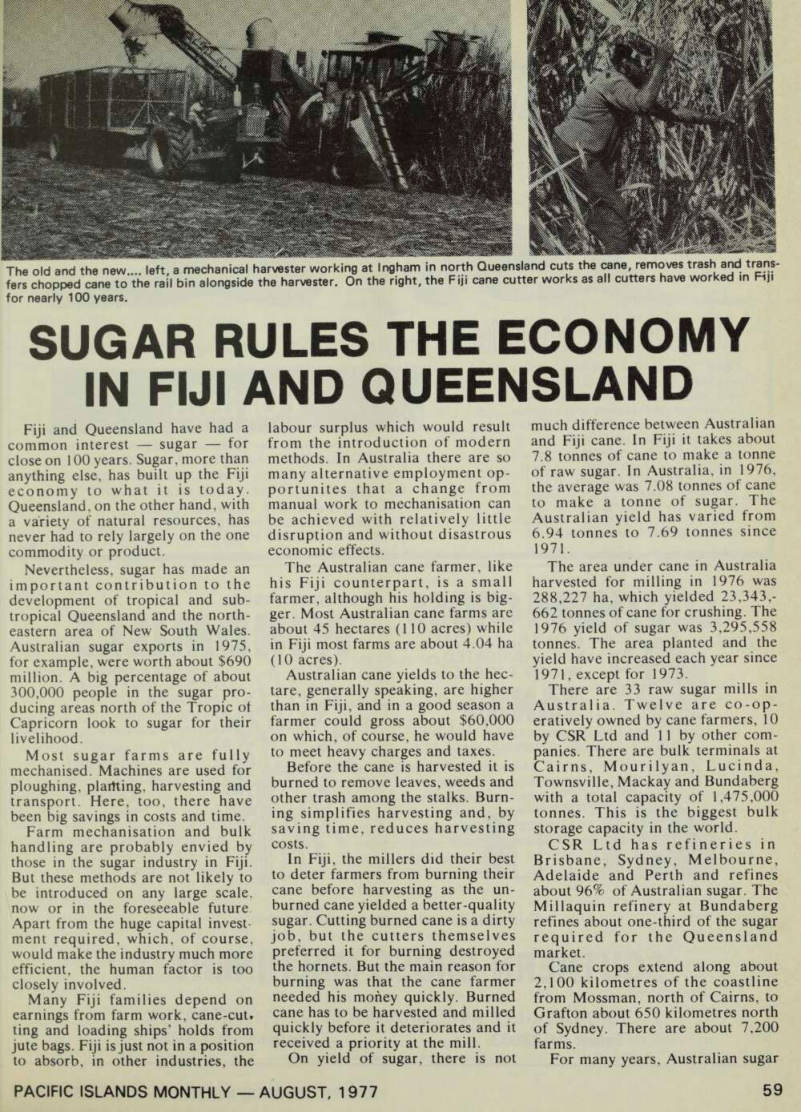
The old and the new... left, a mechanical harvester working at Ingham in north Queensland cuts the cane, removes trash and trans fers chopped cane to the rail bin alongside the harvester. On the right, the Fiji cane cutter works as all cutters have worked in Fiji for nearly 100 years.
was sold in three distinct categories to the domestic market, under the various agreements (Com monwealth Sugar Agreement, Inter national Sugar Agreement, US Sugar Act, etc) and the residual world free market.
Under drastically changed cir cumstances, Australia now develops long-term export contracts with established customers. Anything left over is sold on the free market on the basis of ruling world prices.
The Sugar Board, set up in 1923, subject to the Queensland Minister for Primary Industry, has an almost complete control of the industry, and also has power to control, man age, operate and maintain the bulk sugar terminals.
The Queensland Government, as owner of all sugar produced, con tracts with CSR Ltd and the Milla quin Sugar Co to refine and dis tribute sugar for the home market. It also contracts with CSR Ltd to finance the sugar crop and market all exports of Australian sugar.
Local cane prices boards draw up awards for each season governing the conditions relating to the supply and delivery of cane to the mills, payment and fixing individual farm peaks. These awards, if there is no appeal, are binding.
In 1975 favourable marketing prospects led the Queensland Government to approve an increase in industry capacity of about 10%, which brought in another 38,000 ha.
All the raw sugar produced in Australia is pooled for marketing.
Sugar industry income available for distribution to growers is the total proceeds obtained from sales of home consumption sugar and ex ported raw sugar, less costs of refin ing, transport, export marketing and other marketing costs incurred on behalf of the sugar pool.
Fiji has a similar system.
The sharing of sugar industry in come between growers and millers is determined by the Central Sugar Cane Prices Board. The division has been about two-thirds to growers and one-third to millers, but can vary slightly according to the quali ty of cane grown and the efficiency of sugar milling. The methods of payment for cane and raw sugar, by placing premiums on quality, play an important part in promoting farming and milling efficiency.