With water everywhere, Islanders
pp. 55-57 · Read in the full issue

Business
With water everywhere, Islanders are still tillers of the soil
By Norman Baxter
The economy of the South Pacific Islands, almost without exception, is based on agriculture and will be for many years in spite of the encroach ment of western influences. There is profitable mining in some groups, and growing secondary industries in others, but from whatever angle the picture is looked at it always comes back to agriculture.
Although copra is no longer king overall, it is still an important in dustry and still the main one for most of the groups. The introduc tion of crops from other tropical areas has given a boost to the econ omy of some groups.
Beef cattle projects are being ex tended throughout the Pacific, with most Island governments aiming at supplying their own needs and building up export markets in the not too distant future. The pig in dustry, so long the source of meat for the Islanders, is also being ex panded in many areas.
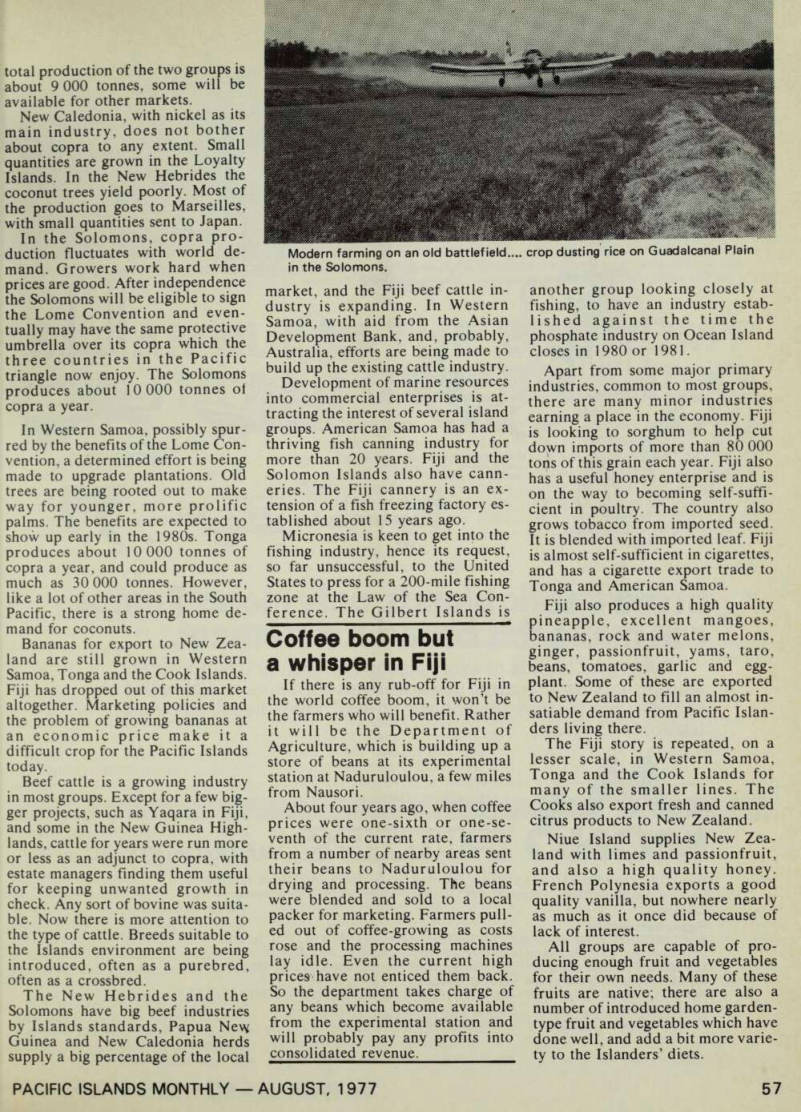
Rice, another introduced crop, is rapidly becoming a staple food in a number of groups. There are a num ber of big rice projects under way, or in the pipeline. As with beef, rice projects are aimed at making the countries concerned self-supporting in this commodity and perhaps building up an export trade as in the Solomons.
The rice industry, on a per capita basis, is probably more advanced in the Solomons than anywhere else in the Pacific. Fiji has been slowly building up a rice industry for many years, with some speeding up re cently. Fiji has a natural rice bowl in the Rewa Valley, where sugar was grown for more than 70 years. CSR Ltd introduced rice as an alterna tive when it closed the Nausori mill in 1959, but farmers did not take kindly to the change and the indus try did not flourish in that area as it should.
However, there has been a new approach in the last three or four
years, and with other areas of Viti Levu and Vanua Levu likely to become paddy fields, Fiji could become self-supporting in rice in a few years.
Papua New Guinea is now reaping the benefit from the introduction of coffee, cocoa, tea and palm oil, world prices for which are booming.
Like all booms, however, there is bound to be a recession, and it is pleasing to see that efforts are being made to build up stabilisation funds to act as cushions when prices come down.
Copra is no longer the major pri mary industry in Papua New Guinea, the biggest copra producer in the South Pacific. But it is still an important crop there. It is also im portant in Fiji, where sugar has been the main primary industry prac tically since Cession in 1874, and it remains the main primary product in most of the other countries in the South Pacific.
Fiji, Western Samoa and Tonga as associate members of the European
Economic Community, enjoy a uni que protection under the Lome Convention, signed in 1975. Subject to certain conditions, prices for commodities they send to the EEC are stabilised at the average price of the previous four years. To qualify, the money a commodity earns from exports to all destinations must be 7‘/2% of export earnings from all commodities. But for the least developed, land-locked and Island countries, the figure is only 272%, and that covers Fiji, Western Samoa and Tonga. Papua New Guinea 1 which has also joined the Lome Convention, can expect simi lar benefits when her associate status is ratified.
The Gilbert Islands and Tuvalu may have a new market for their copra in the Marshall Islands, where a processing plant has been established at Majuro. The Marshall Islands Development Authority has made tentative arrangements to buy 6 800 tonnes of copra a year from the Gilberts and Tuvalu. As the
total production of the two groups is about 9 000 tonnes, some will be available for other markets.
New Caledonia, with nickel as its main industry, does not bother about copra to any extent. Small quantities are grown in the Loyalty Islands. In the New Hebrides the coconut trees yield poorly. Most of the production goes to Marseilles, with small quantities sent to Japan.
In the Solomons, copra pro duction fluctuates with world de mand. Growers work hard when
prices are good. After independence
the Solomons will be eligible to sign the Lome Convention and even tually may have the same protective umbrella over its copra which the three countries in the Pacific triangle now enjoy. The Solomons produces about 10 000 tonnes of copra a year.
In Western Samoa, possibly spur red by the benefits of the Lome Con vention, a determined effort is being made to upgrade plantations. Old trees are being rooted out to make way for younger, more prolific palms. The benefits are expected to show up early in the 1980 s. Tonga produces about 10 000 tonnes of copra a year, and could produce as much as 30 000 tonnes. However, like a lot of other areas in the South Pacific, there is a strong home de mand for coconuts.
Bananas for export to New Zea land are still grown in Western Samoa, Tonga and the Cook Islands.
Fiji has dropped out of this market altogether. Marketing policies and the problem of growing bananas at an economic price make it a difficult crop for the Pacific Islands today.
Beef cattle is a growing industry in most groups. Except for a few big ger projects, such as Yaqara in Fiji, and some in the New Guinea High lands, cattle for years were run more or less as an adjunct to copra, with estate managers finding them useful for keeping unwanted growth in check. Any sort of bovine was suita ble. Now there is more attention to the type of cattle. Breeds suitable to the Islands environment are being introduced, often as a purebred, often as a crossbred.
The New Hebrides and the Solomons have big beef industries by Islands standards, Papua Nev* Guinea and New Caledonia herds supply a big percentage of the local
market, and the Fiji beef cattle in dustry is expanding. In Western Samoa, with aid from the Asian Development Bank, and, probably, Australia, efforts are being made to build up the existing cattle industry.
Development of marine resources into commercial enterprises is at tracting the interest of several island groups. American Samoa has had a thriving fish canning industry for more than 20 years. Fiji and the Solomon Islands also have cann eries. The Fiji cannery is an ex tension of a fish freezing factory es tablished about 15 years ago.
Micronesia is keen to get into the fishing industry, hence its request, so far unsuccessful, to the United States to press for a 200-mile fishing zone at the Law of the Sea Con ference. The Gilbert Islands is
another group looking closely at fishing, to have an industry estab lished against the time the phosphate industry on Ocean Island closes in 1980 or 1981.
Apart from some major primary industries, common to most groups, there are many minor industries earning a place in the economy. Fiji is looking to sorghum to help cut down imports of more than 80 000 tons of this grain each year. Fiji also has a useful honey enterprise and is on the way to becoming self-suffi cient in poultry. The country also grows tobacco from imported seed.
It is blended with imported leaf. Fiji is almost self-sufficient in cigarettes, and has a cigarette export trade to Tonga and American Samoa.
Fiji also produces a high quality pineapple, excellent mangoes, bananas, rock and water melons, ginger, passionfruit, yams, taro, beans, tomatoes, garlic and egg plant. Some of these are exported to New Zealand to fill an almost in satiable demand from Pacific Islan ders living there.
The Fiji story is repeated, on a lesser scale, in Western Samoa, Tonga and the Cook Islands for many of the smaller lines. The Cooks also export fresh and canned citrus products to New Zealand.
Niue Island supplies New Zea land with limes and passionfruit, and also a high quality honey.
French Polynesia exports a good quality vanilla, but nowhere nearly as much as it once did because of lack of interest.
All groups are capable of pro ducing enough fruit and vegetables for their own needs. Many of these fruits are native; there are also a number of introduced home garden type fruit and vegetables which have done well, and add a bit more varie ty to the Islanders’ diets.
Modern farming on an old battlefield... crop dusting rice on Guadalcanal Plain in the Solomons.