Magazine
pp. 38-43 · Read in the full issue
Norfolk: From hell-hole to heaven-on-earth
Norfolk Island, 7 676 km north-east of Sydney, is the second oldest British settlement in the South Seas, having been occupied within a few weeks of the first British settlement at Sydney in 1788. It became a vile penal colony until 1856 when the descendants of the Bounty mutineers moved there from Pitcairn, and turned it into their own particular paradise. Recently a paper called the Nimmo Report has threatened to change the island's life style, and this article outlines the arguments, against the background of the Norfolk Island tradition.
By Alan Gill
The Australian Minister for Ad ministrative Services, Senator Reg Withers, and Federal Attorney- General. Mr Bob Ellicott, were guests of honour at Norfolk Island’s 121st Anniversary Day celebrations on June 8.
The grander-than-usual celebra tions also marked the Queen's silver jubilee.
Bounty mutineers may have seiz ed one of her ancestor’s ships but their descendants are today the monarch's most loyal subjects. And with good reason —the bid to avoid total integration into Australia (and become liable for Australian taxa tion) is based partly on the claim that in the 19th century Queen Vic toria had given Norfolk to the Pit cairners.
At the traditional picnic in the now-roofless former gaol. Cr Bill Blucher. standing just inside Gallows' Gate, reminded the guests of the settlement’s origin as a penal colony.
"At one lime the penalty for being hungry and borrowing your neighbour's bread was transporta tion to this hell-hole that we now regard as a paradise and our heaven on earth.”
Clearly. Cr Blucher, president of committees on Norfolk Island Council, is unwilling to see his “paradise” go a message con veyed to Senator Withers and Mr Ellicott as they tucked into their sucking pig and other delicacies.
A few hours earlier Cr Blucher. in
the uniform of Captain Denham.
RN, who with the departing convict settlement's commissariat storekeeper had facilitated the Bounty descendants’ arrival, joined the Administrator of Norfolk. Mr Desmond O’Leary, and Mrs O’Leary at Kingston jetty.
Mr O’Leary, alias Mr Stewart (the commissariat storekeeper) and his wife wore period costumes hired in Sydney. It was a popular touch for the first time an Administrator had participated in. rather than merely watched, the re-enacted arrival of the Adams, Christian.
Young. Evans. McCoy. Quintal, Buffett. Nobbs and other families from Pitcairn.
The day before the celebrations, the two visitors from Canberra had attended an open meeting of the Norfolk Island Council to discuss the Royal Commission into Norfolk Island (the Nimmo Report), which recommends that Norfolk's popula tion of 1500 should have a voice in the Federal Parliament, be eligible for Australian welfare benefits and pay Australian taxes.
Cr Blucher, who has the blood of that famous German Field Marshal (remember Waterloo) and also that of the Christian and Quintal mutineer families said islanders had their own “distinct culture, history and bloodlines” and it was absurd to regard Norfolk as a bit of Australia 1 000 miles out in the Pacific.
He told the two ministers that he
and his colleagues did not feel deprived by not having the vote.
The two ministers asked council members what they considered to be their present nationality and status.
Cr John Rives said: “We are de facto Australians. I like to think we have the protection of Australia in our external needs.” Cr Greg Quin tal told the ministers: T always classify myself as a Norfolk Islander not as an Australian ... I intend no disrespect by this.”
Cr Roy Smith said: “We are Australian, and have proved it in two world wars, but are a different type of Australian.”
The two ministers were given vot ing papers relating to the poll taken some weeks earlier which purported to show that the majority of islan ders wanted Norfolk to remain “a distinct and separate Territory of Australia, with its own system of laws, benefits and taxes”.
Senator Withers suggested that the poll had been conducted in an unsatisfactory manner and did not meet Australian requirements for a secret ballot. In a subsequent radio interview he appeared to express himself more forcefully, considering the poll “totally and utterly value less”.
Happily, courtesy still reigns supreme on Norfolk. On the day after the council meeting, Cr Blucher acted the convivial host to the two ministers at the Bounty pic nic, and applauded Senator Withers’
“all-comers” team which trounced
the Norfolk side at cricket.
Still dressed as Captain Denham, RN, he went on to win the old-time waltz contest at the Bounty Ball.
Senator Withers charmed the local lasses with his progressive barn dance and Mr Ellicott performed a versatile, if unorthodox, rock’n’roll.
The council believes that im
position of “mainland-style” taxa
tion would send prices rocketing, cripple the tourist industry, and ac tively discourage younger islanders from remaining on Norfolk.
With the exception of the tourist revenue Norfolk’s income is small.
Main sources of public revenue were (in 1 975) customs duty $409 735, stamp sales $347 713, company fees $197 961, liquor sales profit $149 453, Australian Government grant $126 000.
Visitors are charged a tourist tax of $2 a person payable on departure.
The official, who asked me to pay up, was so apologetic about the mat ter (the receipt bore an equally courteous statement about why the tax was necessary) that I felt like
paying twice.
Leading islanders dispute recent widespread claims that Norfolk Is land “costs” Australia S2V2 million every year in subsidies.
The council maintains that there is no poverty on Norfolk, negligible crime (there are three policemen on the island), and that social security benefits are unnecessary. Where hardship occurs the family spirit en sures that each looks after its own.
A minority of residents vocally dispute this situation. Mrs Carol Adams, who has been circulating a pro-Nimmo petition, stopped me in the street to say that a small number of islanders, having returned to Norfolk after “making their pile” on the mainland, were presenting a false picture for selfish motives. She said that for the majority of islan ders the introduction of mainland social security benefits would more than compensate for the imposition of taxes.
Certainly, the island looks prosperous. This year for the first time there are more cars than peo ple. Most cars the one hired to Senator Withers had the label removed in advance carry stickers proclaiming Lub-be Nor folk (leave Norfolk alone).
Some Norfolk people relate the
island’s prosperity to the absence of trade unions. They fear this situ ation would disappear if the island were totally integrated with Australia. A women in a chemist shop told me; “We don’t want Bob
Hawke and his friends to take over Norfolk.”
The absence of employer and
employee cartels has unexpected
benefits for the consumer. I was told that an islander who dies receives an
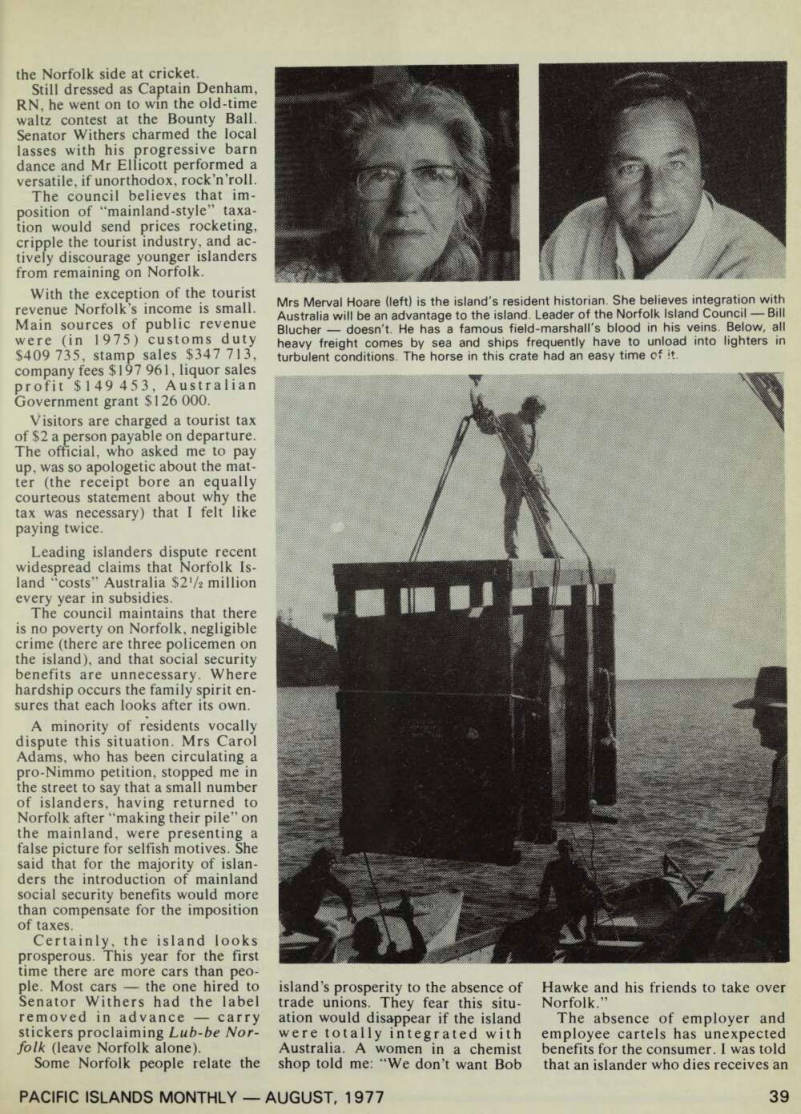
Mrs Merval Hoare (left) is the island's resident historian. She believes integration with Australia will be an advantage to the island. Leader of the Norfolk Island Council - Bill Blucher - doesn't. He has a famous field-marshall's blood in his veins. Below, all heavy freight comes by sea and ships frequently have to unload into lighters in turbulent conditions. The horse in this crate had an easy time of it.
all-inclusive funeral (including lin ed wooden coffin) for $lO. Visitors are also eligible for this benefit.
Mourners generally do much of the digging, while the bell of the Methodist church signals to the en tire population that a death has oc curred.
Many islanders are prepared to pay some form of taxes provided the revenue benefits Norfolk Island. Mr Tom Lloyd, editor, printer and sole reporter on the Norfolk Islander, embraces this “moderate anti” stance.
He told me: “I would really like Norfolk to be a kind of people’s park, where folk can unwind away from television, pollution, and all the problems of ’mainland’ living. I can see some good points about Nimmo but cannot agree that taxes raised in Norfolk Island should leave Norfolk Island. I fear we would all become mere numbers in some Canberra computer.
“1 think many of us would be pre pared to pay taxes if all the revenue were to remain here, less, perhaps, a small portion for the defence of Norfolk or similar essential pur
pose.”
During the past 18 months there has appeared another publication on Norfolk, a monthly, the Norfolk Is land News, owned and edited by an American-born resident, Mr Ed Howard, who took out Australian citizenship (on Norfolk).
He tends to be emphatic where others are speculative about the ‘Tights” accorded by Queen Vic toria to the Bounty descendants. He supports the council’s view.
An opposing view is taken by Mrs Merval Hoare, long-term “main land” resident of Norfolk, the is land’s local historian and author of Rambler’s Guide to Norfolk Island and Norfolk Island: An Outline of its History.
Mrs Hoare, who came from New Zealand 28 years ago. supports the Nimmo Report and believes that the introduction of Australian “main land” social security benefits will be a boon to the elderly Pitcairn de
continued on p 43
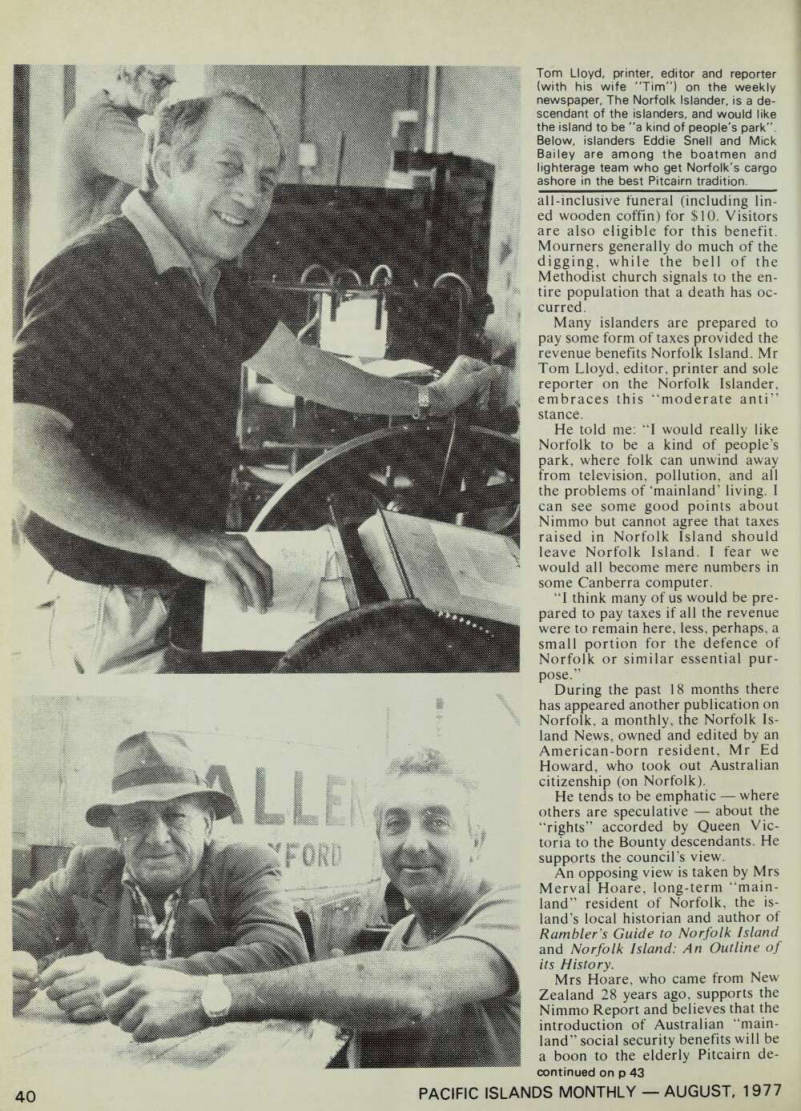
Tom Lloyd, printer, editor and reporter (with his wife "Tim") on the weekly newspaper, The Norfolk Islander, is a de scendant of the islanders, and would like the island to be "a kind of people's park".
Below, islanders Eddie Snell and Mick Bailey are among the boatmen and lighterage team who get Norfolk's cargo ashore in the best Pitcairn tradition.
Philip Island
scendants now eligible for a “miserable $l5 a week” from the Senior Citizens’ Fund (previously known as Distressed Persons’
Fund).
She points out that many main land residents already pay Australian taxes on their pensions and other income but are unable to claim benefits.
Mrs Hoare does not believe that Norfolk was officially ceded to the arriving Pitcairn Islanders.
She says that according to George Hunn Nobbs, the first pastor of the Pitcairn community, who arranged and personally led the migration from Pitcairn to Norfolk (in 1856), articles of cession were read to him by Captain Stephen Fremantle, of HMS Juno, and later handed to the Magistrate, Frederick Young.
This document, often quoted as evidence for the islanders’ “rights” to Norfolk, was discovered by Mrs Hoare after a lapse of more than 100 years among Bishop George Augustus Selwyn’s papers at the Auckland Institute and Museum.
The document outlines the dis tribution of land for various pur poses but makes no reference to “ownership” or legal rights by Pit cairners in their new homeland.