Tropicalities
pp. 29-31 · Read in the full issue

Tune in
a tsunami
A popular radio programme at the University of Hawaii these days is “tune in a tsunami”.
Though popularly called tidal waves, the dreaded tsunamis are not caused by the tide, nor are they or dinary ocean swells. According the US National Geographic Society, tsunamis are a series of almost in visible seismic sea waves that travel at more than 600 miles an hour in very deep water. They are detectible while at sea only by sensitive shore based instruments.
As they approach land, however, tsunamis suddenly become terrify ing walls of water that sweep every thing before them.
Scientists at the University of Hawaii are now testing a new early warning system to locate the deadly waves. Earthquakes that cause tsunamis generate disturbances in the ionosphere high above the earth that can be detected by radio.
In the new warning system, a special radio receiver on the island of Hawaii reads signals from a “time-and-frequency” station on Kauai. Reflected from the ionosphere, the signals will show a shift in frequency if an earthquake with tsunami potential occurs. The location and size of the quake are determined by other equipment.
Hawaii is especially vulnerable to tsunamis. In the last 150 years, at least 85 have struck the islands, causing almost 400 fatalities.
More about
the Coe family
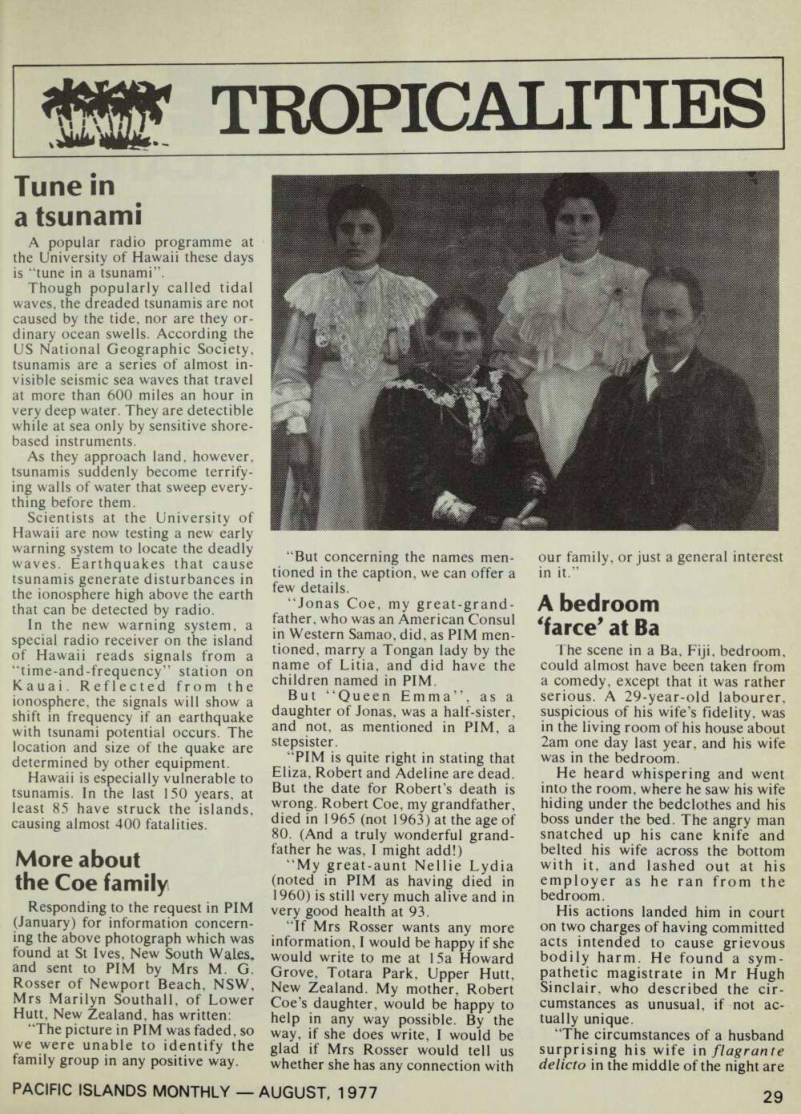
Responding to the request in PIM (January) for information concern ing the above photograph which was found at St Ives, New South Wales* and sent to PIM by Mrs M. G.
Rosser of Newport Beach, NSW, Mrs Marilyn Southall, of Lower Hutt, New Zealand, has written: “The picture in PIM was faded, so we were unable to identify the family group in any positive way.
“But concerning the names mentioned in the caption, we can offer a few details.
“Jonas Coe, my great-grandfather, who was an American Consul in Western Samao, did, as PIM mentioned, marry a Tongan lady by the name of Litia, and did have the children named in PIM.
But “Queen Emma”, as a daughter of Jonas, was a half-sister, and not, as mentioned in PIM, a stepsister.
"PIM is quite right in stating that Eliza, Robert and Adeline are dead.
But the date for Robert’s death is wrong. Robert Coe, my grandfather, died in 1965 (not 1963) at the age of 80. (And a truly wonderful grandfather he was, I might add!) “My great-aunt Nellie Lydia (noted in PIM as having died in 1960) is still very much alive and in very good health at 93.
“If Mrs Rosser wants any more information, I would be happy if she would write to me at 15a Howard Grove, Totara Park, Upper Hutt, New Zealand. My mother, Robert Coe’s daughter, would be happy to help in any way possible. By the way, if she does write, I would be glad if Mrs Rosser would tell us whether she has any connection with
our family, or just a general interest in it.”
A bedrOOMl
af Ra ■ dl Dd The scene in a Ba, Fiji, bedroom, could almost have been taken from a comedy, except that it was rather serious. A 29-year-old labourer, suspicious of his wife’s fidelity, was in the living room of his house about 2am one day last year, and his wife was in the bedroom.
He heard whispering and went into the room, where he saw his wife hiding under the bedclothes and his boss under the bed. The angry man snatched up his cane knife and belted his wife across the bottom with it, and lashed out at his employer as he ran from the bedroom.
His actions landed him in court on two charges of having committed acts intended to cause grievous bodily harm. He found a sym pathetic magistrate in Mr Hugh Sinclair, who described the cir cumstances as unusual, if not ac tually unique, “The circumstances of a husband surprising his wife in flagrante delicto in the middle of the night are
productions and form the basis of the subject of numerous theatrical many farcical situation comedies,”
Mr Sinclair said.
But the realities of life, as such, were serious.
“The man, to all accounts, a faithful husband and good father to five children who surprises his wife in such a situation can well be ex cused from not appreciating the comical aspect of such situations to others,” Mr Sinclair said.
"It is understandable for such a man to act in anger, for his mind to be temporarily warped by his hor ror, and to act i I logical ly in his anger.”
Mr Sinclair said a deterrent sen tence was not appropriate. He sen tenced the man to 12 months’ im prisonment on each charge, to be served concurrently, then suspend ed sentence for 18 months.
There was a happy sequel. The court was told the husband and wife were reconciled and had moved elsewhere.
Claret for the
stomach’s sake
As was the case in a number of other Pacific Island countries in the past, the Cook Islands had a series of acts and regulations which either forbade or restricted the sale of alcoholic liquor.
These prohibitions grew in the main from the desire of the mission aries to shield the indigenous peo ples from the evils of the demon grog- However, there were always those who sought means to satisfy their thirst. On February 5, 1905, the Re sident Agent at Mangaia wrote to the Resident Commissioner: “Clause 22 of the Statute of Mangaia is very clear as far as the prohibition of liquor as a beverage is concerned and indeed I cannot see why it should be regarded as a beverage as at least two of the Euro peans on the island are quite unable to take it in moderation. Infinitely better for them, therefore that they should not have it at all. But I do not think this applies to claret. which is taken with meals and therefore is really a food. The new liquor law of your Rarotonga Island Council seems to make an exception in favour of claret”.
There were some odd attitudes to the matter of racial origins as far as
allowing access to alcohol was con cerned. In 1904, The Rarotonga Is land Council enacted an ordinance to regulate the sale of spiritous li quor, section 5 reading “No spiritous liquor shall be sold or given to any Native inhabitant of any Polynesian island, except on the written permission of the Resident Medical Officer. For the purposes of this ordinance all Chinamen shall be deemed to be Native inhabitants of Rarotonga.”
Over the years, there have been some notable hard drinkers residing in the Cook Islands but in 1911 they must have been quite exceptional.
On July 17, 191 1, the Governor in New Zealand assented to an or
dinance prohibiting the importing
except under conditions of an American cod-liver oil extract. The ordinance included the following statement, “And whereas in the opi nion of the Governor the im portation of a medical preparation stated to contain 17% alcohol and called or known as ‘Wampole’s Ex tract of cod-liver oil’, prepared by Henry K. Wampole and Co (Incor porated), Philadelphia, United States of America, into the said is lands is likely to be injurious to the inhabitants by reason of their using the same as drink of an intoxicating
nature
Lae the last outpost
Last January this column gleefully reported that more than 12 months after independence, the Papua New Guinea Post Office was still postmarking local mail with TP & NG, which means “Territory of Papua and New Guinea,” and which ceased to be meaningful years ago.
Well, we can report that things are improving. We’ve just got a let ter from a government department in Lae, franked TPNG. They’ve got rid of that “and”. Perhaps next year they’ll go to work on the “Territo ry”.
Siers is
sailing again
New Zealander Jim Siers, who sailed an outrigger canoe, the Taratai from the Gilbert Islands to Fiji in 1976, plans another adven ture to prove a point. He is sailing
another vessel, built in Fiji, to New Zealand the long way round, follow ing the path of ancient Fijians. He intends to make landfalls in Samoa, Tonga, the Marquesas and the Cook Islands.
His vessel, the Taratai II was launched at the Regent Hotel, in Nadi Bay, by the Tui Nadi, Ratu Napolioni Dawai, who splashed ya qona over her. Many people, in cluding Gilbertese, helped Siers to build the boat, which has a hull of marine dakua, a present from the Pacific Lumber Co, of Lautoka.
Siers said the ancient Fijians pro duced a beautiful pottery called lapita. Pottery found in the Mar quesas, and dated to the beginning of the Christian era had since been identified as having been made in the Rewa delta, or that the materials from which pots were made came from there. There were those who felt that pottery made in Fiji was traded to Tonga and from there taken on a voyage which finished in the Marquesas.
Scientists tour
the Islands
The Royal Society of New Zea land has organised a scientific ex pedition to the outlying islands of Fiji and Tonga. Seventeen scientists interested in botany, biology and geology among other things have been visiting Ata and Fua in the Tongan Group and the Lau Islands of Fiji.
Two additional projects involved a linguistic survey of island dialects and the recording and documenta tion of Lau music.
The scientists, from universities, government departments and museums set off aboard the Depart ment of Scientific and Industrial re search vessel Tangaroa on June 15.
The Tangaroa, which also carries out oceanographic surveys in the nearby regions, was due to return to Wellington on July 29.
Many of the islands have rarely been visited by scientists. The ex pedition continued the Royal So ciety’s policy of fostering scientific research in the South-west Pacific region. The last expedition in 1969 marked the Bicentenary of Captain James Cook’s first voyage to the region.
Expedition leader was J. V. Eade of the New Zealand Oceanographic Institute.