Nutshell
pp. 20-25 · Read in the full issue


The
News
In A
Nutshell
A Bouncer!
Nauru MP Rene Harris lost his seat in parliament through a court conviction for assault but he bounced back in no uncertain manner when the by-election was held. He polled 95 votes in his Aiwo constituency, a majority of 32 over his three opponents Reginald R. Akiri (41), John C. D. Bill (12) and August D.
Deiye (10). The Deputy Speaker, Derog
Gioura, lost his seat through a Supreme Court order which ruled that his election for the Übenide constituency was in valid. Kennan R. Adeang was declared elected in his stead. The Member for Yaren, Leo Keke, was elected Deputy
Speaker.
Moving House
The Congress of Micronesia is moving house from Saipan to Ponape, with a first session in its new abode scheduled for August 15-20. The COM will lead a general exodus of Trust Territory government departments as the standing decision that Ponape should be the new capital is put into effect.
All correspondence to the COM should now be addressed to Kolonia,
Ponape.
A Burning Question
A huge banyan tree collapsed and fell across the main road on the Island of Makira in the Solomons. No one was hurt but the tree blocked the road. Two trucks and a trailer travelling from Kira Kira were trapped on one side and another vehicles was stranded on the other side. How to clear the road? Set fire to the tree. The fire burned for two
days!
Tragic Coincidence
Paul Tatamat, 28, a taxi driver of Nguna, New Hebrides, was found dead
in bed in May at the Foyer-Hostel, Vila.
A post mortem failed to discover the cause, and organs from his body were sent to Australia for scientific exam ination. Four years ago his brother Wilfred, a police sergeant, was found dead in bed in Santo.
Boys Wanted!
Dick Kidby, a former Melbourne busi nessman with a lifelong interest in foot ball, has thrown in his lot with the Papua New Guinea Office of Sport, a govern ment agency, and is helping to promote Australian Rules football in PNG.
To help get his plans moving he sent circulars- to 83 high schools in PNG to assess their requirements for 1978. One of the early answers received said: “Dear Sir; Thank you for your interest, but we wish to advise that this is a girls’ school.
Our only requirements for 1978 are
boys.”
The Road Back
Japanese-born Taicho Futemma, 71, was a tailor in Vila before World War 11. When the war broke out he was in terned in Australia and was repatriated to Japan at the war’s end. He had left behind in Vila his wife, their three sons and two daughters.
He returned to Vila on a visit in May, found his wife, and learned that they now had more than 60 grandchildren and great grandchildren.
Both he and his wife had since remar ried, but in both cases their partners had since died.
Million For Artifacts
A huge collection of South Pacific ar tifacts fetched nearly $1 million at auc tion at Christies, London, in June.
A spokesman for the auctioneer said highlights included a heavily tattooed shrunken Maori head with black hair and a plugged nose, and a red and yellow Hawaiian cloak made from half-a million parrot feathers.
The collector, Mr James Cooper, haunted British dealers’ shops for years to accumulate the items. He never set eyes on the countries from which they came.
Killer Flu
At least 14 people were reported dead late in June after an outbreak of in fluenza in the remote Sambanga area of Kabwum district in Papua New Guinea’s
Morobe province.
Gaoled For Greed
Mr Colin Perrier, a Fiji magistrate, was in no mood to be lenient when two young men appeared before him on charges relating to the theft of NZ School Certificate examination papers.
He said they had caused “total disrup tion of the lives of several thousand” young people at a critical time of their lives. He sentenced Rajendra Narayan, 20, to four years’ gaol for having stolen the papers and Subhas Chand, 19, to
three years for having received the papers. Narayan’s father had received the papers in his capacity as chief super visor for Rishikul School, and put them in a carton under his bed. Narayan took some of the papers, selling a set of book keeping papers to a boy for $2O and a set of biology papers to another person for $25. He gave the rest of the papers to Subhas Chand, who sold them to four other people, who copied them and then returned them. The court was told that because of their action 3 000 students re ceived their School Certificate results late and 19 students were disqualified.
Mr Perrior said Narayan and Chand had been motivated solely by greed.
Pamela S Victims
About 1500 Mortlockese, their home islands ravaged by last year’s Typhoon Pamela, could be relocated on some is lands in'Micronesia’s Ponape district if local leaders agree. The Mortlock Is lands lie about 306 km (190 miles) south of the Truk district centre, Moen.
Ponape’s new weekly newspaper, Pohnpei Spotlight, said a survey by the Truk department of agriculture had shown that no food crops could be grown on the affected islands for at least five years. The typhoon victims are at present on a welfare programme which will cut out before the end of the year. 9 more on p. 25
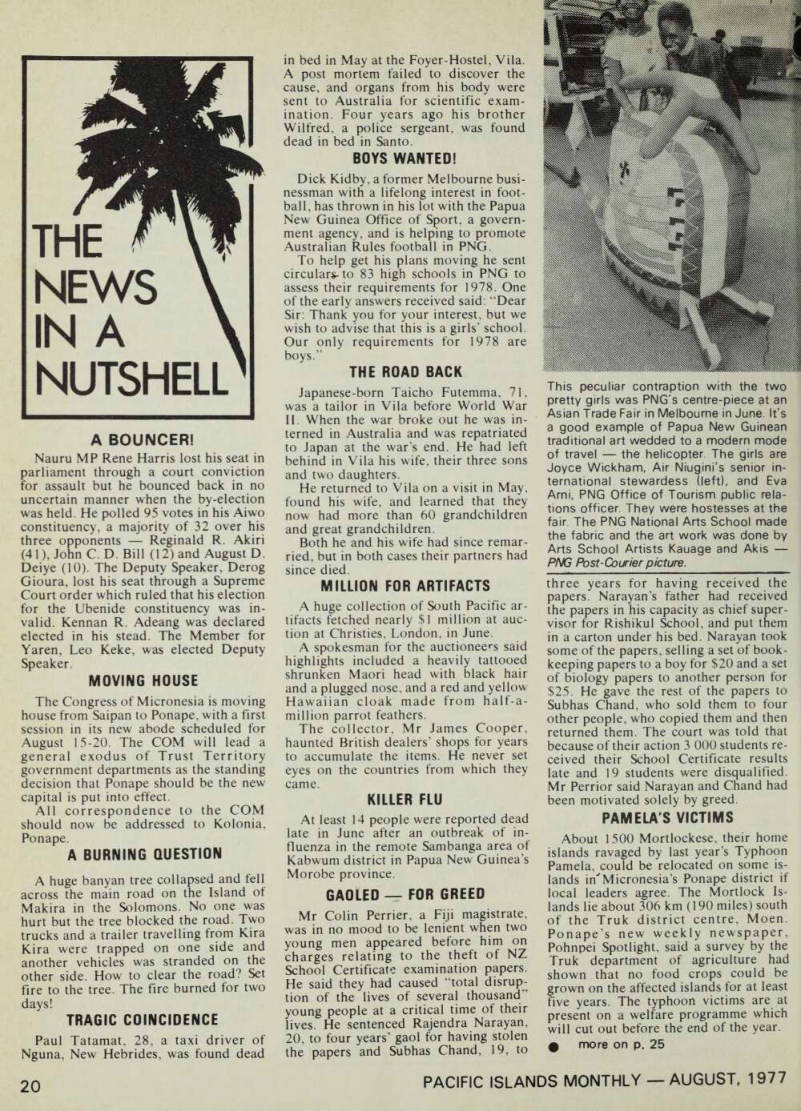
This peculiar contraption with the two pretty girls was PNG's centre-piece at an Asian Trade Fair in Melbourne in June. It's a good example of Papua New Guinean traditional art wedded to a modern mode of travel - the helicopter. The girls are Joyce Wickham, Air Niugini's senior in ternational stewardess (left), and Eva Arni, PNG Office of Tourism public rela tions officer. They were hostesses at the fair. The PNG National Arts School made the fabric and the art work was done by Arts School Artists Kauage and Akis - PNG Post-Courier picture.
"Experts" Not Wanted
Papua New Guinea’s North Solomons provincial government refused in June to see a consultant group appointed by the national government in Port Mores
by. Two representatives of McKinsey
Consultants had gone to the North Solomons capital of Arawa to discuss problems of provincial government with local leaders.
North Solomons Premier. Dr Alexis Sarci. said: “We don’t want consultants to tell us what provincial government is about. We know what we want.”
Appointment of the group, at a re ported cost of K 1 ().()()() a week for 15 weeks, plus K I ().()()() expenses, was also attacked by the deputy speaker of the National Parliament, Mr John Kaputin. who served on the constitutional plan ning committee which drew up docu ments outlining the powers and func tions of provincial governments. Mr Kaputin described the appointment of the McKinsey group as “another exam ple of a deal” in which consultant groups were exploiting the country through wantoks (relatives) who are or were working as advisers to the government.
Deadly Drink
Two Fiji dockworkers died and one became seriously ill after drinking methyl alcohol at Kings Wharf. Suva.
Several others also drank the liquid. The two who died were Manasa Koromo. 36 and Eparama Vakacabeqoli. 40. The police later issued a warning that about 45 litres of the methyl alcohol was miss ing from the wharf, and that it was deadly if consumed. The dead men left 1 1 children, aged from 3 to 18. The Fiji Waterside Workers'and Seamen's Union immediately moved to put $1 ()()() into a trust fund for the children’s benefit.
Chief Sues Usa
A Palauan chief has launched a multi million dollar lawsuit against the US and
Trust Territory governments claiming
his land is being occupied illegally. Ac cording to the Micronesian News Ser vice. Thomas Orrenges. head of the Ochedarechei clan in Angaur, a phosphare-rich island in southern Palau, has charged the US and TT governments with illegally taking away land owned by his and another clan.
Orrenges claimed that the US Coast Guard, which built a LORAN naviga tional radio station and airport on the land in 1952. has never paid rent.
He claims that the island has always been owned by the people and clans in Angaur “from time immemorial up to the present”, and that there is no public land in Angaur. It says the two govern ments had recognised the Angaur peo ple's ownership until about 1952 when the so-called “German deed” surfacr ed. “The “German deed” was re portedly signed in 1908 by a number of Angaur representatives to sell two-thirds of the 9.6 sq km (3.3 sq m) island to the
Germans. Six chiefs are said to have “signed” it with crosses.
The Angaur lawsuit maintains that “there was no such sale”, and that even if there had been one it was “a direct result of coercion, force and duress”, and therefore invalid.
Chief Orrenges and his clan are said to have been the recipients of one of the TT’s largest war claim settlements. $U5250,000, for postwar damage done by the US military to the clan’s property.
Preserving An Art
A group of customary leaders in Santa Cruz. Solomon Islands, fearing that the art of making the feather money unique to their area may die out. have formed a company to preserve it. Feather money is used in a number of places in the Solomons’ outer eastern islands, but is only made on Santa Cruz, and at present by only a handful of people A standard length of the money is made from the feathers of 1500 birds and may take a year to weave. It is a tra ditional way of settling bride price and customary trade.
Get Out Of The Office
Present training programmes for com munity workers in the Pacific Islands are “too office- and classroom-orientated”, according to a group of specialists in social work from five Pacific countries who met recently in Madang, Papua New Guinea. They said after their fortnight long meeting: “Too often one hears the complaint that field staff spend more time in their offices than with the people in the village, and perhaps this reflects the bias of current training institutions.
We feel that the major emphasis should be on field training and field work ex periences, with less time spent on study ing theory based on conditions in bigger countries overseas.” The meeting, spon sored by the South Pacific Commission, grouped people from the Cook Islands.
Fiji, the New Hebrides. Papua New Guinea and the Solomon Islands.
Cure For Drugs
A senior magistrate in Papua New Guinea proposed in May that Papua New Guinean youths should do a two year period of “national service” work ing on the land. Mr Francis Iramu made the proposal, saying that from what he had seen in the courts PNG could be on the way to a serious drug and organised crime problem. Much of the situation stemmed from dissatisfied young people who were trying to find a place in the community. Under his proposal, when a youth turned 18 he would begin a two year community work period in his home area.
Mr Iramu said he believed his pro posal conflicted with citizen freedoms laid down in the national constitution.
In the overall national interests, however, he believed the proposal re quired close government examination.
The Sting
Bernard Narokobi. who is fast earning a reputation as the Third-World philosopher of Papua New Guinea, in a newspaper article in May praised the mosquito for bringing sickness and death to early White settlers. He wrote: “I feel Papua New Guineans owe a lot to the mosquito.” Whites in Port Moresby, reacting to the statement, accused Mr Narokobi of taking an uncharitable at titude. They said: “He would think us nasty-minded if we gloated over the chronic sickness which the mosquito has brought to his own people.”
Critics of Mr Narokobi recalled that several years ago President Amin of Uganda established a decoration which he called the Order of the Mosquito. He said he selected the name because of the suffering the mosquito had brought to Whites in Africa.
Tuvaluans In Nz
Nine men and three women from Tuvalu have gone to New Zealand to work. They were the first Tuvaluan re cruits to work in a foreign country other than those engaged on a regular basis for the phosphate workings on Nauru. It was the first opportunity for overseas employment since Tuvalu (then the Ellice Islands) separated from the Gilbert Islands. On the way they spent three days in Suva where they were X
rayed.
$5Oo 000 Holiday!
The cost of a 36-hour shutdown at Fiji’s two biggest sugar mills, Lautoka and Rarawai. cost the Fiji Sugar Cor poration about $5OO 000. The mill workers refused to work on the Queen's Birthday holiday on June 13. The 500 workers involved gave notice late in the preceding week that they would not work that day. However, they did not break the law. even though they broke an agreement the Fiji Sugar Corporation had with the Fiji Sugar and General Workers’ Union. The question of work ing on a public holiday was not one of the items in a certificate of dispute, although the question of the rate of pay for a public holiday was. The dispute has still to be adjudicated.
$5Oo 000 Fall
A 70-tonne ore hauler worth more than SASOO 000 was destroyed in a spec tacular 100-metre fall at the Bougain ville copper mine. The truck was being inspected by a mechanic at the side of the pit when it moved forward and plunged over the edge. No driver was aboard. The accident was the third at the mine in four days: in the two others, dri vers escaped injury when a loaded ore hauler went over a steep slope, and an oil tanker left the road as it approached the mine complex.
Cost of the three accidents was esti mated at more than SAI million.