“Dramatic Piece Of Coastal
pp. 57-58 · Read in the full issue
Engineering" In Gilberts
Tenders are to be returned in July for construction of the Betio-Bairiki causeway in the Gilbert Islands.
Says Mr John Taylor, director of Wilton & Bell, the Australian con sulting engineers who prepared the detailed plans for the causeway: “This ends more than 10 years of studies, paperwork and many leng thy discussions.”
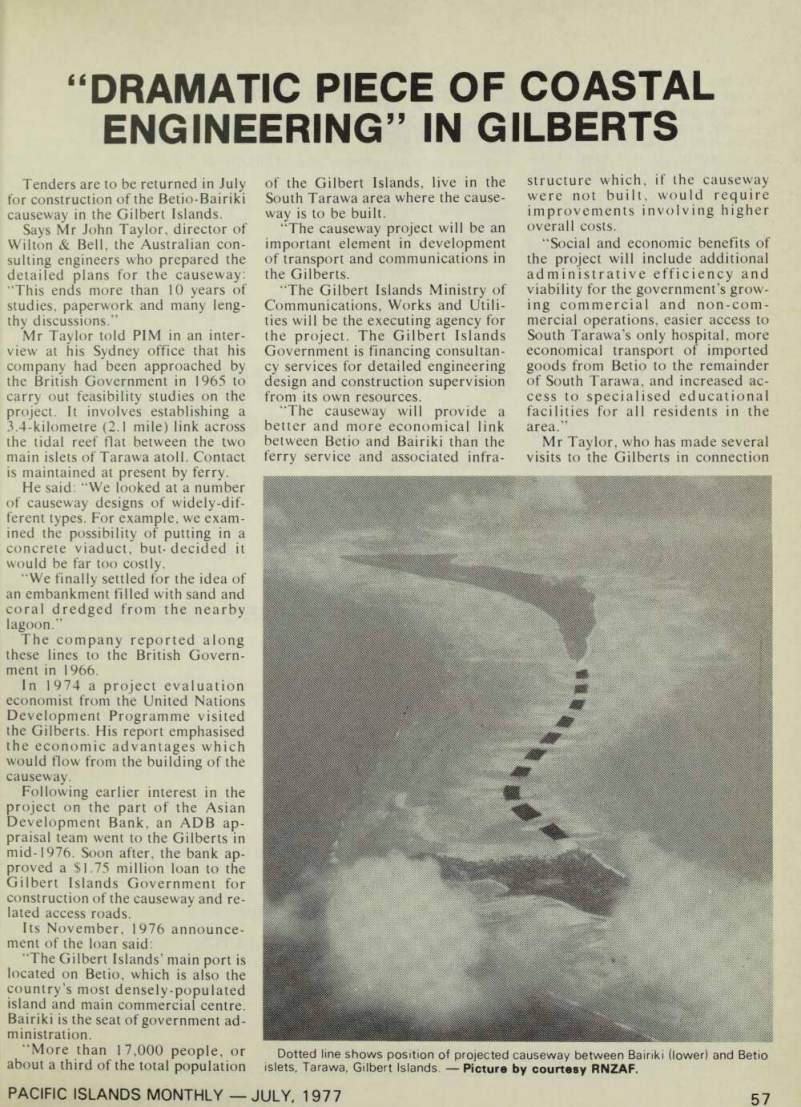
Mr Taylor told PIM in an inter view at his Sydney office that his company had been approached by the British Government in 1965 to carry out feasibility studies on the project. It involves establishing a 3.4-kilometre (2.1 mile) link across the tidal reef flat between the two main islets of Tarawa atoll. Contact is maintained at present by ferry.
He said: “We looked at a number of causeway designs of widely-dif ferent types. For example, we exam ined the possibility of putting in a concrete viaduct, but* decided it would be far too costly.
“We finally settled for the idea of an embankment filled with sand and coral dredged from the nearby lagoon.”
The company reported along these lines to the British Govern ment in 1966.
In 1974 a project evaluation economist from the United Nations Development Programme visited the Gilberts. His report emphasised the economic advantages which would flow from the building of the causeway.
Following earlier interest in the project on the part of the Asian Development Bank, an ADB ap praisal team went to the Gilberts in mid-1976. Soon after, the bank ap proved a $1.75 million loan to the Gilbert Islands Government for construction of the causeway and re lated access roads.
Its November, 1976 announce ment of the loan said: “The Gilbert Islands’ main port is located on Betio, which is also the country’s most densely-populated island and main commercial centre.
Bairiki is the seat of government ad ministration.
“More than 17,000 people, or about a third of the total population
of the Gilbert Islands, live in the South Tarawa area where the cause way is to be built.
“The causeway project will be an important element in development of transport and communications in the Gilberts.
“The Gilbert Islands Ministry of Communications, Works and Utili ties will be the executing agency for the project. The Gilbert Islands Government is financing consultan cy services for detailed engineering design and construction supervision from its own resources.
“The causeway will provide a better and more economical link between Betio and Bairiki than the ferry service and associated infra
structure which, if the causeway were not built, would require improvements involving higher overall costs.
“Social and economic benefits of the project will include additional administrative efficiency and viability for the government’s grow ing commercial and non-com mercial operations, easier access to South Tarawa’s only hospital, more economical transport of imported goods from Betio to the remainder of South Tarawa, and increased ac cess to specialised educational facilities for all residents in the area.”
Mr Taylor, who has made several visits to the Gilberts in connection
Dotted line shows position of projected causeway between Bairiki (lower) and Betio islets, Tarawa, Gilbert Islands. - Picture by courtesy RNZAF.
with the causeway project, de scribed it as “a dramatic piece of coastal engineering”. He said his company knew of only one other similar type of coastal construction in the world. It is a sand-filled breakwater in South Africa, near
Capetown.
Wilton & Bell receive regular re ports from the Gilberts on the height and direction of waves and on wind characteristics in the causeway area to help in their continuing design work.
Thirty-five dredging companies, including some of the world’s big gest, had replied to the original ad vertisements concerning the cause way. Eighteen of them had subse quently “pre-qualified” for tender ing.
When completed, the embank ment, topped by a two-lane highway which is to be built by local labour employed by the Gilbert Islands Government, will be about 160 metres (1 75 yards) wide at the base, about 25 metres (27 yards) wide on top, and standing about 4 metres (13 feet) above reef level.
Target date for completion is June 30, 1979.