Business
pp. 53-54 · Read in the full issue
Australia’S Far-Flung
Outposts Of Trade
The flourishing trade relationship between Australia and the Island nations of the South Pacific has developed naturally over a period of years. Itself an integral part of the Pacific region, Australia has long standing cultural and commercial ties with its neighbours.
The largest of these countries, Papua New Guinea, ranks 11th among world markets for Australia’s exports and two-way trade between the two countries reached a value of about s2llm in 1975/76.
Australian exports to Papua New Guinea consist mainly of a variety of foodstuffs and a wide range of manufactures. Main imports from Papua New Guinea are coffee, cocoa, timber, cork and crude rub ber.
Today, trade relations between the two countries are governed by the Papua New Guinea/Australia Agreement on Trade and Com mercial Relations which came into force on February 1, 1977. This laid the foundations of the post-indepen dence trade relationship between the two countries. The agreement replaced the Memorandum of Un derstanding relating to interim trade and commercial relations which had been in force since December, 1973, when Papua New Guinea attained self-government.
Meanwhile, the other Pacific na tions and particularly Fiji are also assuming increasing im portance as markets and sources of imports for Australia, and as partners in promoting the con tinuing development of the region.
Excepting Papua New Guinea, Fiji is the leading Pacific Islands market for Australian products. It is also a centre for Australian trade activities through much of the South Pacific region. The Australian Trade Commissioner post in Suva has responsibilities extending beyond Fiji to New Caledonia, ‘New Hebrides, the Solomon Islands,
Samoa, Tonga, Gilbert and Ellice Islands, French Polynesia, Norfolk Island, Nauru and Cook Islands.
The Island nations are undergoing a period of economic growth and change. Industry is expanding in many areas and business activity is increasing. These trends have ereated demands for a variety of industrial and manufactured products and processed and unprocessed foodstuffs which Australia is well placed to supply.
Australia’s imports from the South Pacific area (excluding Papua New Guinea) are made up of phosphate, gold bullion (from Fiji) and other minerals, coconut products, timber products, handicrafts, foodstuffs and a range of other items.
Other important Island trading partners in addition to Papua New Guineaand Fiji include Nauru, New Caledonia, New Hebrides, Solomon Islands, Gilbert and Ellice Islands, French Polynesia, Western Samoa and Tonga.
Australia has a record of practical assistance in encouraging the growth of equitable two-way trade with its Pacific neighbours. In 1966, Australia became the first nation to offer assistance to the developing countries, including those of the Pacific, to obtain increased export opportunities for their products through a system of tariff preferences.
In January, 1974, it revised and expanded this system, providing preferential entry for manufactures. semi-manufactures, and substan tially-processed primary products except for revenue items (cigarettes, spirits, etc) and some products where developing countries are already competitive. Quotas have been abolished on most items. Duty free and quota-free treatment for handicraft products has been retain ed, but with a revised definition of handicrafts.
For Pacific Islands exporters seeking a better understanding of the Australian market and of the
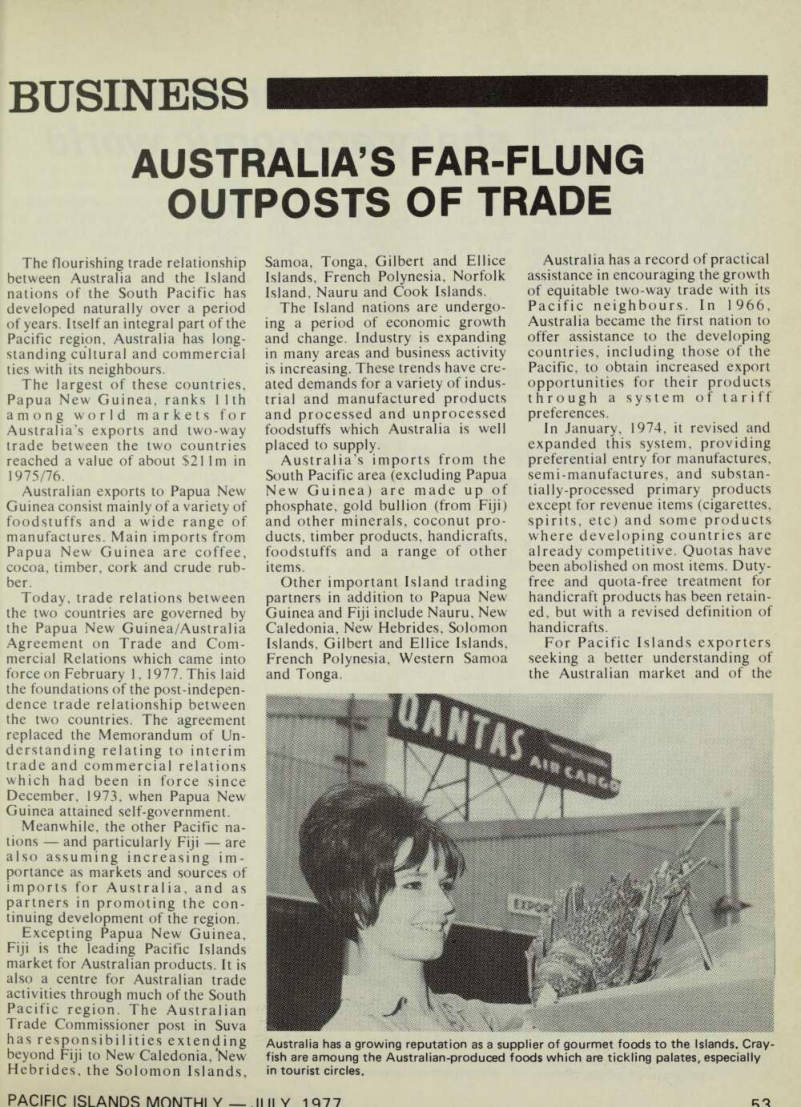
Australia has a growing reputation as a supplier of gourmet foods to the Islands. Cray fish are amoung the Australian-produced foods which are tickling palates, especially in tourist circles.
selling and other techniques as sociated with it, assistance and ad vice is available from the Australian Trade Commissioner in Suva and from Australia’s Department of Overseas Trade through its Market Advisory Section in Canberra.
The work of the section covers two main areas. The first is product and market analysis. This involves the incorporation of a data base of information on the Australian market, and investigation of ways in which developing countries can take best advantage of the Tariff Preference System.
The second area of the section’s work is market development, which includes practical help by advising developing countries on the market ing and promotion of their products in Australia.
The section undertakes research and prepares studies, in response to specific requests, on products of likely interest to developing country exporters, the marketing oppor tunities in Australia for products from developing countries; and features peculiar to Australian trade with developing countries.
Australia takes an active part in the work of the South Pacific Forum and the South Pacific Bureau of Economic Co-operation, partic ularly in efforts to advance the economic development of Pacific Island countries. Australia con tributes further to regional develop ment through such agencies as the South Pacific Commission, the Asian Development Bank, the United Nations Development Programme, World Food Program me, the Australian South Pacific Technical Assistance Programme and the Commonwealth Co-op eration in Education Scheme.
As trading partners, Australia and most South Pacific countries share a number of advantages, including geographic proximity, regular ship ping and air links and com paratively short delivery times.
These factors, together with long standing cultural and commercial ties, should provide a background for continued economic co-op eration. • Coffee prices on the London ter minal market fell by almost $3OO a tonne early in May. The downturn generally was attributed to buyer re sistance, a suggestion that coffee might be close to pricing itself off the market.