Glass-Plated Island History
p. 40 · Read in the full issue
By W. G. Coppell
There is a great deal of Pacific historical evidence which prob ably does not, as yet, receive the full measure of attention that it deserves. In sketches, paintings and old photographs there is so much to be studied and analysed which will give to both the pro fessional and amateur Pacific Is lands historians a clearer view and a more intimate feeling for past islands life styles.
Unfortunately, much of this visual evidence is in constant danger of being lost for all time, and this is especially true of the old photographic records.
The Cook Islands serve as a good example if the case of the work of George Crummer is taken up. He was a commercial photographer on Rarotonga in the years from the beginning of this century onwards and was a most skilful and prolific photo graphic artist.
Unfortunately, over the years, the many glass plates that George Crummer had processed became to be regarded as rubbish and they were scattered about, sent to the rubbish dump or smashed. It has been possible to recover only a fraction of his work, and through the good offices of the New Zealand National Film Ser vice about 200 of the plates were salvaged, restoration work car ried out and a permanent record made and returned to the Cook Islands.
Recently, a small collection of plates in extremely poor condi tion were taken to fhe photo graphic department at Mac quarie University in Sydney and from these it was possible to salvage 39 pictures which will eventually be added to the photographic collection of the Cook Islands Library and Museum in Avarua.
In some cases, it will be possi ble to identify the people in the photographs, as names were written in pencil on them; in
other cases it may require detective work in order to establish identities, while in other cases there will be a continuing mystery.
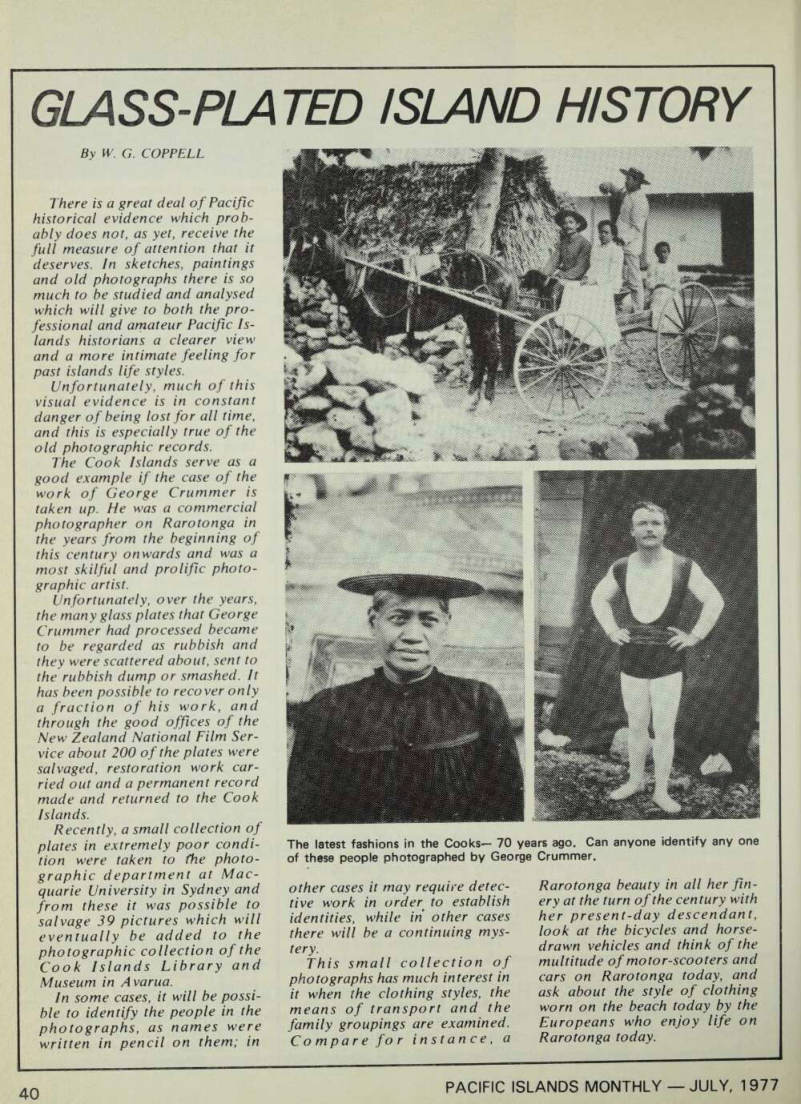
This small collection of photographs has much interest in it when the clothing styles, the means of transport and the family groupings are examined.
Compare for instance, a
Rarotonga beauty in all her fin ery at the turn of the century with her present-day descendant, look at the bicycles and horse drawn vehicles and think of the multitude of motor-scooters and cars on Rarotonga today, and ask about the style of clothing worn on the beach today by the Europeans who enjoy life on Rarotonga today.
The latest fashions in the Cooks— 70 years ago. Can anyone identify any one of these people photographed by George Crummer.