Magazine
pp. 36-39 · Read in the full issue

When the Breathless Army marched against murderers on Malaita
By Jim Boutilier
The little Solomon Islands town of Tulagi on the island of the same name was electrified early in October, 1927, when the schooner Wheatsheaf arrived bearing news that District Officer W. R. Bell, his cadet, K. C. Lillies, and 13 Solomon Islands policemen and boat’s crew had been massacred on Malaita during the collection of native tax near Sinarango Harbour on October 4.
The Resident Commissioner, Richard Kane, was absent in the Eastern District at the time and Kidson, Secretary to the Government, was reluctant to despatch the 20-man police force from Tulagi for fear that the colonial capital might be attacked by Malaita men employed nearby at the Burns Philp and Lever Brothers depots at Garutu and Makambo.
At the same time, however, it was obvious that something had to be done and done quickly to restore the administration’s prestige to capture the culprits, and to prevent the “further spread of disaffection.” Reports suggested that there were 300 rebellious bushmen in the cloud country of Malaita, intent on driving the government and the missions off the island, and so it was decided to call on the Royal Australian Navy and the local European community for assistance.
The cruiser, HMAS Adelaide, was ordered to the Protectorate imme diately but on the understanding that naval force would not be utilised during the pacification campaign except in cases of “extreme necessity”.
The admiral commanding was pre pared to countenance the employment of the ship’s company for “moral effect,” but maintained that “active measures should be undertaken solely by civil power”.
Of civil power, there was woefully little. Malaitan police were considered
unreliable for operations on their home island, and Kane was convinced that it would be impossible to arrest the murderers and prevent widespread insurrection unless the police force was stiffened by the enrolment of 30 Europeans as special constables, supported by native levies.
These “specially selected” volunteers were, in fact, a motley, ill-trained lot who reckoned that “a quid a day and a bottle of whisky was their pay.”
They entertained a sense of righteous indigation at what they considered to have been a dastardly deed; a sense of outrage tinged with ill-disguised rac i sm .
“When they got the opportunity of being all wound up and go in and chase Bossie (Bassiana, Bell’s murderer) out,” one old-timer recalled, “they couldn’t get in there quick enough”. It was, in short, an opportunity, complete with government sanction, to teach the ‘ nigger’(to quote a nearcontemporary account) a lesson that he would never forget.
Moreover, the excitement of tracking down the murderers was greeted as a welcome relief from the boredom of the daily round in Tulagi or on the plantations, The government, for its part, welcomed European participation in the expedition as a check against inter clan or district hostility. The feeling among the Malaitans was generally “so intensely against the perpetrators” that the Resident Commissioner was con cerned that native levies, if uncon trolled, might use the occasion of the punitive campaign to settle old scores, By the same token, he was concerned about the over-zealous attitude of some of the volunteers. He ordered them put through their paces but long hours of parade training in the hot sun failed to damp their enthusiasm.
The “Breathless” or “Deathless Army,” as it came to be known from its casualty-free exertions in the rugged uplands of eastern Malaita, sailed from Tulagi on October 20 on board
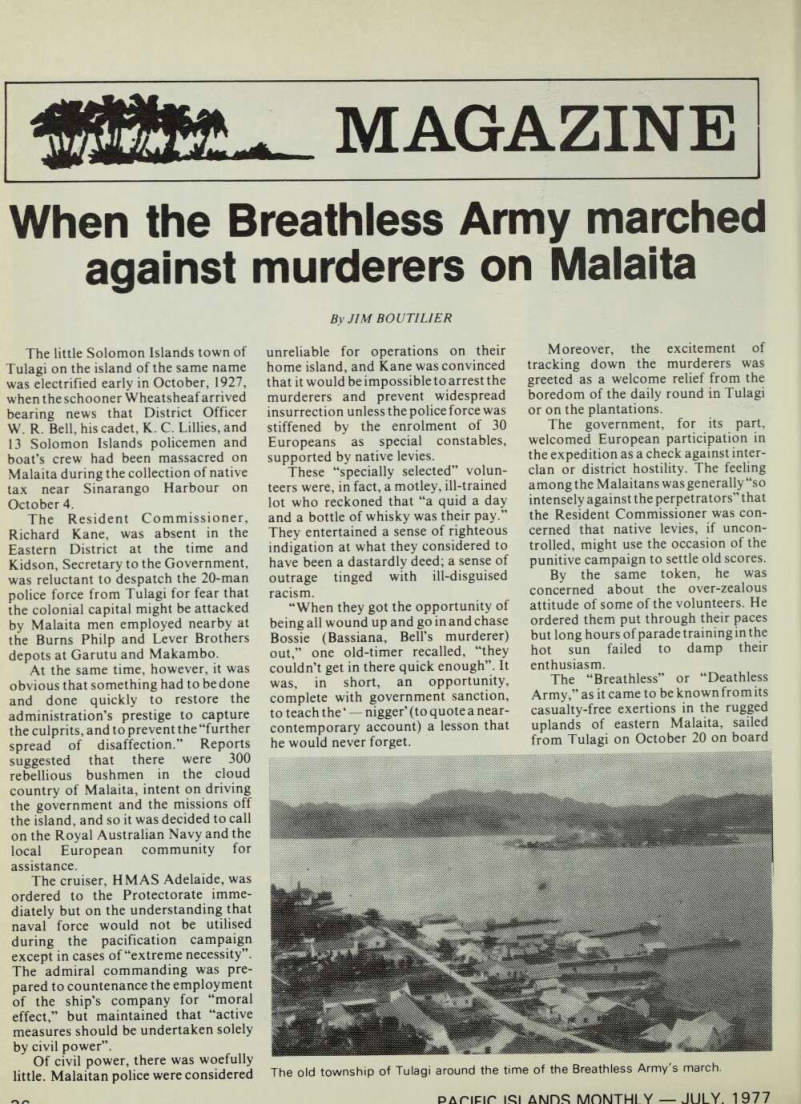
The old township of Tulagi around the time of the Breathless Army's march.
the Ranadi. District Officer, C.E.J.
Wilson, who was in overall command of punitive operations (though nominal supernumerary to the Resident Commissioner) had departed a week earlier to assess conditions on the island.
He found the residents at Su’u, “pretty windy”, and all the local Europeans living on their schooners in the harbour. Over 500 islanders had come to the government station at Auki to volunteer their services but only 40 ex-constables had been retained to meet the threat of a possible attack by Bassiana.
Wilson arrived at Sinarango on October 16, collected the tax-papers and the murder weapon (the barrel of a Snider rifle which had been used to smash in Bell’s skull), and began to clear land for a base camp almost at the top of the precipitous escarpment overlooking the harbour. The weather was foul, “Everything,” he reported, was “drenched and muddy... (though) the road was not too horrible.”
HMAS Adelaide dropped anchor two days later and a party of bluejackets was sent ashore to assist. Kane arrived with 50 police and the European volunteers on October 20, and Sub-Inspector Davis, Officer in Charge of the Constabulary, arrived the following day with another platoon
of police.
Progress was slow from the outset, The bearers had to be “practically driven” up the steep mountain tracks, which led through dense jungle to the base camp more than two thousand feet above. Moreover, it rained
incessantly, turning the advanced
camp into a “swirling mass of mud.”
Slowly but surely, the bravado of the European volunteers, eroded by sore feet, dysentery and groundless rumours, began to wane.
“Everyone,” it seemed, was “distinctly unhappy and uncomfortable.”
Toward the end of October, some of the volunteers began to grow insubordinate to the point of mutiny.
Their spokesman, Charles Widdy (who was Lever Brothers’manager at Banika plantation, Cape Marsh) complained that the Breathless Army had been brought to Malaita under “false pretences,” and that their understanding had been that they would (in Wilson’s words) “act independently and so relieve the government of any embarrassment which might occur.”
Wilson assured Widdy that he was “utterly mistaken” if he felt the Europeans were free to go “at all and sundry”.
The latter accepted his assurance for the time being, but Johnstone, the butcher from Tulagi, informed Wilson privately that the volunteers were so frustrated for want of action that they had even considered shooting a crippled leper whom they had found in one of the villages.
Three days later, Widdy became “foully abusive” and harangued Wilson publicly, charging that the “government people were out to get all the honour and glory” while the volunteers were left to collect taro and conduct fruitless patrols.
Subsequently, he apologised, in what the district officer considered to be a “half-hearted manner,” and set out with his companions in search of food.
While they were gone, they appear to have fired indiscriminately at a number of Malaitans whom they saw in the bush; conduct which, in Wilson’s mind, was “fully in keeping with (Widdy’s) idea of an open slather.” It was obvious that the European volunteers were not only an embar rassment but a liability to the operation and so the majority of them were withdrawn to the sea coast on November 11, after a night of gambling and carousing.
They did not take their release lightly, however, and 14 of them addressed a letter to the Resident Commissioner complaining bitterly that Wilson had “to all extent and purposes ignored” them, that disci pline was ‘’almost non-existent,” and that they had never received any clear definition of what was considered to be resistance from the enemy, “We must be fired on, or attacked with axes,” they wrote, “before we dare fire a shot.” Had they been able to serve under “an able and competent leader,” they opined, they would have been of direct military value, but, as it was, they had been “belittled and made to appear a laughing stock to the natives.”
The government was less than sympathetic to their plight. They appeared, the acting High Commis sioner observed, to have been under a “complete misapprehension” as to their function and at no time were they intended to constitute an “attacking force,” Moreover, the conduct of some of the volunteers had been “insubordi nate and subversive of discipline and good order”; a state of affairs which was considered to be “extremely reprehensible” in view of the large
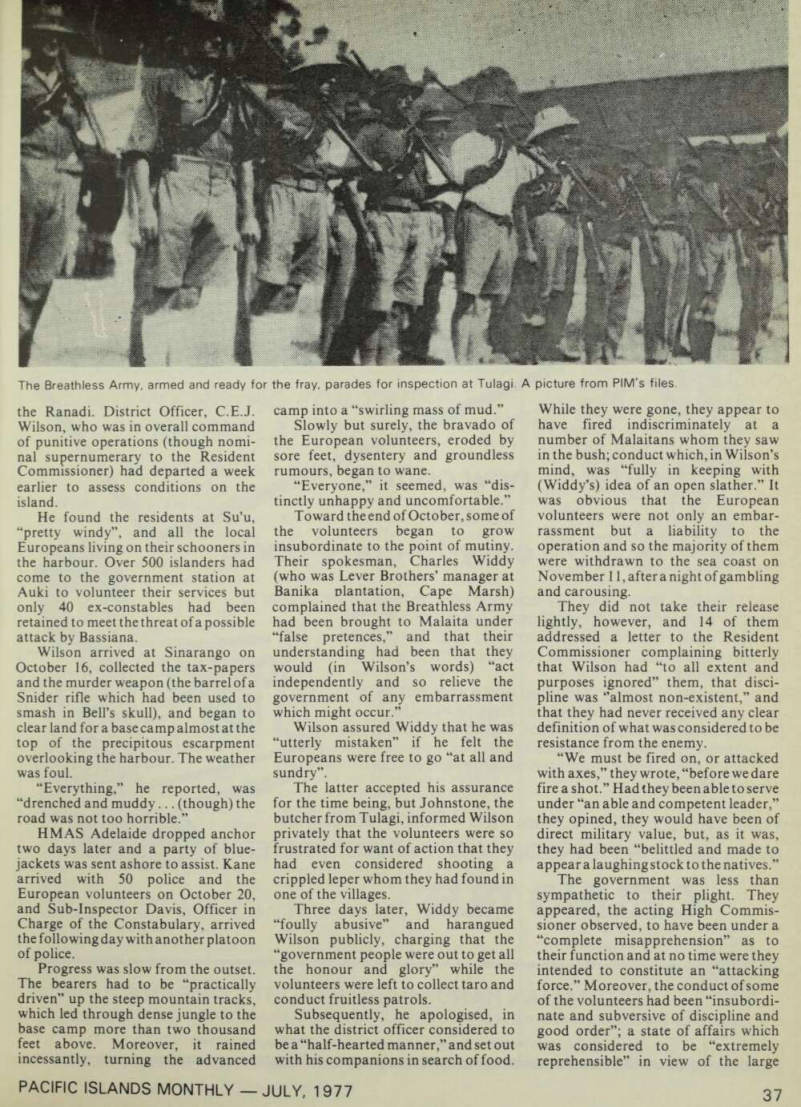
The Breathless Army, armed and ready for the fray, parades for inspection at Tulagi. A picture from PIM’s files.
number of Solomon Islanders accom panying the expedition.
Meanwhile, Bassiana was captured on November 20 and his accomplice, Noru, was apprehended early in December. By the following March, 198 Malaitans had been arrested and brought to Tulgai to stand trial, thereby bringing large-scale opera tions on the island to a close.
There are two footnotes to the Breathless Army’s activities: one serious and one amusing. During more than two months of patrolling, 27 islanders had been killed or reported killed. The evidence bore out a “strong suspicion of indiscriminate firing at sight” by the European volunteers and local police. Wilson apologised
officially for his failure to report the deaths in writing, alleging that the pressure of work, coupled with bad health, had caused him to lose the “true perspective” of affairs on Malaita.
Kane accepted his apology and defended his subordinate by claiming that it could “hardly be hoped to arrest savage bushmen in wild country
without regrettable incidents.”
Yet, the evidence suggested that most of the Malaitans had been shot while trying to escape and the High Commissioner was moved to recoid a minute that Kane would have to ‘‘face the music” when an inquiry was held.
The other footnote involved the purchase of 22 pairs of boots against public funds. Late in October, Wilson had telegraphed Tulagi urgently requesting the footwear because the boots and shoes which the volunteers had brought to Malaita were being “absolutely cut to pieces . . . owing to the rough country.” However, there had been the secretary to the govern ment observed pedantically, “a want of method without any record being kept.”
No one could remember who had acted as quartermaster, and Wilson noted lamely that since none of the leaf houses was windproof and the wind “quite frequently blew with hurricane force”, the dockets in question must have been “blown on the ground and stamped out of recognition in the mud.”
Vaskess, the Secretary to the High Commission, was unimpressed by Wilson’s reasoning.
“The general loss of memory in the matter,” he minuted, “borders on the incredible,” and he suggested that if the cost of the boots was surcharged against the district officer’s account, it might “stimulate his memory.”
But nothing was done. The boots and the bodies were forgotten, the volunteers went back to drinking squate-faced gin at Elkington’s Hotel and relating doubtful tales of daring do.
They played poker for V/i days, one of the volunteers, Bobby Sterling, winning all the money.
The government vessel Auki brought back the bodies to Tulagi. “It was the dirtiest I’d ever seen it,”
Tommy Elkington recalled. Then, he realised, as he looked more closely, that the discoloration was blood which had run down the sides of the hull.
And the Gilbert and Sullivan army, as Caroline Mytinger described it, faded into history.
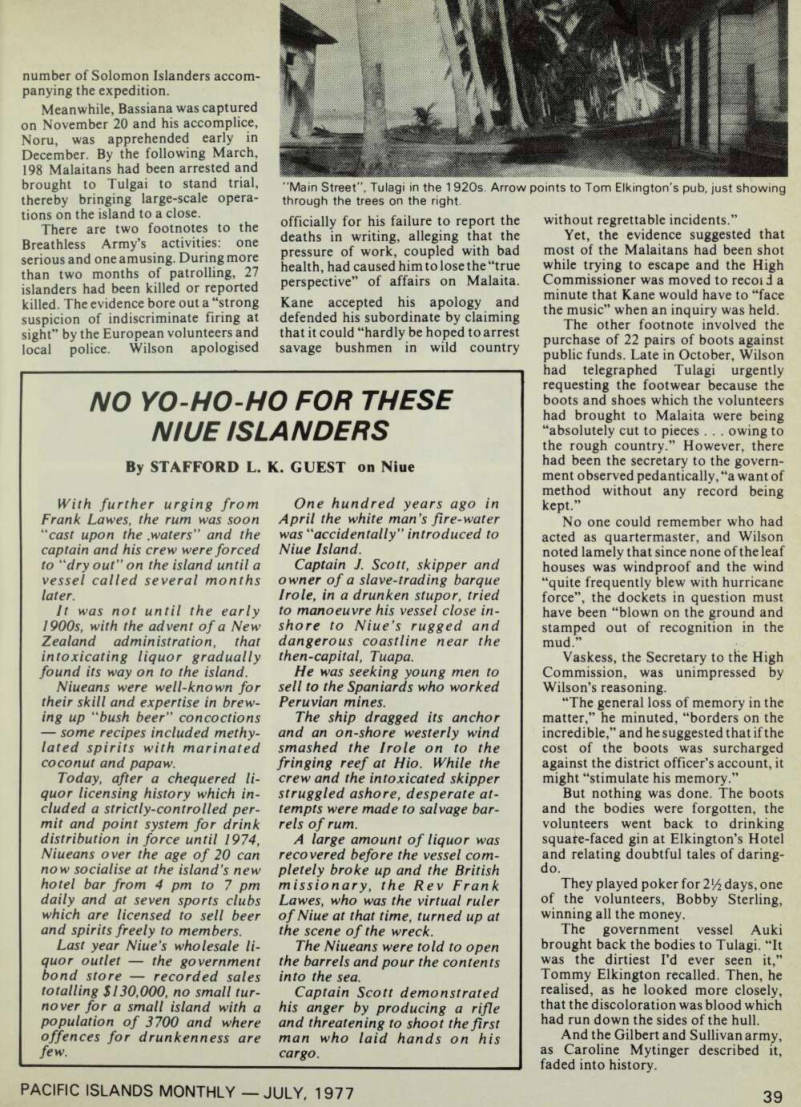
"Main Street", Tulagi in the 1920s. Arrow points to Tom Elkington's pub, just showing through the trees on the right.