Editor’S Mailbag
pp. 29-31 · Read in the full issue

Oceanic Research
Over the years Dr David Lewis has established a reputation as one of the most persistent and perhaps most unorthodox scholars concern ed with solving some of the mys teries of the Pacific.
In particular. Dr Lewis has pur sued with unflagging interest the question of the manner in which the Polynesians were able to navigate over the immense distances of the Pacific. He has also had the courage and vitality to undertake a single handed and unique voyage under sail into Antarctic waters.
Now Dr Lewis is the foundation president and chairman of the ex ecutive board of the Oceanic Re search Foundation. The foundation has an impressive list of foundation members including Professor Roger Keesing, Professor James Fox, Pro fessor Noel Rutherford, Dr Colin Jack-Hinton, Professor Roger Green and Lord Ballantrae, the former Governor-General of New Zealand.
The prospectus for the foundation indicates that it has a very high level of aspiration for its future activities.
Its objectives say that “most people and depleted world resources must bring new and increased human ac tivity to the less accessible and spar se 1 y-inhabited places near Australasia, especially Oceania and the Antarctic”.
The foundation has outlined in very general terms the areas and fields in which it sees itself fulfilling a research function.
“The foundation’s research will be expedition-oriented. Small low cost expeditions will go to remote places and learn by direct ex perience the real problems of living, working and travelling there, and the environmental effects of these activities. ... The aim will be to learn by adventure and experience”.
The Oceanic Research Founda tion states that “expeditions are now being planned in detail” and these include programmes concerned with the Antarctic, the Australian coastal waters and the South Pacific.
This is all very commendable
the whole cornerstone seems to be based upon the foundation charter ing a 62 ft auxiliary sailing ketch. It is here that, perhaps, some questions might be asked, as it is also propos ed that the ketch be used on an all year round programme.
“ORE expeditions will operate on small budgets, to encourage and force the drive and resourcefulness which are essential to its objec tives ... The public will be asked to contribute to the research program me of the foundation by both dona tion and active participation in ex peditions where the opportunity to assist in both research undertaken and the handling of the vessel will be available”.
Let’s be hard-headed about en terprises like ORE. This is a time of economic stringency, many people are becoming jaundiced about causes which offer, at the least, very peripheral outcomes and the costs of maintaining medium-sized sailing vessels are such that they are usually met by the wealthy dilettante. All honour to ORE for what it wants to achieve, it is to be hoped that a sense of reality will eventually predeter mine the limits of the expeditions it mounts.
W. G. Coppell
Pennant Hills, NSW
English Murdered
I have a minor complaint con cerning the murder of the English language, how she is spoke. I refer to PIM (April, 1977, p 36): “Bill Brewer’s Guale Rai home has been burglarised five times.” The Shorter Oxford English Dictionary gives
“Burglarize” V. Us 1871. To
rob burglariously.” So the word ex ists, albeit with a zed (or rather, I should say, a zee, as it is American).
But the English word, which is somewhat less laborious, is burgle I burgle, you burgle, he burgles which is given precisely the same meaning.
Admittedly not a very serious crime and by no means to be comwith “on-going” (horror of
horrors try declining that and you’ll end up with the offwentation of hostilities), or the locally popular “escapee” (definitely not in the dic tionary and for the best of etymological reasons).
Nevertheless, our fair language has been under sustained attack for a number of years, and I feel bound to spring to its defence!
R. Mitchell
Melbourne.
Ha, ha. PIM, getting smartly from under, points out that the quotation complained of was an extract from a report in the newspaper Marianas Variety (American) published in the US Trust Territory and used by PIM as an example worthy of in clusion in Islands Press. PIM prints these extracts “as is” and would not dare to alter them. We agree with Mr Mitchell about the murder of the English tongue and with the comments of Professor ’iggins in the musical My Fair Lady anent English as she is spoke l ln America they haven’t spoken it for years ...” The Editor.
Cooks' Tourism
With the recent opening of The Rarotongan, the Cook Islands now boasts an international-standard hotel which enables it to enter the keen competition in the Pacific tourist trade.
However, in most countries throughout the world, there is an ap parent lack of information about the Cook Islands, so that very few visi tors from overseas are attracted by the amenities of Rarotonga.
A welcome change may result from the publication of a fine pic torial book by well-known New Zealand photographer, Mr James Siers, who is to be congratulated on the particular care he has taken in doing justice to the scenic beauty of
Rarotonga.
Unfortunately for many intending visitors, the author missed the op portunity of using some descriptive material and factual information available from the Cook Islands Tourist Authority. For instance, a clear sketch-map of Rarotonga would have greatly added to the in terest of the average reader. May I suggest that such omissions should be rectified if and when a further edition is contemplated?
Robert Rousseau
Paris, France.
Bishop Epalle
The Rev Amos Waiaru of Aoba and Mr Harry Mehare of Honiara are quite right (PIM, May, p 31): Bishop Epalle was killed on Santa Ysabel when he ventured beyond Maunga Point, and not on San Cristobal. Dr Laracy’s book Marists and Melanesians makes this clear.
Mr Mehare’s reference to Catholics being “only the second largest of the churches” in the Solomons is, however, only correct if one speaks of the islands governed from Honiara. If we also encompass the people of Bougainville, Buka and certain small islands, which are part of Papua New Guinea, then Roman Catholics are in the majority among Solomon Islanders.
Harry Jackman
Bathurst, NSW.
Wrong Picture
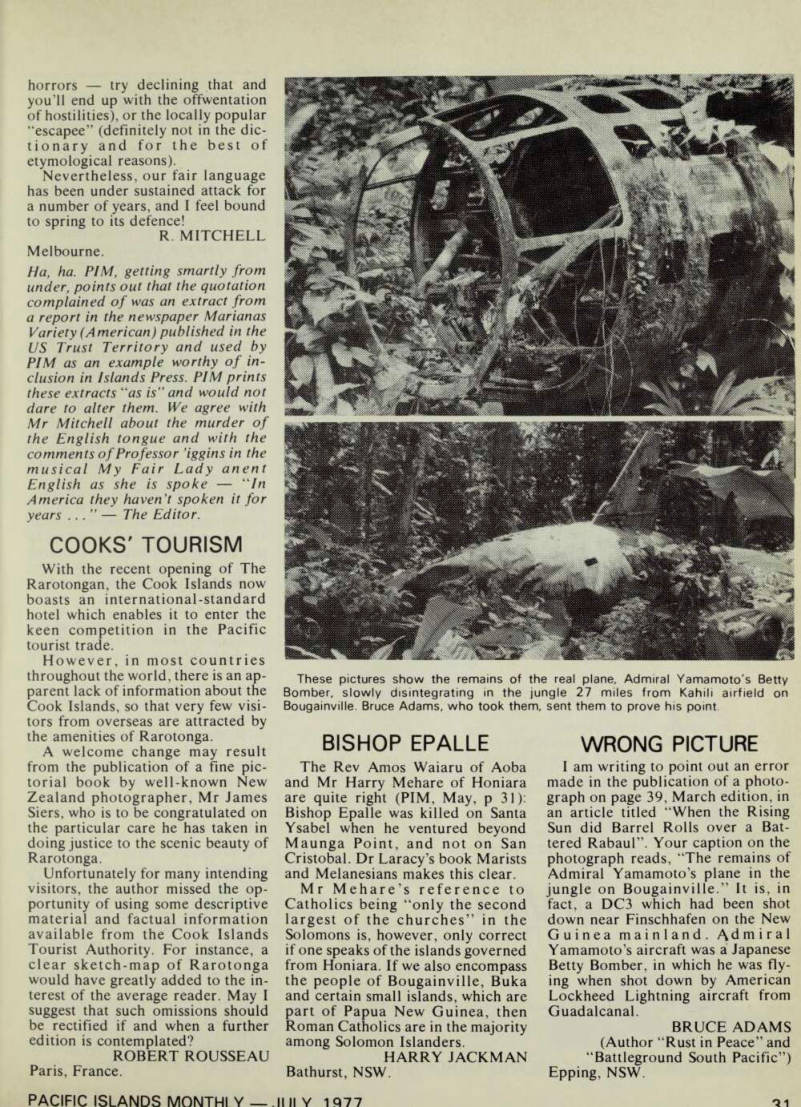
I am writing to point out an error made in the publication of a photo graph on page 39, March edition, in an article titled “When the Rising Sun did Barrel Rolls over a Bat tered Rabaul”. Your caption on the photograph reads, “The remains of Admiral Yamamoto’s plane in the jungle on Bougainville.” It is, in fact, a DC3 which had been shot down near Finschhafen on the New Guinea mainland. Admiral Yamamoto’s aircraft was a Japanese Betty Bomber, in which he was fly ing when shot down by American Lockheed Lightning aircraft from Guadalcanal.
Bruce Adams
(Author “Rust in Peace” and “Battleground South Pacific”) Epping, NSW.
These pictures show the remains of the real plane. Admiral Yamamoto's Betty Bomber, slowly disintegrating in the jungle 27 miles from Kahili airfield on Bougainville. Bruce Adams, who took them, sent them to prove his point.