Tropicalities
pp. 23-27 · Read in the full issue


Back to the
Island way
Man does some funny things. The Pacific Islander, said by so many from the west to be backward in a number of ways, is really down to earth, as Fiji Prime Minister, Ratu Sir Kamisese Mara, pointed out in an address to the American Society of Newspaper Editors in Honolulu.
In his own inimitable way he showed how complicated life was becoming for the Islanders as more and more western ways were in troduced. In his own country there were more than enough food re sources for all, if only she could rediscover all the varieties of food available from land or sea. In some cases it might only be necessary to elevate its status and publicise its nutritional value.
He was not preaching a return to the old ways. There were many new and helpful agricultural techniques which would be promoted. And to some local foods would be directed research which had been so heavily weighted in favour of export crops.
Coconut research institutions, tea research centres, sugar research sta tions, coffee research organisations, etc, were dotted around the world.
But how many institutions specialis ed in the varieties of dalo (taro) or yams? Yet the number of people who ate those roots crops was not in significant. There were millions of them in Indonesia, the Philippines, south-east Asia, the West Indies and Africa. And there was no need to talk of the virtues of taro in Hawaii.
Recent writings showed horrify ing examples of people pushed by aid agencies into developing export crops or products at the expense of their own diet, and even exporting their own natural protein to buy im ported processed protein.
The Pacific way, an expression Ratu Sir Kamisese frequently uses, has a lot going for it, as the tempo of life increases in the western world.
The Islander’s general approch to life may be simple, but there are vir tues in a simple life.
Toto shook
the barmen
Miss Toto Vunibaka, 22, the only female entrant in a contest to find the Fiji cocktail barman of the year, won the title with two blends, Yellow Hibiscus (based on Bacardi Rum) and Island in the Sun (based on Gordons Gin). She developed' her cocktail-shaking technique at Plantation Village, on Malolo Lailai Island in the Mamanucas, off the western coast of Viti Levu. The judges looked for new creations with distinctive Fiji flavours, made with expertise and professional flourish.
Miss Vunibaka won prizes totall ing $4OO. The contest was sponsored by Morris Hedstrom Ltd, who plans to make it an annual event.
However, perhaps unprepared for a female winner, the sponsors have decided to dub the 1978 contest winner as Bartender of the Year.
For the record Miss Vunibaka’s creations were: Yellow Hibiscus 1 oz Bacardi Rum, 1 oz Galliano, l h oz cherry brandy. Long drink, serve with straws, top with orange juice, cher ries and slice of orange and yellow hibiscus.
Island in the Sun 1 oz Gordons Gin, 1 oz Galliano, V 2 oz dry ver mouth, with orange juice. Serve with straws with slice of orange and cher ries.
More than UFOs
up in the air
April, it seems, was “unidentified objects” month in the Cooks.
On Sunday, April 17, three boys playing near Black Rock, Rarotonga, claimed to have seen an unidentified flying object which ap peared from the direction of Arorangi village. They say the round, white object travelled slowly on a straight course before becom ing stationary, and remaining so for about 40 minutes. Then it started moving again and stopped again, re peating this performance until it was out of sight. (Last reported sighting of UFOs in the Cooks was also in April, but back in 1975.) At about the same time, the Cooks Premier, Sir Albert Henry, told the New Zealand press that he had un covered a plot for an armed uprising in the Cooks in which he was to be assassinated.
Leader of the opposition De mocratic Party, Dr Tom Davis, ridiculed suggestions that his party was involved in any such thing. Said Dr Davis: “We certainly would not be involved in any assassination plot because it would make Sir Albert a martyr. Anyway, we’re so far ahead in the Gallup-type polls that it
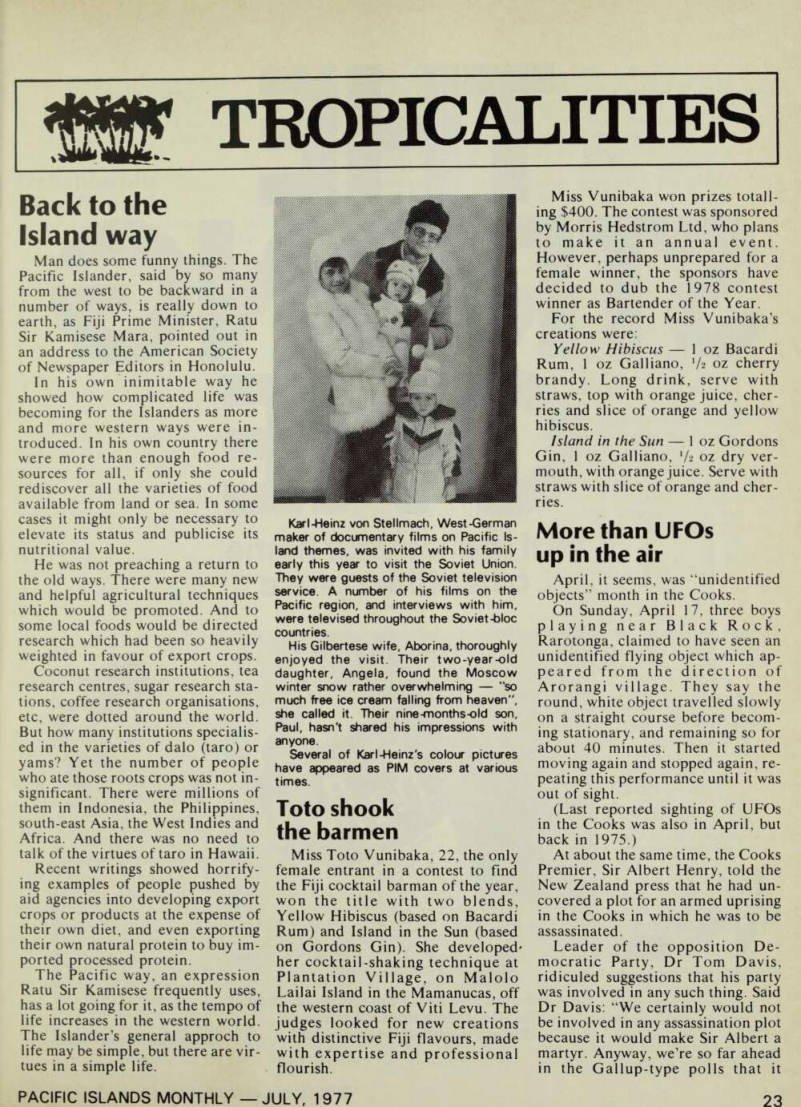
Karl-Heinz von Stellmach, West-German maker of documentary films on Pacific Is land themes, was invited with his family early this year to visit the Soviet Union.
They were guests of the Soviet television service. A number of his films on the Pacific region, and interviews with him, were televised throughout the Soviet-bloc countries.
His Gilbertese wife, Aborina, thoroughly enjoyed the visit. Their two-year-old daughter, Angela, found the Moscow winter snow rather overwhelming - "so much free ice cream falling from heaven”, she called it. Their nine-months-old son, Paul, hasn't shared his impressions with anyone.
Several of Karl-Heinz's colour pictures have appeared as PIM covers at various times.
would be stupid of us to get involv ed in such a hairy scheme.”
Like whatever it was the three boys saw, the object of the alleged “coup” exercise remains uniden tified.
Deflation hits
a Pacific book
The posthumous reputation of Sir Arthur Grimble, former British Re sident Commissioner on Ocean Is land, took a caning at the British High Court hearing last December into the claim by the Banabans for compensation for the ravages caus ed by phosphate mining on the is land.
The presiding judge. Sir Robert Megarry, said a statement addressed by Sir Arthur to the Banabans in 1928 “could not be read without a sense of outrage”.
Insult is added to injury by a cir cular sent not long ago to various schools throughout the Pacific by a British book distributor. The cir cular said of Grimble’s book, A Pat tern of Islands, which was once one of the most popular English language works on the Pacific: “I have just been advised by the pub lishers of this book a copy of which I enclose that they have a massive overstock of it and are will ing to supply any bulk order at a price of 10 UK New Pence, plus freight.”
Wishful thinking
in the Islands
If Pacific Islanders want to live in Western style they need to make a few changes in their attitude to life.
That message comes through in an article former PIM editor, Judy Tudor, wrote in People, the London journal, on world population and family planning trends. She wrote that most of them now had aspira tions based on wishful thinking, rather than hard economic facts.
“Since the Second World War, Western-style education has become a fetish and once a youth has become ‘educated’ he usually scorns all manual work and sets his sights on a white collar job, in the security of government service if possible”, she wrote. “An oversupply of would-be clerks and other seekers of the good life therefore drifts into towns and larger centres to become disillusioned, unemployed, to swell
squatter settlements and to exert pressure on the authorities for social services once taken care of by the extended family unit back in the village.
“For one reason or another small land area, rapidly-growing populations, increased expectations, industrial inroads into subsistence farming no Pacific Island, even the well-endowed, is without people
problems”.
Adding that the resources of most islands was limited, she wrote: “Yet most Islanders have learned to live in a way unknown to the subsistence farmers who were their ancestors and now have aspirations based on wishful thinking rather than on hard economic facts”.
Biting the hand
that reeds it
The School of Education at the University of the South Pacific has recently established a “Continuing role for the School of Education in Regional Curriculum Develop ment”. It has been seeking the sup port of other tertiary institutions within the Pacific and on the periph ery of the region which are concern ed with curriculum development.
The information supplied by the School of Education says that estab lished within the school are, firstly, a curriculum resources workshop, and, secondly, a curriculum re sources agency. The workshop is seen as having the functions of a clearing house for regional cur riculum information; a working area and repository for a collection of curriculum materials, and a base for research.
The aim of the Curriculum Re sources Agency is to “provide with in the resources of, but using the facilities of the School of Education and the university, curriculum materials for the regional coun tries”. It will be interesting to ob serve the extent to which this development is accepted by the various commercial interests which have been seeking to establish a market for curriculum materials produced to meet the needs of Pacific Islands countries.
It is said of the proposed Cur riculum Resources Agency that “the agency will use the university print ing unit on a commercial basis.
This will provide services “at ap proximately two-thirds of com
mercial business rates”. This would seem to be a radical departure from generally-accepted university stan dards that the facilities of the universities should not be used in direct competition with private en terprise, when production of the same product is the object of the game.
Shake the bottle
and the doctor
A doctor in Papua New Guinea wants to kill the old myth that bad handwriting indicates a good doc tor.
In a note in the latest issue of the PNG Medical Journal the editor. Dr D. Amato, appeals to his fellow doc tors to clean up their handwriting.
He describes sloppy writing from doctors as ”a remnant of the days when an authoritarian arrogance on the part of medical practitioners was accepted by patients”.
He believes that, more often than not, doctors had used bad writing as a mask for their own ignorance, “but these days happily are on their way out, and with them should go the il legible scrawl”.
Dr Amato says in the Medical Journal that he finds it heartening to see many medical students and younger doctors adopting neater writing, and “older doctors would do well to follow their example”.
He calls bad writing “in considerate, presumptuous and an insult”.
Dr Amato also appeals to doctors to print their names as well as to sign them on prescriptions and charts which he describes as poten tially-legal documents.
It’s been 58
years a’coming
There is news of the opening of an airstrip on Atiu Island in the books, which will add a further dimension to the operations of Cook Islands Airways. It will also very markedly influence the way of life of Atiuans, as they will now be able to reach Rarotonga in less than an hour and without all the discomfort which has been part and parcel of travel on small inter-island vessels.
But this recent move into aviation isn’t the first that has been mooted for Atiu. Over the years all manner of suggestions for landing places in the Cook Islands have been put for
ward, but Johnstone Dyer, the Re sident Agent on Atiu in 1919 must have had a pioneer view of the future role of the aircraft.
On January 13, 1919, Dyer wrote to the Resident Commissioner on Rarotonga “I should like to make a little suggestion. If the Minister of Defence is looking for a mid-ocean aerodrome, Atiu offers the best situ ation, being about 400 feet above sea-level, with a gentle slope to the sea and devoid of trees on the hilltop. There are patches on the top of the hill about over 100 acres in extent, without trees or any other obstruction”.
Fiji’s defaulting
ratepayers
Fiji ratepayers must be among the most dilatory when it comes to meeting their just dues. An unofficial survey in May showed they owed more than $1 million, nearly $2 a head for every person in the country. In many cases people have not paid their rates since 1972.
At the top of the list was Suva, which showed arrears of $639,962, enough to meet the cost of several council services for a year. Others with debts of more than six figures were Nadi ($166,000) and Lautoka ($100,000). Councils are beginning to realise that unpaid rates have cumulative problems, not only for them, but also for the slow ratepayers. Accumulated rates run into solid lump sums, which many ratepayers find they just cannot meet.
The councils get further behind in providing services and development programmes, and find the govern ment does not exactly rush into ap proving and then guaranteeing loans while so much is owed to them. The councils have the remedy in their own hands the time-consuming process of prosecuting defaulting ratepayers. Unfortunately, some councillors, with their eyes on the ballot boxes, often put up a fight for defaulters, which does not make any easier the task of council officers who collect the money.
About 15 years ago a PIM writer, who had attended a Suva City Coun cil meeting which voted to, delay launching prosecutions, checked the list of defaulters and found the names of at least two councillors who were in favour had not paid their rates.
Making a ‘blue’
on old Niue
Many writers who specialise in topics concerned with the Pacific Is lands countries tend to wax with considerable strength about the blue laws imposed upon many islands by the missionaries.
On the island of Niue the chiefs and rulers passed a set of laws at their Fono held at Alofi on Decem ber 1, 1875.
It seems that many of the laws agreed to then could not have been too unacceptable to the New Zea land Government, as on June 5, 1900 the laws, with modifications and additions, were confirmed by the Fono. These laws were pub lished in the 1901 New Zealand Parliamentary Papers.
Working on the roads, or making lime-ovens seems to have been an obsessive form of punishment on Niue at the time, as it appears as a form of retribution imposed upon a wide spectrum of offenders.
“Whosoever shall be convicted of fornication, for the first offence, shall be liable to one week’s labour
in making lime-oven or work on the roads; for a second offence, an oven of lime involving two weeks work.”
And let’s ponder about sexual discrimination in this modern world ...
“A woman convicted of fornica tion, for the first offence, shall be liable to work on the roads for a term of one week, for second offence, two weeks work on the roads.” Making a lime-oven must, in some way, have got the male of fender nearer to hell. If only such penalties applied today in Australia or New Zealand all the road con struction problems would be solved.
What about solving the unemployment problems which now bedevil the developed world? In the Niue laws the following appeared “Disobedient sons who wander to other lands, and when at home are lazy and dissolute, not helping at all in the work of the plantations, but appropriating the father’s coconuts and living upon the fruits of his in dustry: Upon the father making known his case to the judges, such sons shall be dealt with by the law of the land.”
Conservation of native fauna is the theme of a June issue of Papua New Guinea stamps featuring five beautiful species of pigeon to be found in the country. Pictured, they are the white-bibbed ground-dove, the Victoria goura pigeon, the Magnificent Pheasant pigeon, the orange-fronted fruit dove and the black-belted fruit pigeon.
Niue is the latest Commonwealth country to join in postal commemoration of the silver jubilee of the reign of Queen Elizabeth with a special issue of two stamps which were placed on sale in Niue's post office on June 7.
Other recent philatelic developments in Island countries include Tonga's issue of a series of three commemorative stamps to mark the 10th anniversary of the coronation of King Taufa'ahau Tupou IV (July 4, 1967), the release by Western Samoa of a series of four stamps to mark the 50th anniversary of Lindbergh's trans-Atlantic flight (20 May, 1927), and the use by the Pitcairn Island postal administration of a rubber stamped "Hands Across the Sea” pictorial cachet on all mail lodged between May 7 to July 7, 1977, to mark 50 years of association with the New Zealand post office.