Irian Refugees—Png Squirms On
pp. 16-17 · Read in the full issue
Its Very Own Hot Seat
From GUS SMALES in Port Morseby
In the timbered grasslands of south-west Papua New Guinea, where anthills stand like sentinels, the sudden appearance of a large number of Irianese from across the border couldn’t have come at a worse time for the PNG Govern ment.
Men, women and children, some of them carrying cooking utensils, knives and axes, trickled in over a period of several weeks in May, tell ing PNG officials of trouble in their adjoining homeland which In donesia controls.
The PNG Prime Minister, Mr Somare, was fresh back from a state visit to Indonesia where he had as sured President Suharto that PNG would not allow itself to become a base for anti-Indonesian border crossing dissidents. President Suharto had given reciprocal as surances to Mr Somare.
But President Suharto’s side of the bargain was little more than an academic exercise to make Mr Somare’s assurance appear more re spectable, because no one in a fit has suggested that Papua New Guineans want to flee across the border into West Irian.
Mindful of Indonesia’s extreme sensitivity regarding the border, and West Irianese rebels in general, Mr Somare later gave the impression that he was keeping his fingers crossed in the hope that the border would remain quiet and the problem would go away.
But it wasn’t to be. And of all times, the newest mass crossing oc curred as the PNG Government was girding up for its national elections and political sensitivities at home were highest and the government executive machine was at its lowest.
In theory there should be no problem. If PNG is friendly with In donesia, and if PNG recognises sovereignty in West Irian and both conditions apply then why not simply pack the border-crossefs home again with arrangements to sort it out with their own authori ties?
And even if they have tales of
hardship which entitle them to refugee status, PNG should be able to quietly process their applications under international protocol, and without any fuss.
But Indonesia’s prickly attitude to the border in general, and PNG’s acceptance of Indonesia’s strength and proximity, together with Mr Somare’s recent Jakarta talks, impeded any easy diplomatic solution.
But on the other hand and quite apart from any moral issues there are two things at home which prevent the PNG government from simply getting tough with the border-crossers.
One of these is that the Papua New Guineans and the West Irianese are ethnic Melanesian brothers (or are certainly so in the border regions), and direct family relationships exist across the border.
The other is that political and community opinion in PNG sympathises with the border-crossers and rides roughshod over any diplomatic niceties. Any PNG government which openly tried to send the West Irianese packing in the interests of smooth diplomatic relations with a big friendly neighbour could find itself in hot water at home.
Against this conflicting back ground it was not surprising that the PNG government appeared con fused and undecided, While it desperately scrabbled for more and more information from its field officers and intelligence op erators, and no doubt prayed that the border-crossers would go home, the government staved off making a ny statement of policy or attitude, and largely closed off access to day by-day information, Then new incidents began to be reporte d from the other end of the border, in the north. Indonesian troops had made forays across the border said some of the reports. A p apua New Guinean had been shot dead near Imondo during one clash, anot her .. ’ , Finally, on June 1, the PNG Prime Minister, Mr Somare, called a . nev ys conference on the border situation.
He announced that the govern ment was returning to their homes all the 218 Irianese who had crossed the border. He said that original of ficial estimates of nearly 500 border-crossers had been based on early information and had been found to be incorrect. The actual
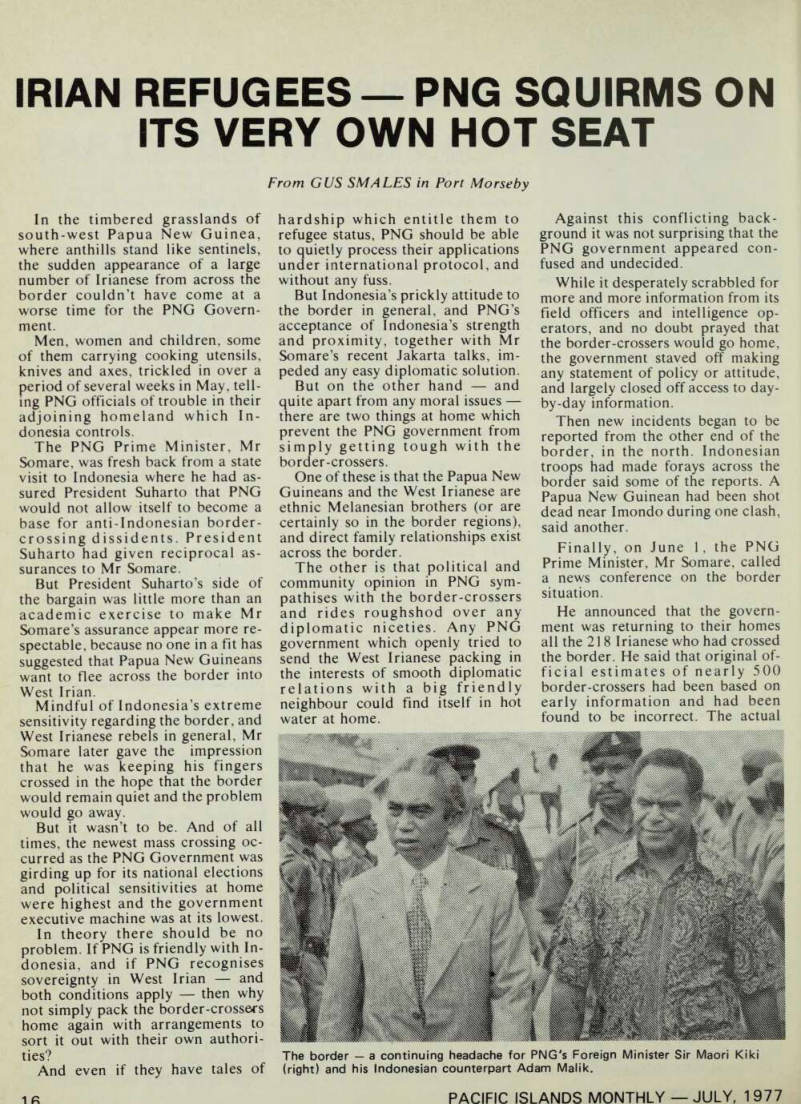
The border - a continuing headache for PNG's Foreign Minister Sir Maori Kiki (right) and his Indonesian counterpart Adam Malik.
number was 218, made up of a group of 203 men, women and children at Suki, and a group of 15 men at Bensbah both places in the southern area of the border.
“We are helping with their transport arrangements back to the border,” Mr Somare said.
He added that PNG would be seeking an assurance from In donesia that the families would not be persecuted for their action in walking out of Irian.
Mr Somare said his government had no confirmation of reports that Indonesian soldiers had illegally crossed into PNG in the northern border region, or that a PNG citizen had been shot.
He said that the May 31 radio news report from Wewak claiming that a border village was deserted following a clash with Indonesian soldiers also could not be substanti ated.
Mr Somare, who was clearly aware of the risk he was running of being branded callous towards peo ple defined as refugees, took con siderable pains to explain the diplomatic ramifications of border crossing incidents.
He said that in addition to inter nationally established procedures, PNG had a specific border-man agement agreement with Indonesia covering arrangements and pro cedures.
He divided border-crossers into two types dissidents who wanted to use PNG as a base to stir up trou ble, and people who for a variety of reasons believed they wanted to live in PNG.
“The first sort we charge and send to gaol, because we don’t tolerate international trouble-makers,” Mr Somare said.
As for the “ordinary” border crossers, unless they could produce evidence that they had crossed the border in fear of their lives or freedoms, they had to be returned.
This was part of the mutual re spect which Indonesia and PNG held for each other’s sovereignty.
But if a person could establish a real refugee status, that was a different matter.
Mr Somare said the recent border-crossers had been properly treated and cared for, they had been questioned, and the situation had been fully explained to them.
They had been asked to return to their homes over the border, and had agreed to do so.