Png’S Election Dance - Take Your
pp. 14-15 · Read in the full issue
Partners For The Government?
From LUKE SELA, in Port Moresby
Mr Michael Somare will again, 1 believe, become Papua New Guinea’s Prime Minister following the general elections of June-July.
But there will, I predict, be con siderably reduced numbers in the national coalition composed of the Pangu Pati and the People’s Progress Party.
I’m aware that these are bold statements if one considers that the elections will still be continuing as this report appears, but I believe that Mr Somare will retain the coun try’s leadership because he has learned to master the art of com promise.
It is this most important quality which has kept Papua New Guinea from breaking into tiny, separate “kingdoms” since independence in 1975, and which has gained Mr Somare so much respect as Prime Minister. He has the ability to con vince, and especially to convince traditional leaders. People have confidence in him when he says in effect, “Well, we cannot give you this now, but I will give it to you next year ...”
None of this is meant to indicate that the election results will be clear cut. They will not be clear cut. I can see sleepless nights ahead before the new parliament sits in July nights similar to those in 1972 when the Pangu-PPP coalition was being hammered out so that a government could be formed.
Only this time it will be even more difficult.
On the one hand there will be the United Party, which currently is, in terms of numbers, the biggest single party in Papua New Guinea, and which I believe will continue to be.
Should it receive support from the Papua Besena and the Country Par ty, Mr Somare would not be the next Prime Minister of Papua New Guinea.
But to be able to do this the com bined United, Besena and Country parties must muster at least 60% of their candidates and likely sup
porters in the 109-man national parliament (there were 100 members in the old parliament), and I don’t think they can do it.
What about the present coalition?
I think Pangu will lose some of its seats, but the PPP will gain some, Mr Julius Chan, PPP leader and current Minister for Finance in the national coalition, says he will be happy if he gains another five or six seats.
I think he is being modest, but
whatever the PPP result, pressures inside the party will not be strong enough to influence Mr Chan into accepting the Prime Minister’s post for himself. Mr Chan respects Mr Somare, as Mr Somare respects him, and they would both want to retain their present positions in the new government.
Deputy leadership would no doubt be offered to a Papuan, to keep regional pressures at bay. That would be a post for the former
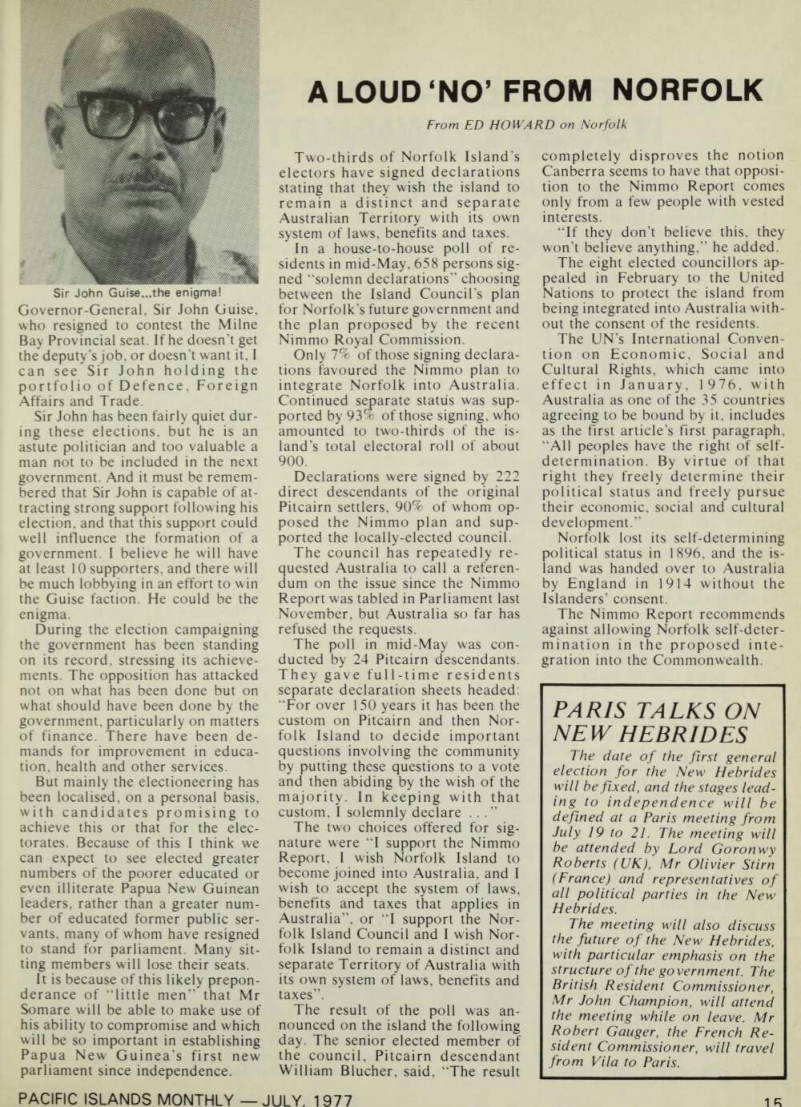
Governor-General, Sir John Guise, who resigned to contest the Milne Bay Provincial seat. If he doesn’t get the deputy’s job, or doesn’t want it, I can see Sir John holding the portfolio of Defence, Foreign Affairs and Trade.
Sir John has been fairly quiet dur ing these elections, but he is an astute politician and too valuable a man not to be included in the next government. And it must be remem bered that Sir John is capable of at tracting strong support following his election, and that this support could well influence the formation of a government. I believe he will have at least 10 supporters, and there will be much lobbying in an effort to win the Guise faction. He could be the enigma.
During the election campaigning the government has been standing on its record, stressing its achieve ments. The opposition has attacked not on what has been done but on what should have been done by the government, particularly on matters of finance. There have been de mands for improvement in educa tion, health and other services.
But mainly the electioneering has been localised, on a personal basis, with candidates promising to achieve this or that for the elec torates. Because of this I think we can expect to see elected greater numbers of the poorer educated or even illiterate Papua New Guinean leaders, rather than a greater num ber of educated former public ser vants, many of whom have resigned to stand for parliament. Many sit ting members will lose their seats.
It is because of this likely prepon derance of “little men’’ that Mr Somare will be able to make use of his ability to compromise and which will be so important in establishing Papua New Guinea’s first new parliament since independence.
Sir John Guise...the enigma!