Britain’s $10 million handout-
p. 13 · Read in the full issue
Britain’s $10 million handoutbut no smiles from Banabans
The British Foreign Secretary, Dr David Owen, announced in May that the partner governments on the board of the British Phosphate Commissioners Britain, Australia and New Zealand —would make an ex gratia payment of SAIO million to the Banabans.
The money would come from the funds currently held by the BPC funds which, he revealed in replying to a question in the House following his statement, amount at present to about SA23 million.
The payment would be made “without admitting any liability”, and “on condition that, in the outs tanding legal actions, no appeal would be made in the case against the Crown and the early resolution of the cases would be sought, and that no further claims would be made arising out of past events”.
Dr Owen made it clear that the payment was quite separate from, and therefore additional to, the damages to be paid to the Banabans by the Phosphate Commissioners themselves. In the course of his five and-a-half-day judgment handed down in December in the Banabans’ marathon High Court case against the British Government, the Vice- Chancellor, Sir Robert Megarry, said that the damages to be paid by the commissioners, should be “neither merely nominal nor very large”.
Also additional would be the SAIO million the Banabans are
likely to receive by way of phosphate revenue from July 1, 1976 until the end of mining (ex pected in 1979-80).
Dr Owen said that it was esti mated that the sum of SAIO million, invested now, would accumulate to SAI2 million by the end of 1979.
This sum would give the benefits of unearned income of about SA3SO per head per year to the 2,500 Banabans now living on Rabi Is land, in Fiji.
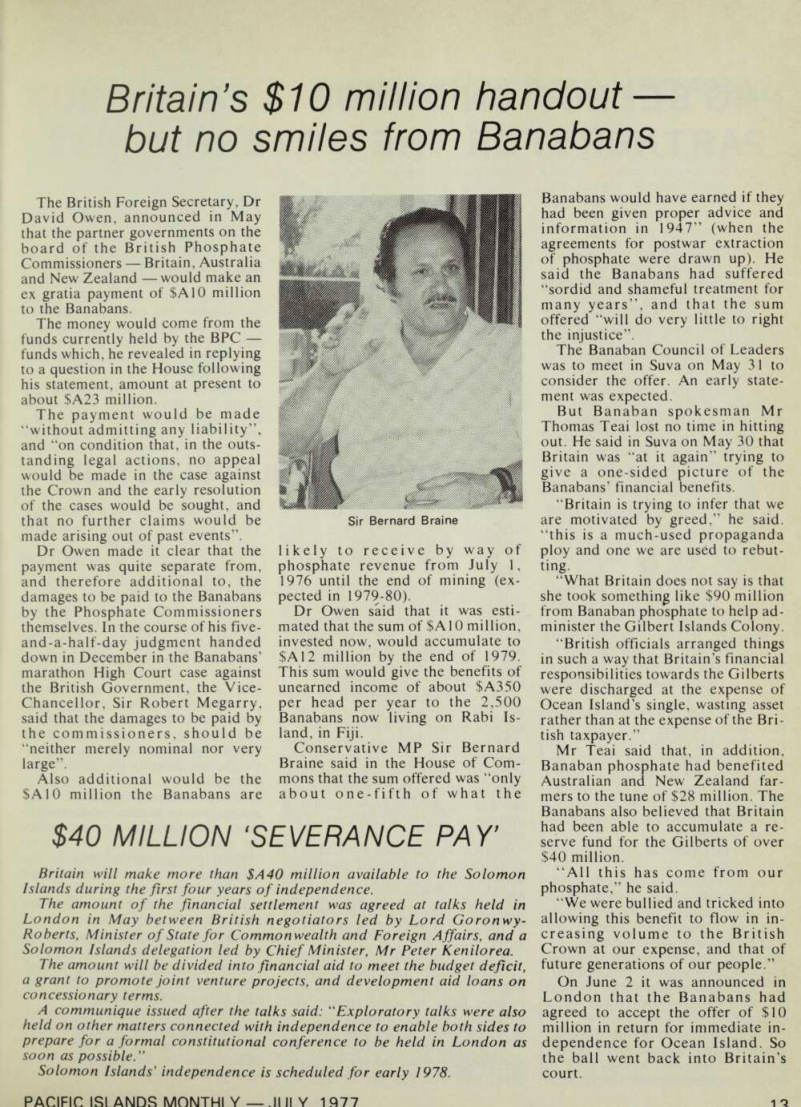
Conservative MP Sir Bernard Braine said in the House of Com mons that the sum offered was “only about one-fifth of what the
Banabans would have earned if they had been given proper advice and information in 1947” (when the agreements for postwar extraction of phosphate were drawn up). He said the Banabans had suffered “sordid and shameful treatment for many years”, and that the sum offered “will do very little to right the injustice”.
The Banaban Council of Leaders was to meet in Suva on May 31 to consider the offer. An early state ment was expected.
But Banaban spokesman Mr Thomas Teai lost no time in hitting out. He said in Suva on May 30 that Britain was “at it again” trying to give a one-sided picture of the Banabans’ financial benefits.
“Britain is trying to infer that we are motivated by greed,” he said, “this is a much-used propaganda ploy and one we are used to rebut ting.
“What Britain does not say is that she took something like $9O million from Banaban phosphate to help ad minister the Gilbert Islands Colony.
“British officials arranged things in such a way that Britain’s financial responsibilities towards the Gilberts were discharged at the expense of Ocean Island’s single, wasting asset rather than at the expense of the Bri tish taxpayer.”
Mr Teai said that, in addition, Banaban phosphate had benefited Australian and New Zealand far mers to the tune of $2B million. The Banabans also believed that Britain had been able to accumulate a re serve fund for the Gilberts of over $4O million.
“All this has come from our phosphate,” he said.
“We were bullied and tricked into allowing this benefit to flow in in creasing volume to the British Crown at our expense, and that of future generations of our people.”
On June 2 it was announced in London that the Banabans had agreed to accept the offer of $lO million in return for immediate in dependence for Ocean Island. So the ball went back into Britain’s court.
Sir Bernard Braine