Fiji's Cuff-Hanger Continues
pp. 11-12 · Read in the full issue
With An Election In The Offing
From ROBERT KEITH-REID in Suva
Fiji still lingers in a state of politi cal suspense four months after a general election that stripped the ruling Alliance Party of its parlia mentary majority, and, hence, power.
Events that have followed in the election’s wake climaxed at the beginning of June with the Governor-General, Ratu Sir George Cakobau, dissolving parliament after the NFP had steam rollered a motion through the House which, in effect, defeated a government-tabled motion of confidence.
Moving the motion Ratu Sir Kamisese said the NFP’s indecision after the election had left the coun try rudderless while the Alliance had been besieged with “unbelieva ble” Opposition offers of a coali tion, interim and caretaker-type governments.
The NFP countered with a curious amendment to the govern ment motion.
This said, in effect, that if, and the “if” was what the Alliance pounced on as evidence of the NFP’s wish to avoid becoming the government if the Governor-General should get the Alliance’s advice to dissolve parliament so that another election could be held, he should ignore it and appoint Mr Koya as Prime Minister instead.
The Alliance, after taking legal advice on this idea, blasted it as
“constitutionally impossible”.
House Leader, Mr Jonati Mavoa said the passing of the amendment would be to ask the Governor- General to do something that he had no legal right to do.
For this reason the Alliance would ignore the advice and carry on as a minority government until a time for a dissolution most favoura ble for it cropped up, he said.
It would resign on the spot only if its own motion for a vote of corl fidence in itself was defeated
directly.
The Fijian Nationalist leader, Mr Butadroka, voted with the NFP.
After the vote, the House continued with its normal business.
As the Alliance had warned, the motion was not accepted as a vote of no-confidence.
Ratu Sir Kamisese said his government would carry on as best it could.
He had told the press beforehand that, as far as he was concerned, a fresh election could be deferred un til February or March next year if the Electoral Commission felt it needed this time in which to sort out some of the administrative foul-ups that had occurred in organising the previous one.
But it would be nice to get the election over and done with before the budget session started in November, he added.
The Alliance is already busy cam paigning for the next round of poll ing, chiefly against the Fijian Na tionalist Party, the cause of its ruin.
It hopes to win back a substantial portion of lost Fijian loyalties, which it must do if it is to regain any kind of majority.
Admirers of the Alliance believe this will restore the mainly Fijian and European-backed party “to its former glory” as one of them over optimistically enthused.
More impartial observers, however, suspect that the Alliance will be lucky to collect anything more than a slender working ma jority of one or two.
Some Alliance men had privately hoped that the arrest of the Fijian Nationalist leader Sakiasi Butadroka in April might nip the nationalist cause in the bud, making it much easier to recover defecting Fijian voters.
Butadroka and two of his followers face charges under the tough Public Order Act, basically of holding illegal meetings and, in Butadroka’s case, of inciting race hatred.
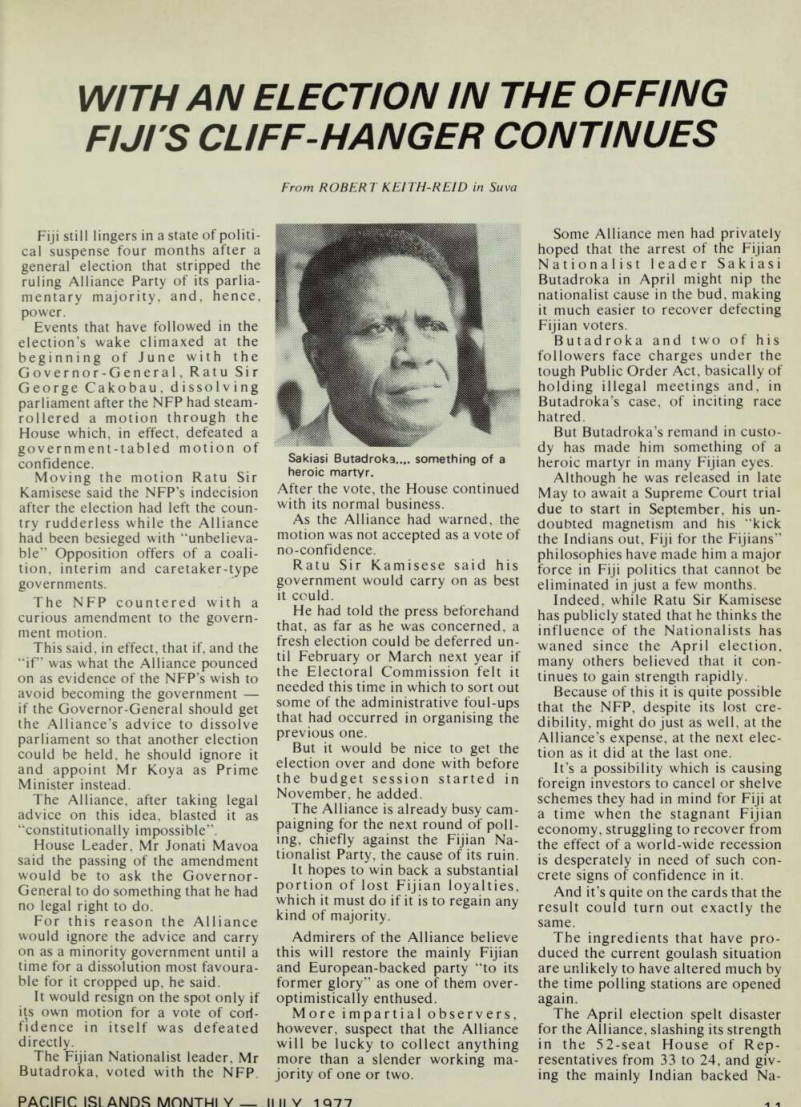
But Butadroka’s remand in custo dy has made him something of a heroic martyr in many Fijian eyes.
Although he was released in late May to await a Supreme Court trial due to start in September, his un doubted magnetism and his “kick the Indians out, Fiji for the Fijians” philosophies have made him a major force in Fiji politics that cannot be eliminated in just a few months.
Indeed, while Ratu Sir Kamisese has publicly stated that he thinks the influence of the Nationalists has waned since the April election, many others believed that it con tinues to gain strength rapidly.
Because of this it is quite possible that the NFP, despite its lost cre dibility, might do just as well, at the Alliance’s expense, at the next elec tion as it did at the last one.
It’s a possibility which is causing foreign investors to cancel or shelve schemes they had in mind for Fiji at a time when the stagnant Fijian economy, struggling to recover from the effect of a world-wide recession is desperately in need of such con crete signs of confidence in it.
And it’s quite on the cards that the result could turn out exactly the same.
The ingredients that have pro duced the current goulash situation are unlikely to have altered much by the time polling stations are opened again.
The April election spelt disaster for the Alliance, slashing its strength in the 52-seat House of Rep resentatives from 33 to 24, and giv ing the mainly Indian backed Na
Sakiasi Butadroka... something of a heroic martyr.
tional Federation Party 36 seats.
The cause was the influence of the anti-Indian Fijian Nationalist Party.
Besieged by troubles that in cluded a murderous internal strug gle for its leadership, and knowing that, with only half of the House of Representative’s seats, it would be unable to control parliament with any effect, the NFP hesitated in try ing to form a government.
The Governor-General. Ratu Sir George Cakobau, made up the NFP’s mind for it four days after the election when he reappointed Ratu Sir Kamisese Mara, the Alliance’s leader, as Prime Minister.
The reason he gave was that the NFP’s leader, lawyer Siddiq Koya, did not command the support of the majority of the House the qualification which the Fiji Con stitution requires of the man who is the country’s PM.
Mr Koya put on an angry show about being deprived of what he said was his party’s just due the right to govern. The NFP, he blustered, could kick the Alliance out of power any time it wanted.
Mr Koya and other NFP big-wigs were also angrily denying reports that their party was crippled by a chasm of distrust and intrigue caus ed by the efforts of anti-Koya fac tions to dislodge him as party boss.
But the round of protestations, ac cusations and confrontations ut tered or promised by the NFP in dealing with the Alliance met with mounting disbelief in all quarters of Fiji as daily reports of what was going on in NFP circles were re counted by the local press.
First of all. the NFP failed to move an immediate vote of no con fidence in the new minority govern ment when the new House of Rep resentatives met for the first time three weeks after the election.
And then its president, Mrs Irene Jai Narayan, and secretary, Mr Karam Ramrakha, openly con tinued their efforts to bring Mr Koya down.
Mr Koya quietly retaliated in his own astute way and, despite all the public uproar against him, staged a recovery that, by the time Parlia ment came to meet again in late May, showed that he was still the single most powerful force in the NFP that the Alliance or his own personal foes had to contend with.