Deaths
pp. 68-74 · Read in the full issue
Charles Sullivan
The trader with drive, guts and natty dress
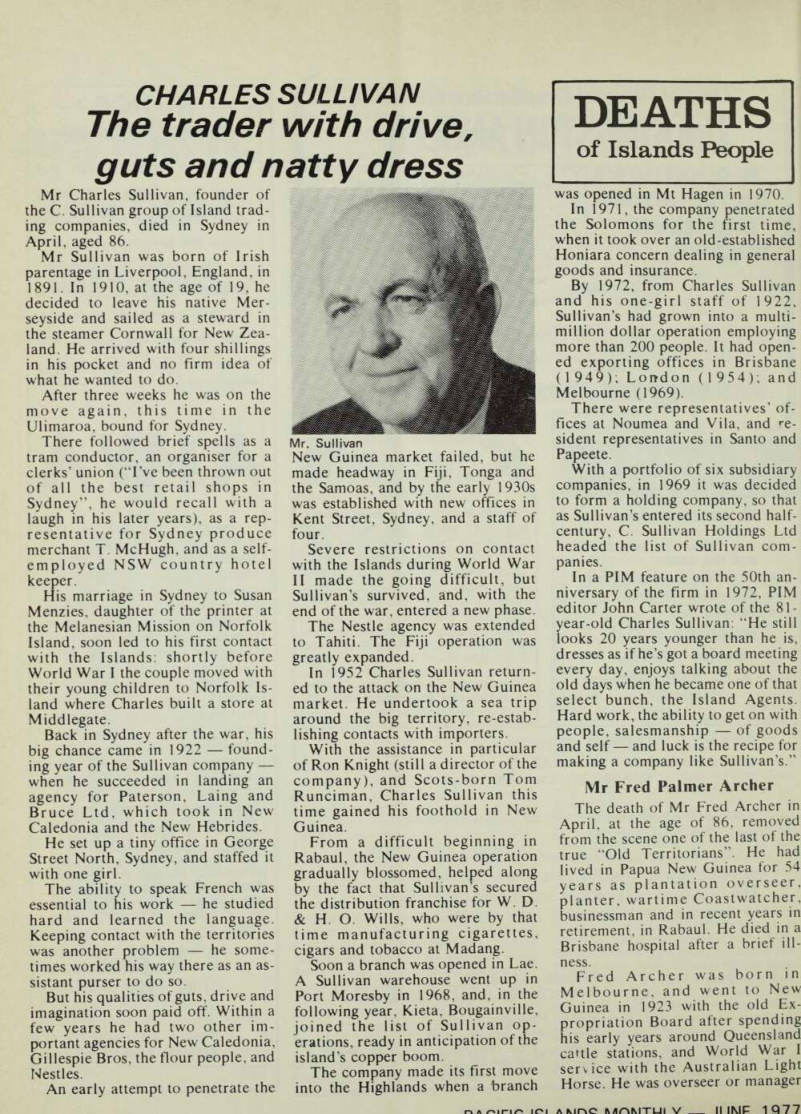
Mr Charles Sullivan, founder of the C. Sullivan group of Island trad ing companies, died in Sydney in April, aged 86.
Mr Sullivan was born of Irish parentage in Liverpool. England, in 1891. In 1910, at the age of 19, he decided to leave his native Mer seyside and sailed as a steward in the steamer Cornwall for New Zea land. He arrived with four shillings in his pocket and no firm idea of what he wanted to do.
After three weeks he was on the move again, this time in the Ulimaroa, bound for Sydney.
There followed brief spells as a tram conductor, an organiser for a clerks’ union (“I’ve been thrown out of all the best retail shops in Sydney”, he would recall with a laugh in his later years), as a rep resentative for Sydney produce merchant T. McHugh, and as a self employed NSW country hotel keeper.
His marriage in Sydney to Susan Menzies, daughter of the printer at the Melanesian Mission on Norfolk Island, soon led to his first contact with the Islands; shortly before World War I the couple moved with their young children to Norfolk Is land where Charles built a store at Middlegate.
Back in Sydney after the war, his big chance came in 1922 —found ing year of the Sullivan company when he succeeded in landing an agency for Paterson, Laing and Bruce Ltd, which took in New Caledonia and the New Hebrides.
He set up a tiny office in George Street North, Sydney, and staffed it with one girl.
The ability to speak French was essential to his work he studied hard and learned the language.
Keeping contact with the territories was another problem he some times worked his way there as an as sistant purser to do so.
But his qualities of guts, drive and imagination soon paid off. Within a few years he had two other im portant agencies for New Caledonia, Gillespie Bros, the flour people, and Nestles.
An early attempt to penetrate the
New Guinea market failed, but he made headway in Fiji. Tonga and the Samoas, and by the early 1930 s was established with new offices in Kent Street, Sydney, and a staff of four.
Severe restrictions on contact with the Islands during World War II made the going difficult, but Sullivan’s survived, and, with the end of the war, entered a new phase.
The Nestle agency was extended to Tahiti. The Fiji operation was greatly expanded.
In 1952 Charles Sullivan return ed to the attack on the New Guinea market. He undertook a sea trip around the big territory, re-estab lishing contacts with importers.
With the assistance in particular of Ron Knight (still a director of the company), and Scots-born Tom Runciman, Charles Sullivan this time gained his foothold in New Guinea.
From a difficult beginning in Rabaul, the New Guinea operation gradually blossomed, helped along by the fact that Sullivan’s secured the distribution franchise for W. D. & H. O. Wills, who were by that time manufacturing cigarettes, cigars and tobacco at Madang.
Soon a branch was opened in Lae.
A Sullivan warehouse went up in Port Moresby in 1968, and, in the following year, Kieta, Bougainville, joined the list of Sullivan op erations, ready in anticipation of the island’s copper boom.
The company made its first move into the Highlands when a branch
Deaths
of Islands People
was opened in Mt Hagen in 1970.
In 1971, the company penetrated the Solomons for the first time, when it took over an old-established Honiara concern dealing in general goods and insurance.
By 1972, from Charles Sullivan and his one-girl staff of 1922, Sullivan’s had grown into a multi million dollar operation employing more than 200 people. It had open ed exporting offices in Brisbane (1949); London (1954); and Melbourne (1969).
There were representatives’ of fices at Noumea and Vila, and re sident representatives in Santo and Papeete.
With a portfolio of six subsidiary companies, in 1969 it was decided to form a holding company, so that as Sullivan’s entered its second half century, C. Sullivan Holdings Ltd headed the list of Sullivan com
panies.
In a PIM feature on the 50th an niversary of the firm in 1972, PIM editor John Carter wrote of the 81year-old Charles Sullivan; “He still looks 20 years younger than he is, dresses as if he’s got a board meeting every day, enjoys talking about the old days when he became one of that select bunch, the Island Agents.
Hard work, the ability to get on with people, salesmanship of goods and self and luck is the recipe for making a company like Sullivan’s.”
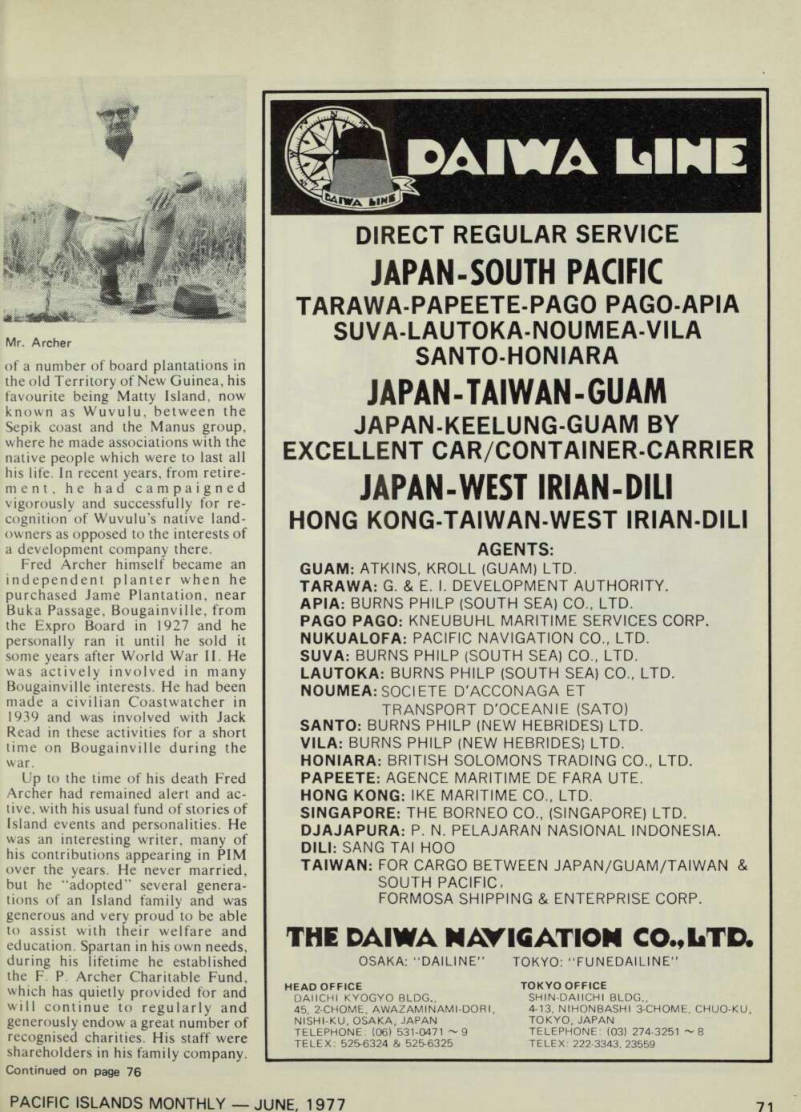
Mr Fred Palmer Archer The death of Mr Fred Archer in April, at the age of 86, removed from the scene one of the last of the true “Old Territorians”. He had lived in Papua New Guinea for 54 years as plantation overseer, planter, wartime Coastwatcher, businessman and in recent years in retirement, in Rabaul. He died in a Brisbane hospital after a brief ill ness.
Fred Archer was born in Melbourne, and went to New Guinea in 1923 with the old Ex
propriation Board after spending
his early years around Queensland cattle stations, and World War I service with the Australian Light Horse. He was overseer or manager
Mr. Sullivan
of a number of board plantations in the old Territory of New Guinea, his favourite being Matty Island, now known as Wuvulu, between the Sepik coast and the Manus group, where he made associations with the native people which were to last all his life. In recent years, from retire menl, he had campaigned vigorously and successfully for re cognition of Wuvulu’s native land owners as opposed to the interests of a development company there.
Fred Archer himself became an independent planter when he purchased Jame Plantation, near Buka Passage, Bougainville, from the Expro Board in 1927 and he personally ran it until he sold it some years after World War 11. He was actively involved in many Bougainville interests. He had been made a civilian Coastwatcher in 1939 and was involved with Jack Read in these activities for a short time on Bougainville during the war.
Up to the time of his death Fred Archer had remained alert and ac tive, with his usual fund of stories of Island events and personalities. He was an interesting writer, many of his contributions appearing in PIM over the years. He never married, but he “adopted” several genera tions of an Island family and was generous and very proud to be able to assist with their welfare and education. Spartan in his own needs, during his lifetime he established the F. P. Archer Charitable Fund, which has quietly provided for and will continue to regularly and generously endow a great number of recognised charities. His staff were shareholders in his family company.
Continued on page 76
Mr. Archer
Auckland (7-1859): Kneubuhl Maritime Services Pago Pago (633-5121)
Us - Tahiti - Samoa
Pacific Islands Transport operates a five/six weekly cargo service from North American west coast ports to Papeete, Pago Pago, Apia Details from Trans-Austral Shipping Pty Ltd, 19 Pitt Street, Sydney (27-2441).
Polynesia Line operates container and general cargo service from US west coast ports to Papeete and Pago Pago.
Details from Polynesia Shipping Services Inc, PO Box 1478, Pago Pago (9-6799) Continued from page 71 His old friend and business as sociate for 65 years, Mr Eric Storm, plans to return Fred Archer’s ashes to Wuvulu.
Mr. E. V. Crisp The death occurred in Sydney in May of Mr Eric Vivian Crisp, chairman and managing director of
Steamships Trading Company. Port
Moresby, from 1946 until his retirement in 1961. He was aged 82.
“Viv” Crisp had gone to Papua from Australia in 1924 after serving with the AIF on Gallipoli in World War He joined Steamships in 1926 as manager at Samarai, and became the company’s general manager in 1939.
It was his direction that enabled the company to greatly expand after the war. * He is survived by his wife. Ruby.
Father J. Zerger Father Jean Zerger, 54, a Roman Catholic priest, died at Noumea in March after a long illness. He went to the New Hebrides from France in 1953, and served in a number of areas in the condominium.