PNG and some problems...
pp. 55-59 · Read in the full issue
Business
Coffee boom brings riches to PNG and some problems...
From GUS SMALES in Port Moresby
While coffee prices rise higher and higher in Australian shops and supplies are often short, Papua New Guinea’s coffee growers have never had it so good. Money is pouring into the PNG Highlands, centre of the coffee industry, in one of the big gest agricultural booms the country has known.
Production is rising every year, and returns have climbed steeply over the past two years. Some of the earnings are going to a handful of major companies in which Australians as well as Papua New Guineans are involved.
But the bulk of the money is flow ing into the pockets or the buried hoards of thousands of village people, many of whom have never before been in a cash economy.
Either directly or through com bined ventures and local sharehold ing, the Highland villagers are banking, hoarding and spending more money than they would have dreamed possible only a few years ago. The big fear of the government is that when the boom starts to fall off, as it well may do in a couple of years, resentment and a degree of hardship will follow.
So, while the money rolls in, the government and the banks are em barking on a finance education programme among the growers, and a stabilisation fund has been set up to cushion the effects of any major
price depressions.
The situation which has pushed up the world price of coffee and has meant a boom for PNG is a simple matter of supply and demand.
Coffee, unlike many other tropical commodities, has a comparatively uncomplicated international marketing structure. Prices fluc tuate on the obvious basis of quality, supply and demand.
There is little interaction with other products, as happens for in stance in the copra and cocoa indus tries which are closely linked with
industrial chemistry. Coffee is also one of the least speculative markets among tropical commodities.
One of the main factors in the present situation was the collapse the Brazil coffee industry in 1975 following disastrous frosts. Brazil, the world’s biggest producer of basic coffees, is still in trouble because the frosts wiped out many of the plantings there, and not merely the crop which was on the trees at the time Coffee industry projections indicate another two years are likely before Brazil begins to approach normal production again.
Brazil’s disaster coincided with a time of expansion in the PNG coffee industry, an expansion which received added impetus from the world shortage. Consumer prices began to rise because of the supply and demand ratio, pushed further by world-wide inflation.
PNG is now producing about
800,000 bags of dry coffee beans a year, weighing out at something like 48,000 tonnes, well in excess of Australia’s total requirements, of , '< would be tempting to think that the two countries, because of their proximity to each other and because of their special relationships, could negotiate a trade deal involving an exclusive two-way commitment troubled coffee drinker m, B ht see . such an arrangement as guaranteeing supply and stabilising over-the-counter prices, and at the same time protecting the long-term interests of the PNG grower. But like most international trade mat ters, the answer is not as simple as it might seem, Quite apart from PNG’s own de sire to diversify its marketing for best results, the fact is that the pro duct is not suitable for such an ar rangement.
PNG coffee is a high-grade, high priced coffee used for blending.
You don’t normally drink it on its
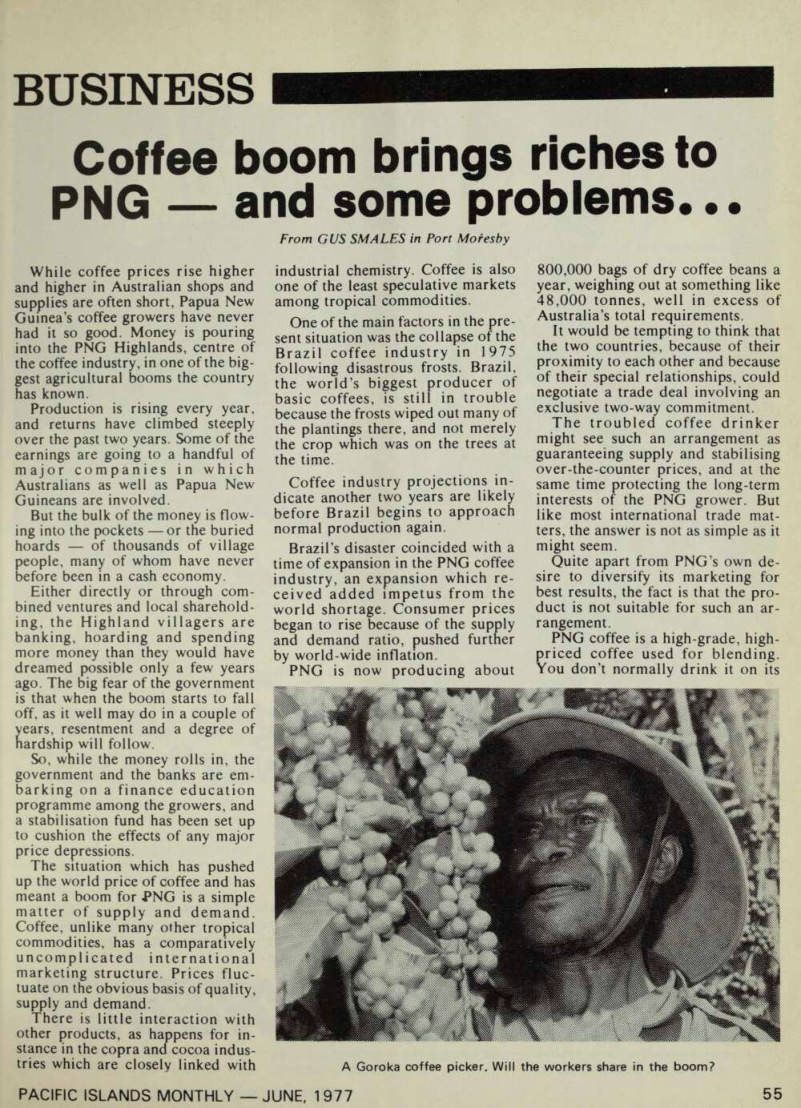
A Goroka coffee picker. Will the workers share in the boom?
... And A Harvest For Thieves
With prices booming, coffee steal ing is fast becoming a major problem in the Highlands.
Armed with spears, axes and clubs, and usually with a truck wait ing just round the corner, the new generation of coffee thieves is mak ing night raids on coffee estates and village plantations.
The raiders know that for every kilogramme of coffee they can take, there will be an easy sale bringing in about $l.
Until stealing reached its present proportions, the boldest of the raiders were selling coffee back to the estates they had stolen it from.
“Give the police guns and let them get tough” was a recent com ment from the Eastern Highlands Provincial Premier, Mr James Yanepa. And the bigger centralised coffee estates disclosed they were using dogs and armed security guards to keep out coffee thieves.
The growing and marketing struc ture existing in PNG has left the way open for illegal selling, made at tractive by booming prices. Much of PNG’s coffee comes from small time growers who sell their produce to large estates or processing centres which have been registered as buyers.
Thousands of villagers and their families cultivate small communal
plantations or individual “back yard” holdings which can contain only a handful of trees. The small holders sell unprocessed or semi processed beans to licensed buyers at the roadside or at central points.
If coffee beans can be stolen from the big estates or the communal plantations, it’s a simple matter to slip the stolen beans into the money market. No one can prove that the poker-faced villager who flags down a dealer’s truck at the roadside didn’t grow the beans in his own backyard.
Small lots of loose beans —worth a mere six cents a kilogramme three years ago now bring close to a dollar, making stealing worth while.
The general manager of Asaro coffee estates, Mr Paddy Leahy, said he believed thousands of dollars worth of stolen coffee beans were changing hands every week. Asaro estate which has 3000 PNG shareholders stood to lose heavily from the stealing, and is now offering a KlOO reward for infor mation leading to the conviction of coffee thieves.
But many villagers who have a fair idea of the identity of some of the thieves are reluctant to turn in former. They fear reprisals, or are bound by tribal loyalties despite the fact that stealing is cutting into their own earnings.
Who owns the
unclaimed coppers?
Hundreds of unclaimed shareholders’ dividends, some of them equivalent to only about $1.35 have been advertised in Papua New Guinea by Bougainville Copper.
The total amount held in unclaimed dividends is equal to more than $9,000.
The bulk of the unclaimed divi dends belongs to Papua New Gui neans who bought small sharehold ings which had to be made available under the company’s formation obligations. The shareholders can no longer be traced and the money has gone into an unclaimed moneys register.
But many western-type names which were last known at PNG ad dresses are also included. The com pany took 18 pages of advertising in the PNG Post-Courier in an attempt to trace the owners of the unclaimed money.
A spokesman for Bougainville Copper said that keeping track of the large number of small investors represented a big operation within the company. This was one of the reasons why the company recently announced a scheme which will en courage people either to sell small holdings of shares, or to build up their present small holdings to marketable parcel size.
Solomons rice for
Papua New Guinea
The Solomon Islands has opened up an export rice trade with Papua New Guinea. The first shipment, of more than 50 tonnes, shipped to Kieta, Bougainville, followed negotiations between the PNG Government and the growers, Brewer Solomon Associates.
It was the first time PNG had im ported rice from a country other than Australia, The next shipment, of more than 100 tonnes, was for Lae. The plan is for the Solomons to send regular shipments of rice to
Png.
NZ’s open arms for
Solomons’ mission
The first Solomon Islands trade mission to New Zealand came home in April with $30,000-worth of firm orders for Solomons products.
Items ordered included timber,
rice, carvings, chillis and tuna.
Leader of the mission was the Solomons Minister for Foreign Trade, Industry and Labour, Mr Ghemu. He said the mission’s re ception in New Zealand had been warmer than expected. “The New Zealand Government opened its arms wide,” he said. “It’s now up to the people of the Solomons to re
spond.”
Will Niue be
another Nauru?
A special committee set up by the Niue Government to investigate a Mining Act which would give the green light to the Avian Mining Company of Sydney to begin ex ploratory test bores on the isla id, was expected to report back to the Cabinet in May.
Several months ago Premier Robert Rex announced that Avian might have found a large deposit of uranium known locally as maka uho (precious rock) and that if the find was confirmed Niue could become another Nauru.
The Mining Act, 1977, consists of 44 clauses and, if adopted, would give the Cabinet power to declare land open for mining without the owner’s consent.
The act also provides for a levy of up to 5% of the market value of any minerals taken from the island and outlines procedure for mine admin istration, licensing, compensation claims and mining regulations.
All income obtained by levies on minerals would go into the Niue General Revenue Account.
The Commission of Inquiry was set up to investigate; • Acquisition of Niuean land for mining purposes, • The granting of access licences over land for mining and com pensation for land taken for mining.
Copies of the act were given to each family on the island and the commission held five sittings in the villages and was available for public submissions on two days.
Members of the commission, which also sought the views of Niueans living in New Zealand, were: Director of Works, Mr B Robinson, retired civil servants S.
Heka, L. R. Rex, police officer H.
Jackson, Pastor Tukutama of Ekalesia Niue and the secretary, Mrs C. Togatule, wife of the legal officer who assisted with the draft ing of thp act.
Tonga to have
a new industry Mr Tutomu Nakao, of Nukualofa, is becoming quite a tycoon by Tongan standards. Apart from run ning construction and soft drink companies, he recently became the major shareholder in a wire mesh fencing venture. This venture, known as Tonga Wire Co Ltd, will be capable of meeting all Tonga’s wire mesh netting needs.
Mr Nakao estimates that his com pany, in which two Auckland men are partners, will substantially cut the wholesale price. Apart from meeting the local demands he hopes to open export markets
Another CSR
link with Fiji goes
The Australian-based CSR Ltd, which dominated the economy of Fiji for many years through its con trol of the sugar industry has few, if any, remaining links with that coun try. One of the last cut was when Fiji Sugar Marketing Co took over re sponsibility from CSR Ltd for sell ing Fiji’s sugar production.
The Fiji Sugar Marketing Co worked closely with CSR Ltd for about a year, learning the intricacies of sugar marketing. CSR Ltd was paid a commission of .66% of the sales price of sugar it sold. Fiji Sugar Marketing Co’s first sale of sugar was a shipment to New Zea land, where it is refined by the NZ Sugar Co, a CSR Ltd subsidiary.