Magazine
pp. 33-34 · Read in the full issue
Henderson Field: aftermath of a bloody holocaust
By Peter L. Young
When you emerge from an air conditioned jet air-liner, the heat from the tarmac of Henderson Air field hits you with full effect. At first it seems that you are drinking the humid air rather than breathing it.
This is, of course, a minor dis comfort soon overcome by Solomon Islands hospitality and a cold beer down by the Honiara waterfront.
In 1942, on Henderson Airfield, Guadalcanal, the hazards were far more deadly. At one stage there were over 35,000 men fighting to defend or capture this airfield; that is slightly less than the present-day population of Guadalcanal.
But, on the day I wandered down to Henderson to polish up the final draft of this story, there was little to see. There were no international flights scheduled that day, so only a skeleton staff was on duty. The only noise was the humming of the air conditioner in the meteorological hut and the occasional truck full of Solomon Islanders racing past the airfield on the dusty unsealed road that leads into Honiara.
It seemed strange that when the Japanese began this airfield 35 years ago, the area was alive with con struction workers and equipment: 500 Japanese military and engineer ing personnel, 2,500 Korean labourers, four heavy-duty tractors, six road-rollers, 12 trucks and even two petrol-driven locomotives with attached hopper trucks.
The activities of the Japanese and Koreans were under the keen (long distance) eye of an Australian coast watcher, Martin Clemens, who ob served their activities from his spec tacular and panoramic view on Gold Ridge. The Japanese started the field from two ends hoping to meet in the middle. They never finished it. It was the Americans who filled in the middle section, de
fended it, and later extended it.
After the war, British military engineers rebuilt and strengthened Henderson. Instead of fighters and bombers, it now welcomes the airliners of Air Niugini, Air Nauru and Air Pacific.
On the tarmac when I was there there were three two-engined Solomons Airways light aircraft; another was tucked away in a hangar.
The miniscule Solomons com mercial air fleet pales in comparison with Henderson’s complement ot planes during World War 11. The first operational aircraft to land on Henderson Airfield after its capture by the Americans numbered 31
comprising 19 Grumman Wildcat fighters and 1 2 Dauntless dive bom bers. Eventually 180 aircraft op erated from Guadalcanal, most of them from Henderson, which by that time had been extended to two fighter strips and a heavy bomber strip.
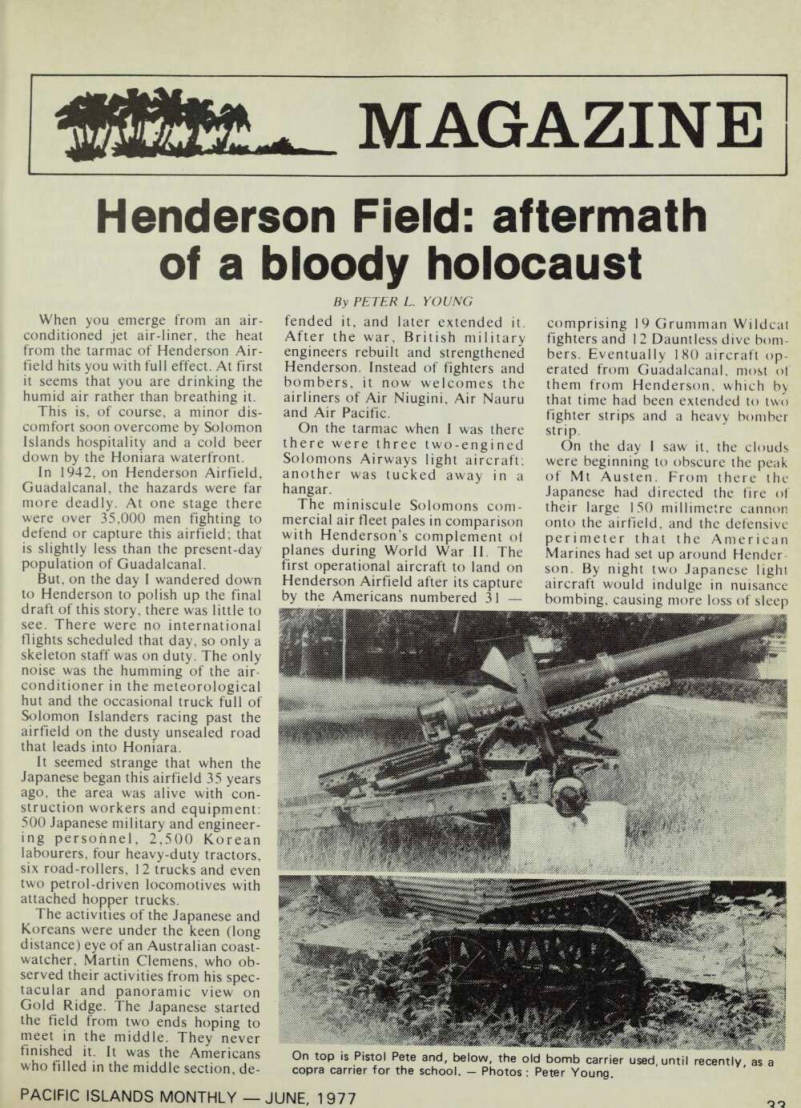
On the day I saw it, the clouds were beginning to obscure the peak of Mt Austen. From there the Japanese had directed the fire of their large 150 millimetre cannon onto the airfield, and the defensive perimeter that the American Marines had set up around Hender son. By night two Japanese light aircraft would indulge in nuisance bombing, causing more loss of sleep
On top is Pistol Pete and, below, the old bomb carrier used, until recently, as a copra carrier for the school. Photos: Peter Young.
than loss of life. With classic under statement the Marines called the cannon “Pistol Pete’’ and the two light aircraft, “Louie the Louse” and “Washing Machine Charlie”.
One of the cannons now stands across from Honiara Museum. On its barrel the formal Japanese characters read, “Type 96, 150 millimetre, gun from the Osaka Ar senal, Fifteenth Year of the Em peror’s Reign (1940)”. It now pro vides the tourists with a snap for their photo-albums, and the long rifled barrel menaces nobody. But in 1942 it was another sfory, for the Marines were so, undermanned in their defensive perimeter around Henderson that for a long time they could not push the Japanese beyond the range of the airfield.
Outside the airport, greeting visi tors as they emerge from the ter minal, is a Japanese 37 millimetre anti-aircraft gun that had been in tended to defend the airfield against American planes. It now provides a place for Solomon Islands graffitists to scratch their work.
On the other side of the road run ning past the airport, is a small sawmill. They are having better for tune than other sawmillers, who found Guadalcanal’s war-time past reappearing in an expensive and unexpected way. Some of the trees of Guadalcanal are riddled with shrapnel. The combination of hid den metal and saw-blades made a most unfortunate combination.
Out of the ground near the saw mill juts a jagged bit of prefabri cated construction metal. I pushed it with my foot. It is firmly wedged in between the yellow, clay rocks. It has stayed where it fell or was dumped, left to rust from Hender son’s days of terrible excitement.
Perhaps it has been there since the day when the Japanese fleet, having driven off the protecting American and Australian destroyers and cruisers, pounded Henderson with 800 eight-inch and 300 five-inch shells, all in the space of a day.
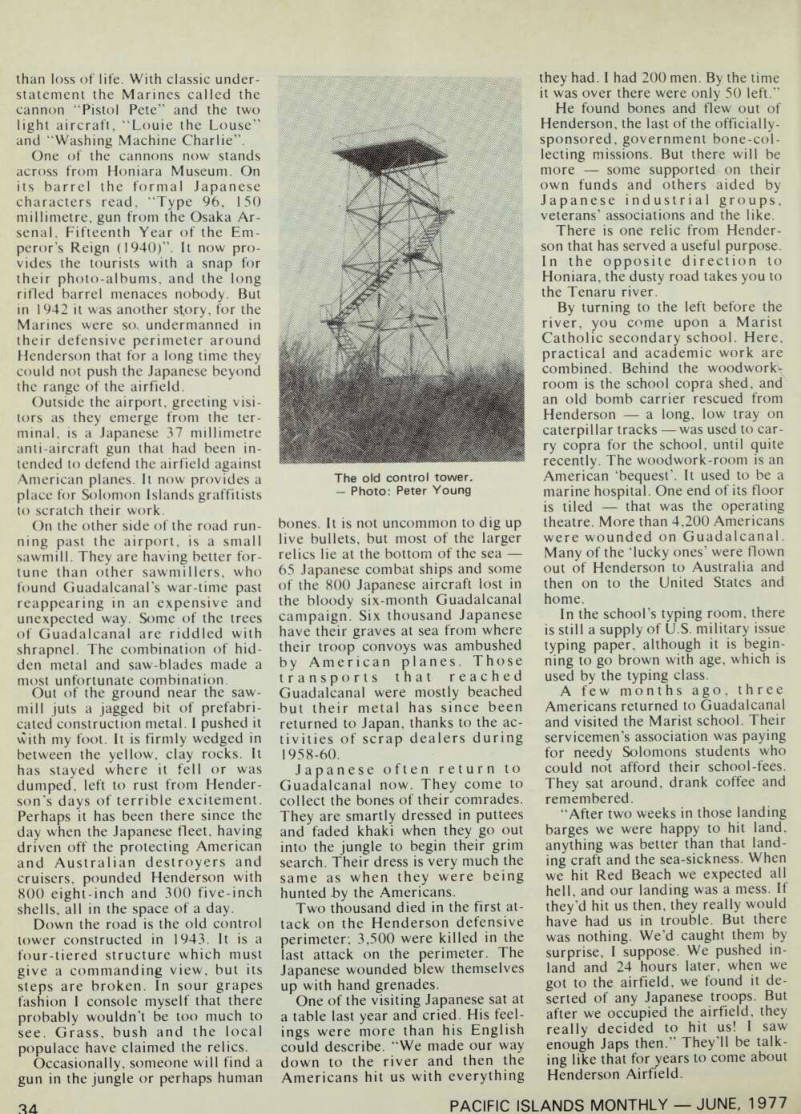
Down the road is the old control tower constructed in 1943. It is a four-tiered structure which must give a commanding view, but its steps are broken. In sour grapes fashion I console myself that there probably wouldn’t be too much to see. Grass, bush and the local populace have claimed the relics.
Occasionally, someone will find a gun in the jungle or perhaps human
bones. It is not uncommon to dig up live bullets, but most of the larger relics lie at the bottom of the sea 65 Japanese combat ships and some of the 800 Japanese aircraft lost in the bloody six-month Guadalcanal campaign. Six thousand Japanese have their graves at sea from where their troop convoys was ambushed by American planes. Those transports that reached Guadalcanal were mostly beached but their metal has since been returned to Japan, thanks to the ac tivities of scrap dealers during 1958-60.
Japanese often return to Guadalcanal now. They come to collect the bones of their comrades.
They are smartly dressed in puttees and faded khaki when they go out into the jungle to begin their grim search. Their dress is very much the same as when they were being hunted by the Americans.
Two thousand died in the first at tack on the Henderson defensive perimeter; 3,500 were killed in the last attack on the perimeter. The Japanese wounded blew themselves up with hand grenades.
One of the visiting Japanese sat at a table last year and cried. His feel ings were more than his English could describe. “We made our way down to the river and then the Americans hit us with everything
they had. I had 200 men. By the time it was over there were only 50 left. 1 ' He found bones and flew out of Henderson, the last of the officially sponsored, government bone-col lecting missions. But there will be more some supported on their own funds and others aided by Japanese industrial groups, veterans’ associations and the like.
There is one relic from Hender son that has served a useful purpose.
In the opposite direction to Honiara, the dusty road takes you to the Tenaru river.
By turning to the left before the river, you come upon a Marist Catholic secondary school. Here, practical and academic work are combined. Behind the woodwork room is the school copra shed, and an old bomb carrier rescued from Henderson a long, low tray on caterpillar tracks was used to car ry copra for the school, until quite recently. The woodwork-room is an American ‘bequest’. It used to be a marine hospital. One end of its floor is tiled that was the operating theatre. More than 4,200 Americans were wounded on Guadalcanal.
Many of the ‘lucky ones’ were flown out of Henderson to Australia and then on to the United States and home.
In the school’s typing room, there is still a supply of U.S. military issue typing paper, although it is begin ning to go brown with age, which is used by the typing class.
A few months ago, three Americans returned to Guadalcanal and visited the Marist school. Their servicemen’s association was paying for needy Solomons students who could not afford their school-fees.
They sat around, drank coffee and remembered.
“After two weeks in those landing barges we were happy to hit land, anything was better than that land ing craft and the sea-sickness. When we hit Red Beach we expected all hell, and our landing was a mess. If they’d hit us then, they really would have had us in trouble. But there was nothing. We’d caught them by surprise, I suppose. We pushed in land and 24 hours later, when we got to the airfield, we found it de serted of any Japanese troops. But after we occupied the airfield, they really decided to hit us! I saw enough Japs then.’’ They’ll be talk ing like that for years to come about Henderson Airfield.
The old control tower.
Photo: Peter Young