The Cooks, last hope for cancer
pp. 23-24 · Read in the full issue
victims, or a haven for a hoaxer?
By W. H. PERCIVAL in Rarotonga and MALCOLM SALMON in Sydney
Take Prague (Czechoslovakia), Auckland (New Zealand), and Rarotonga (Cook Islands) three places as remote from each other in distance as they are in the customs and lifestyles of their people. Add the worldwide human scourge and fear of cancer. Then throw in a pinch of traditional Polynesian medicine.
Now you have the main ingre dients of the extraordinary story of 40- year -old Czechoslovak.
Vladimil Milan Brych.
The story began in August, 1968, as Soviet tanks rolled across the borders of Czechoslovakia to snuff out the brave and brief attempt by that country’s communist leaders to liberalise their country’s political system, to give socialism “a human face” as they said.
With thousands of others. Brych fled his homeland.
Later that year he arrived in New Zealand. He applied for admission to the medical profession, claiming to have been a doctor in Czechoslovakia but having no papers on his person to prove it.
He was given work in the patholo gy department of Auckland Hospital, and was later granted probationary registration as a medi cal practitioner. Main aspect of his work was the treatment of cancer by immunological methods. He won full registration on August 11,1972.
His first brush with the world of official medicine, represented by the New Zealand Medical Council, came very soon after his registra tion. In late 1972, some of his cancer patients went on television and claimed that he had saved their lives where other doctors offered them no hope.
The council deregistered him for this, seeing it as a clear breach of the ethics of the profession. But Brych's appeal to the Supreme Court was. successful, and he was back on the rolls 24 hours later.
In 1974, he was charged by the council with making false rep
resentations when he applied for registration. Brych had claimed that he held medical degrees in Czechoslovakia, but council inqu iries in Prague had been answered with claims by Czechoslovak authorities that at the time Brych said he was studying medicine at Masaryk University in the city of Brno he was actually serving seven years in gaol for robbery with as sault. Later, it was said, he worked in a biochemical laboratory, but had been sacked from this job.
The council claimed that no one of Brych’s name held a Czechoslovak medical degree.
Brych’s name was struck off the NZ medical register for a second time on November 8, 1974.
Brych appealed again, and was granted an interim stay of the coun cil’s action. The New Zealand Herald of April 6, reporting Supreme Court proceedings of the previous day, said. “In July 1975, Mr Justice Roper granted permis sion to the council for a commission to take evidence in Czechoslovakia.
Mr Brych appealed against that un successfully in the Court of Appeal, and following a petition to the Privy Council was denied the right to any further appeal . . . The basis of Mr Brych’s opposition was that he had been advised that, as a political
refugee, he could not expect to be treated properly in Czechoslovakia.”
The result of the Supreme Court hearing was that Brych was removed from the medical register once again, with $15,000 costs awarded against him.
But the bird had flown. Brych was already in Rarotonga capital of the Cook Islands, busily setting up a cancer clinic there.
His case had been followed with interest by the Cook Islands Health Minister. Dr Joe Williams, and by the Premier, Sir Albert Henry.
Following initial contacts in New Zealand, and an exploratory visit to the Cooks by Brych, a deal was struck; Brych could practise his cancer therapy in Rarotonga, if at the same time he worked as head of an Institute of Island Medicine, set up to study traditional Polynesian medicine.
As Sir Albert Henry said, in a speech of welcome to Brych in April: “We want to know all about our traditional medicine before the people who know how to identify, grow and preserve the medicinal plants are all gone.”
Earlier, Sir Albert had told a New Zealand television interviewer, Gordon Drydon, that Brych was ac ceptable to him because he was out side the “ring” that the medical pro fession had formed around them selves in their attitudes to tradi tional Polynesian medicine, and their refusal to make a serious study of it.
The deal with Brych did not go through without a flaming row in the Cook Islands House of Assembly over the amendment to the Medical and Dental Council Act which was necessary to allow Brych to practise.
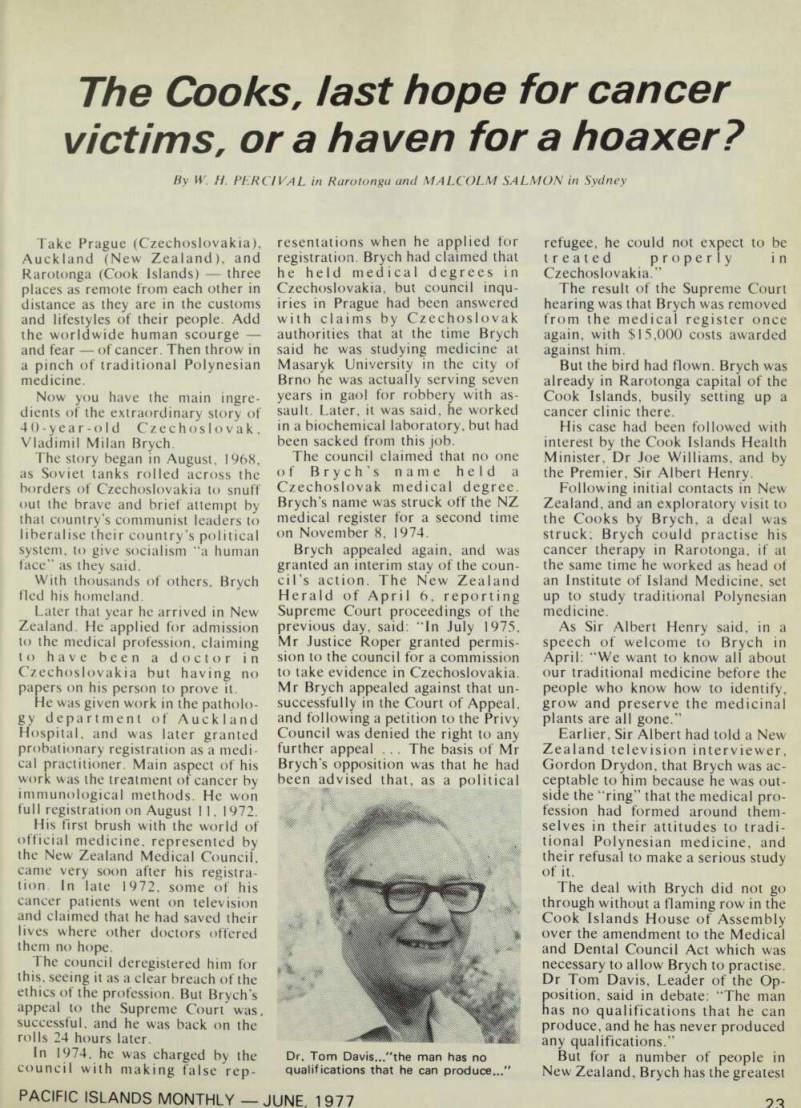
Dr Tom Davis, Leader of the Op position, said in debate: “The man has no qualifications that he can produce, and he has never produced any qualifications.”
But for a number of people in New Zealand, Brych has the greatest
Dr. Tom Davis..."the man has no qualifications that he can produce..."
qualification of all they see him as having saved their lives, after they had been diagnosed by other doctors as having terminal cancer.
Melbourne Truth in April ran a series of articles called The Brych Report drawn up after months of in vestigation by a number of its senior journalists. The articles contained details of such cases.
One of Brych’s patients, 52-year old Auckland engineer Mr Maurice Cunningham, described his cure at Brych’s hands as “mircaulous”.
Brych himself pooh-poohs such statements. He told Truth: “This isn’t magic, and despite what well meaning emotional patients say there is really nothing miraculous about it.”
Brych calls his treatment chemo immunotherapy. It involves stimulating the body’s immune system to fight the cancer. hive or six treatments are given over a period of six months.
Brych says he has isolated the an tigens of particular tumours. He in jects a serum containing the antigen into the patient. This stimulates the body’s immune system to the point where anti-bodies attack and de stroy the malignancy.
He says the 20% of patients he has failed to save were people with melanomas he has not yet developed an antigen for melano mas and, principally, people whose immunological systems have been rendered ineffective by major surgery or extensive radio-therapy or chemotherapy treatment Keystone of his theory is the con viction that cancer is to be at tributed to a breakdown of the body’s immunological defences.
True or false? Is Brych a charlatan or a saviour? Was the New Zealand Medical Council lied to by the authorities in Prague? Or did the council fall victim to professional jealousy at the successes recorded by Brych? Or are both these pro positions true?
Questions crowd in on the ex traordinary story of Vladimil Milan Brych.
The answers are not yet known.
But what is known is that cancer sufferers from both New Zealand and Australia are already beating a path to his door in far-off Rarotonga.