Nutshell
pp. 20-21 · Read in the full issue
The
News
In A
Nutshell
They Killed A "Sorcerer"
Seven men have been gaoled for periods of up to three years and nine months by the National Court at Goroka in PNG for murdering a man whose identity is still unknown. Mr Justice Raine was told the men murdered the stranger because they believed he was a sorcerer who had come to their village of Yanuta. One of the men told the court the man had “poisoned our people” and that 20 villagers had lost their lives.
Fijians Lose Jobs
Nasella tussock is the curse of much good sheep-farming country in the north Canterbury area of New Zealand, and there is no way of getting rid of it, except by rooting it out. Since 1968, the North Canterbury Nasella Tussock Board has been recruiting Fijians to dig out the tussock. Now, because of recent adverse publicity involving the behaviour of Fi jians worse for liquor, in several small towns in the area, the board has turned to Tongans, and recruited 38.
They will receive $2.12 an hour, or about $B5 a week. The board pays their air fares, and then deducts it from their wages over 20 weeks. They get free ac
commodation, including cooking and
washing facilities, but are required to provide their own food. They will live in camps at Cheviot and Waiau, north of Christchurch.
And Not Only Fijians!
A New Zealand publican is un dismayed about a charge under that country’s Race Relations Act that he refused lo sell spirits to Fijians. The pub lican, Mr Arthur Jones, of the town of Cheviot, in the South Island, went on na tional television to explain his view. He claimed there was “nothing remotely racist” in his action. After saying that he
was married to a Maori, he said the men concerned were tussock cutters who had returned to Fiji. Townspeople of Cheviot, while expressing respect for the Fijians, agreed with Mr Jones, who said he would not serve spirits to Fijians because they “just go mad”.
Some Fiji publicans disagreed with Mr
Jones, although one said that most Fijians drank beer, not spirits. They also considered that in any racial group there were people who could not hold their
liquor.
Accidentally Opened
The new 722-metre, single-span bridge linking the islands of Koro and Babelthuap in the Carolines was dedicated and “accidentally” opened towards the end of April. Palauan chief Ebedul Gibbon and Guam’s Governor Ricardo J. Bordallo were supposed to head a 20-car procession over the bridge in the opening ceremony. Nobody told them and the two started to cross on foot. More than 2,000 spectators followed. Before the bridge was built, the only link between the two islands was a ferry which could only accommodate 14 cars at one crossing and took 15 minutes to do it. The bridge, financed by the United States, was completed three months ahead of schedule.
What! All 225!
* ' Fiji judges of a competition for an emblem for the Sixth South Pacific Games scheduled for Fiji in 1979 rejected all 225 entries and asked for more. Most of the designs, which came from 12 Island countries New Caledonia sent 78 —were good but rejected either because they would need much modification or because they forgot to include the date and venue or, maybe, because they were just plain
l°usy.
Stamp Market Newcomer
Niue is getting ready to claim a larger s^'ce °/ income from the postage stamp industry. The government has de cided to establish its own philatelic department instead of allowing the New Zealand Post Office to handle stamp sales and has appointed Mr Finbar Ken ny, of New York, as the department’s ad v,ser - Mr Kenny already handles stamp production and sales for the Cook Is lands and Tonga. Stamp revenue from Niue stamps has averaged more than $45,000 a year over the last 10 years even though Niue has never attempted to n ° od the market PAM one pdime Ud UhlMt The April row over alleged rape and general lawlessness on the campus of the
University of Papua New brought strong
official reactions. The PNG Prime Minister, Mr Michael Somare, per sonally ordered the UPNG Vice-Chan cellor. Dr Gabriel Gris, to ensure that criminal behaviour on the campus “ceases immediately”. Dr Gris re sponded by banning alcohol on campus (except for staff residential areas and of ficial functions), closing the University Club until revision of the Discipline Statute was completed, and vesting new disciplinary powers in himself, the Deputy Vice-Chancellor and the University Secretary. At the same time he moved to increase lighting and physi cal security measures, especially at the Luavi women’s residential hostel, from which all visitors were banned. Police officers cannot enter the campus unless invited. On this the Police Com missioner, Mr Pious Kerepia, declared “I don’t see why the police should not patrol the campus. Universities in Papua New Guinea should not copy traditions of overseas universities. Male students are taking advantage of the existing ban on police entry to the UPNG campus.”
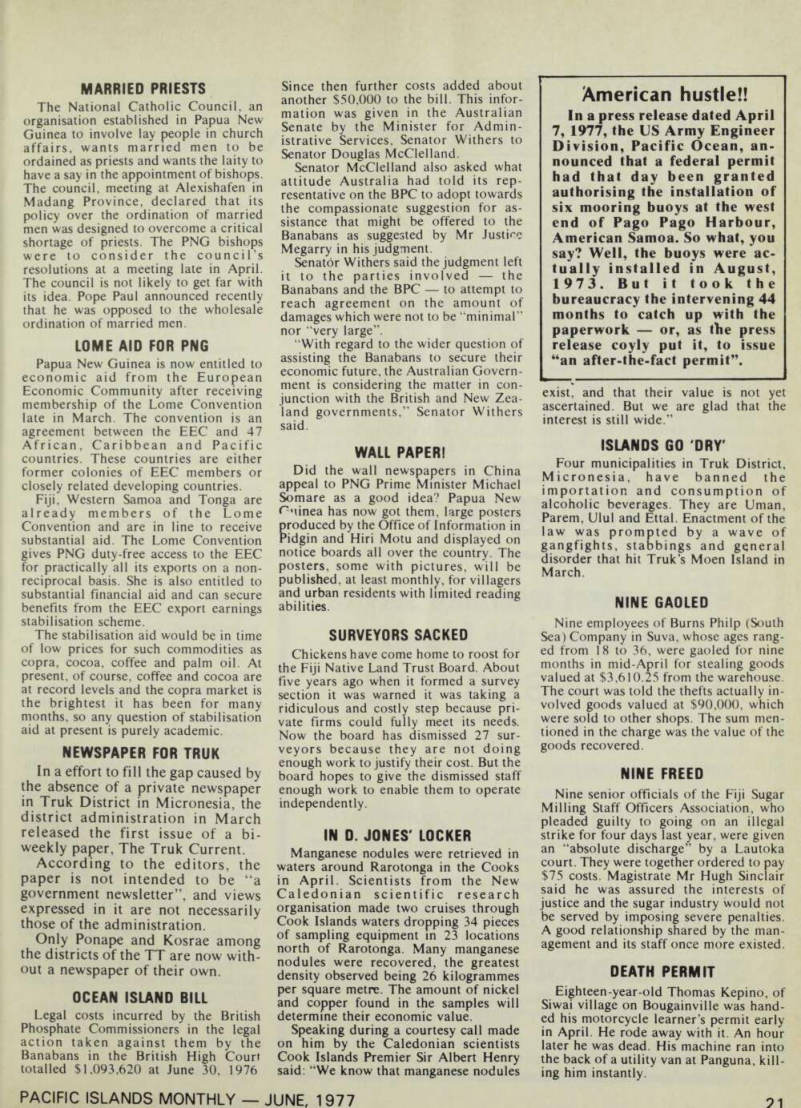
Easter 1977 and the 400th anniversary of the painter Peter Paul Rubens (1577-1640) are simultaneously commemorated in this new series of three stamps from the Cook Islands. The stamp designs reproduce in five-colour photogravure Rubens' the Cruci fixion, Christ Between Two Thieves, and The descent form the Cross. A decorative corner label with profile of Queen Elizabeth is included in each sheet.
Demoninations are 7c, 15c, and 35c.
Married Priests
The National Catholic Council, an organisation established in Papua New Guinea to involve lay people in church affairs, wants married men to be ordained as priests and wants the laity to have a say in the appointment of bishops.
The council, meeting at Alexishafen in Madang Province, declared that its policy over the ordination of married men was designed to overcome a critical shortage of priests. The PNG bishops were to consider the council’s resolutions at a meeting late in April.
The council is not likely to get far with its idea. Pope Paul announced recently that he was opposed to the wholesale ordination of married men.
Lome Aid For Png
Papua New Guinea is now entitled to economic aid from the European
Economic Community after receiving
membership of the Lome Convention late in March. The convention is an agreement between the EEC and 47 African, Caribbean and Pacific countries. These countries are either former colonies of EEC members or
closely related developing countries.
Fiji, Western Samoa and Tonga are already members of the Lome Convention and are in line to receive substantial aid. The Lome Convention gives PNG duty-free access to the EEC for practically all its exports on a non reciprocal basis. She is also entitled to substantial financial aid and can secure benefits from the EEC export earnings stabilisation scheme.
The stabilisation aid would be in time of low prices for such commodities as copra, cocoa, coffee and palm oil. At present, of course, coffee and cocoa are at record levels and the copra market is the brightest it has been for many months, so any question of stabilisation aid at present is purely academic.
Newspaper For Truk
In a effort to fill the gap caused by the absence of a private newspaper in Truk District in Micronesia, the district administration in March released the first issue of a bi weekly paper, The Truk Current.
According to the editors, the paper is not intended to be “a government newsletter”, and views expressed in it are not necessarily those of the administration.
Only Ponape and Kosrae among the districts of the TT are now with out a newspaper of their own.
Ocean Island Bill
Legal costs incurred by the British Phosphate Commissioners in the legal action taken against them by the Banabans in the British High Court totalled $1,093,620 at June 30, 1976
Since then further costs added about another $50,000 to the bill. This infor mation was given in the Australian Senate by the Minister for Admin istrative Services, Senator Withers to Senator Douglas McClelland.
Senator McClelland also asked what attitude Australia had told its rep resentative on the BPC to adopt towards the compassionate suggestion for as sistance that might be offered to the Banabans as suggested by Mr Justice
Megarry in his judgment.
Senator Withers said the judgment left it to the parties involved the Banabans and the BPC to attempt to reach agreement on the amount of damages which were not to be “minimal” nor “very large”.
“With regard to the wider question of assisting the Banabans to secure their economic future, the Australian Govern ment is considering the matter in con junction with the British and New Zea land governments,” Senator Withers said.
Wall Paper!
Did the wall newspapers in China appeal to PNG Prime Minister Michael Somare as a good idea? Papua New Guinea has now got them, large posters produced by the Office of Information in Pidgin and Hiri Motu and displayed on notice boards all over the country. The posters, some with pictures, will be
published, at least monthly, for villagers
and urban residents with limited reading abilities.
Surveyors Sacked
Chickens have come home to roost for the Fiji Native Land Trust Board. About five years ago when it formed a survey section it was warned it was taking a ridiculous and costly step because pri vate firms could fully meet its needs.
Now the board has dismissed 27 sur veyors because they are not doing enough work to justify their cost. But the board hopes to give the dismissed staff enough work to enable them to operate
independently.
In D. Jones' Locker
Manganese nodules were retrieved in waters around Rarotonga in the Cooks in April. Scientists from the New Caledonian scientific research organisation made two cruises through Cook Islands waters dropping 34 pieces of sampling equipment in 23 locations north of Rarotonga. Many manganese nodules were recovered, the greatest
density observed being 26 kilogrammes
per square metre. The amount of nickel and copper found in the samples will determine their economic value.
Speaking during a courtesy call made on him by the Caledonian scientists Cook Islands Premier Sir Albert Henry said: “We know that manganese nodules
exist, and that their value is not yet ascertained. But we are glad that the interest is still wide.”
Islands Go Dry'
Four municipalities in Truk District, Micronesia, have banned the
importation and consumption of
alcoholic beverages. They are Uman, Parem, Ulul and Ettal. Enactment of the law was prompted by a wave of
gangfights, stabbings and general
disorder that hit Truk’s Moen Island in March.
Nine Gaoled
Nine employees of Burns Philp (South Sea) Company in Suva, whose ages rang ed from 18 to 36, were gaoled for nine
months in mid-April for stealing goods
valued at $3,610.25 from the warehouse.
The court was told the thefts actually in volved goods valued at $90,000, which were sold to other shops. The sum men tioned in the charge was the value of the
goods recovered.
Nine Freed
Nine senior officials of the Fiji Sugar Milling Staff Officers Association, who pleaded guilty to going on an illegal strike for four days last year, were given an “absolute discharge” by a Lautoka court. They were together ordered to pay $75 costs. Magistrate Mr Hugh Sinclair said he was assured the interests of justice and the sugar industry would not
be served by imposing severe penalties.
A good relationship shared by the man agement and its staff once more existed.
Death Permit
Eighteen-year-old Thomas Kepino, of
Siwai village on Bougainville was hand
ed his motorcycle learner’s permit early
in April. He rode away with it. An hour later he was dead. His machine ran into the back of a utility van at Panguna, kill
ing him instantly.